
This article is general information, not veterinary advice. If your pet seems unwell, is in pain or may have eaten something harmful, contact your vet or an animal poison control line right away. Read our vet disclaimer.
A pet recovery support checklist should begin with the veterinary discharge plan, not a generic home remedy. Merck Veterinary Manual guidance reviewed in December 2025 tells owners to understand activity limits, medication directions, wound or bandage care, food and water monitoring, elimination, and follow-up instructions before managing recovery at home. A related HubPet health-and-comfort guide is how to Prevent a Pet from Licking Wounds.
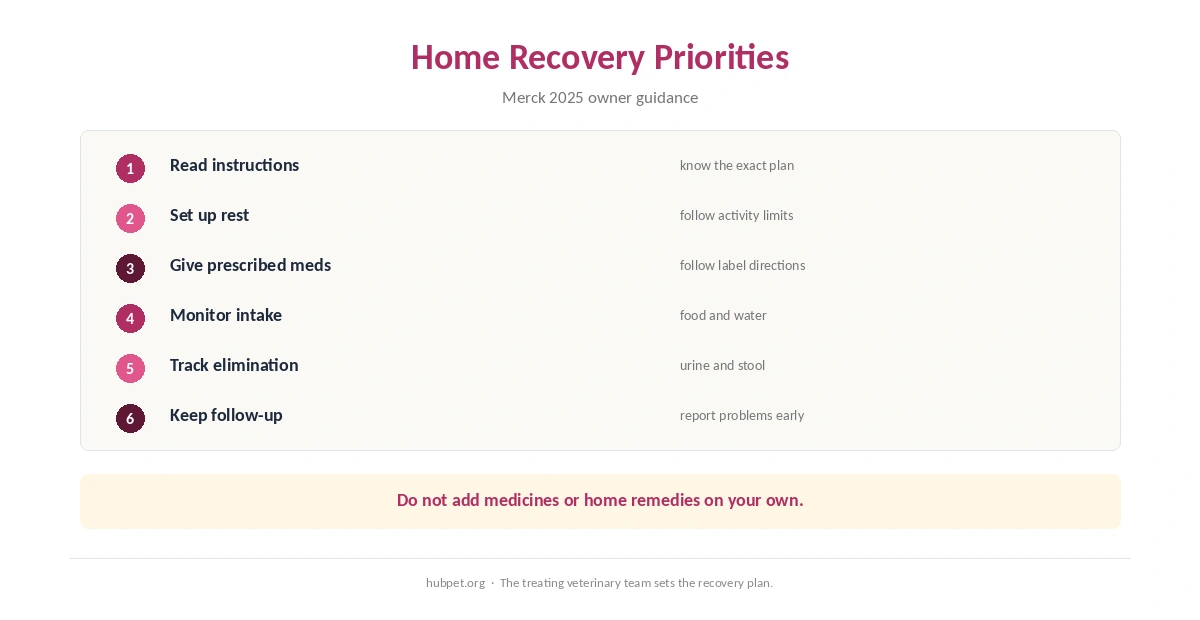
Pet Recovery Support Checklist: Set Up the Home Plan
- Put the discharge instructions in one place. Merck 2025 guidance says owners should understand all home-care directions and call the clinic when questions arise.
- Create the recommended rest area. If the veterinary team prescribed activity restriction or confinement, set up a safe, quiet space that supports those limits.
- Use medications only as directed. Merck 2025 advises following the prescribed instructions and label directions; do not add human medicines or change the plan on your own.
- Follow wound or bandage directions exactly. Merck 2025 advises watching wounds or stitches for redness, swelling, or discharge and changing bandages only as instructed.
- Track food and water. Merck 2025 recommends monitoring intake and making diet changes only within veterinary recommendations.
- Track urine and stool. Merck 2025 specifically advises monitoring whether the pet is urinating and passing stool and reporting abnormalities.
- Record movement and behavior. AAHA 2022 pain guidance emphasizes owner observations because changes from the pet’s normal behavior can help identify pain.
- Protect scheduled follow-up. Merck 2025 notes that follow-up appointments are often part of recovery, so keep the planned recheck even if the pet seems improved.
- Keep an emergency route ready. Know which clinic to call after hours and where to go if an emergency sign appears.
Use the vet visit checklist to organize questions and the first-aid preparation checklist to keep emergency contacts easy to find. If the pet has just returned from a clinic, our post-vet comfort guide can help you reduce unnecessary stimulation without changing the medical plan. The pet recovery support checklist should stay beside those records so the household follows one plan.
Pet Recovery Support Checklist: What to Monitor Each Day
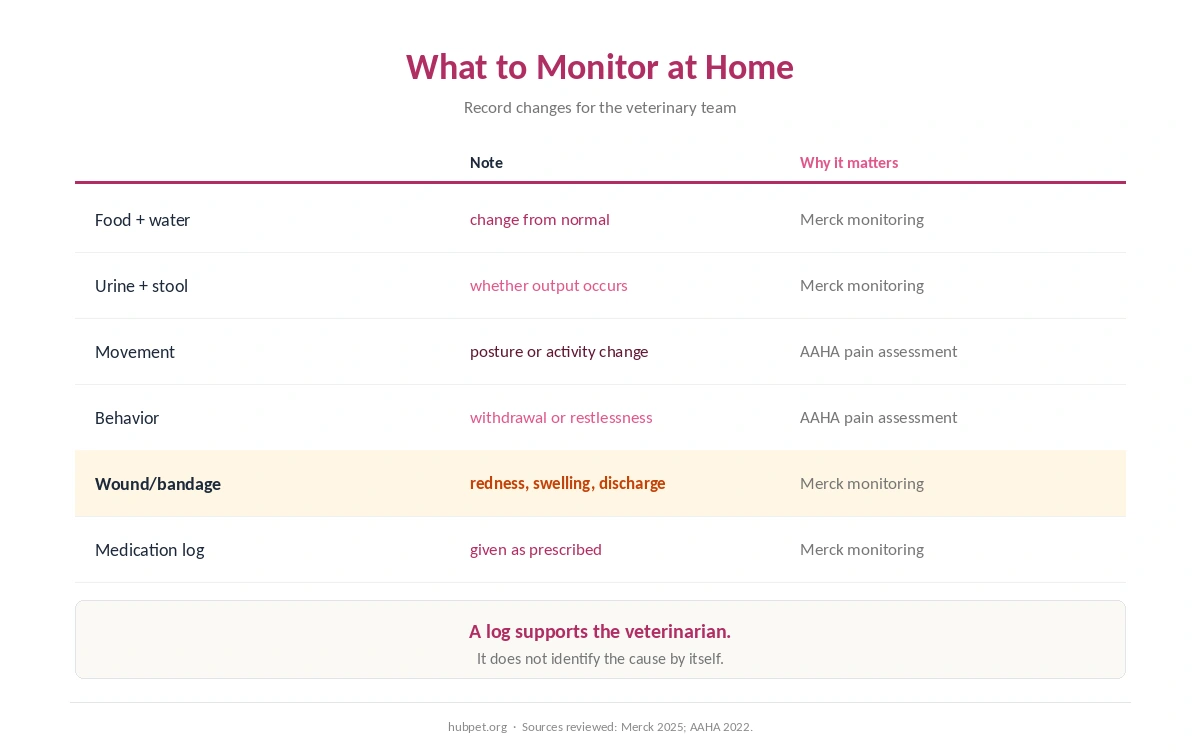
AAHA’s 2022 pain guidelines emphasize that owners know their pet’s normal behavior and can notice deviations at home. That does not diagnose the cause. It does give the veterinary team useful information about appetite, posture, movement, demeanor, and function. A pet recovery support checklist makes those day-to-day deviations easier to record and report.
| Track | What to note | Source basis |
|---|---|---|
| Food and water | Amount relative to the pet’s usual pattern and any change | Merck 2025 home monitoring |
| Urine and stool | Whether elimination is occurring and what changed | Merck 2025 home monitoring |
| Movement | Reluctance, stiffness, altered posture, or reduced normal activity | AAHA 2022 pain assessment |
| Behavior | Withdrawal, restlessness, irritability, or other change from normal | AAHA 2022 pain assessment |
| Wound or bandage | Redness, swelling, discharge, damage, or instructions not working | Merck 2025 home monitoring |
| Medication record | What was given according to the prescribed label and when | Merck 2025 home monitoring |
If your veterinarian wants reduced activity, use the play-and-rest guide only within those limits. If confinement is part of the plan, the crate comfort guide can support the environment, but veterinary restrictions take priority over general training advice.
Do not improvise nutrition or hydration targets. Merck 2025 advises monitoring intake and making changes within veterinary recommendations. General reminders from our hydration guide and our picky-eater guide should not override a recovery diet or feeding plan. Therefore, a pet recovery support checklist should record intake rather than invent a target.
When to Call Your Vet
Call the treating clinic when recovery is not following the discharge plan, when pain seems worse, or when you notice concerning changes in food, water, elimination, wounds, bandages, movement, or behavior. Merck 2025 advises contacting the veterinarian when problems arise, and AAHA 2022 supports using behavior changes as part of pain assessment.
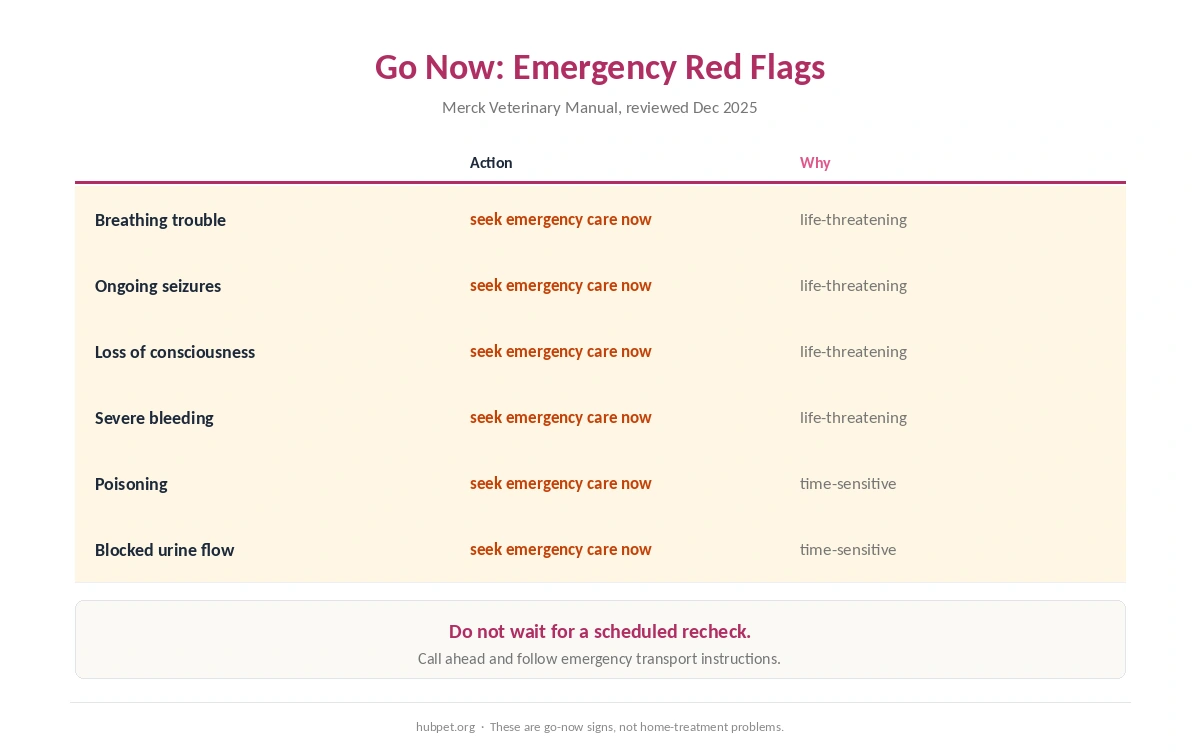
Go now: Merck Veterinary Manual emergency guidance reviewed in December 2025 lists breathing difficulty, ongoing seizures, loss of consciousness, severe bleeding, poisoning, and blocked urine flow among problems needing immediate veterinary care. Use our pet emergency signs guide for the go-now list.
Pain may be subtle during recovery. Our pain-signs guide summarizes AAHA-backed behavior changes to watch for. If handling itself is difficult, cooperative handling practice is for stable, nonurgent situations only and should not delay needed care.
For future appointments, lower-stress vet visit preparation may help with transport and waiting-room stress. During an active recovery, however, the treating veterinary team’s instructions remain the source of truth.
How We Research
HubPet reviewed guidance on October 11, 2026. We used Merck Veterinary Manual home-monitoring guidance, reviewed December 2025, AAHA’s 2022 pain assessment guidance, and Merck emergency guidance, reviewed December 2025. Our method is on How We Research.
The individual discharge plan. Merck 2025 guidance tells owners to understand the veterinary instructions for activity, medication, wounds or bandages, intake, elimination, and follow-up.
No. Merck 2025 advises giving medications exactly as directed. Contact the treating veterinary team if the plan seems ineffective or difficult to follow.
Record eating, drinking, urination, stool, movement, behavior, wound or bandage changes, and prescribed medication administration. These observations can help the veterinary team assess progress.
Do not add products or treatments unless the veterinarian instructed you to use them. Follow the wound and bandage plan you were given.
Merck 2025 lists breathing difficulty, ongoing seizures, loss of consciousness, severe bleeding, poisoning, and blocked urine flow among problems that need immediate care.
Pet Recovery Support Checklist: Bottom Line
A pet recovery support checklist is a way to carry the veterinary plan into daily life. Follow instructions exactly, record changes, protect rest and activity limits, and report problems early. Recovery support should make the medical plan easier to follow, not replace it. For a focused companion guide, see how to Support a Pet After Surgery at Home.
Once recovery is complete and the veterinarian has cleared normal activity, the weekly pet care checklist can help you return to routine monitoring.