
This article is general information, not veterinary advice. If your pet seems unwell, is in pain or may have eaten something harmful, contact your vet or an animal poison control line right away. Read our vet disclaimer.
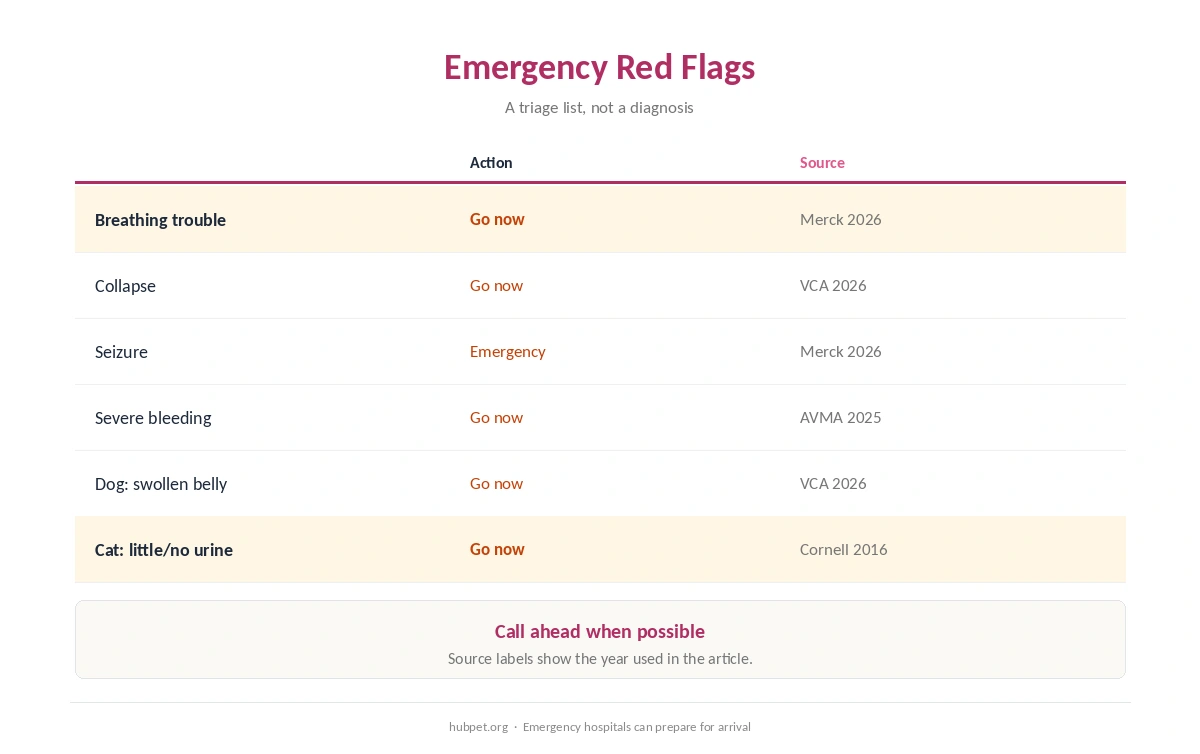
Pet emergency signs can affect breathing, consciousness, bleeding, urination, pain, or abdominal function (Merck, accessed 2026). Merck lists breathing trouble, seizures, heavy bleeding, severe pain, and inability to urinate as immediate-care signs (Merck, accessed 2026). VCA says collapse should always be treated as a medical emergency (VCA Animal Hospitals, accessed 2026). In dogs, a distended abdomen with repeated dry retching needs immediate attention (VCA Animal Hospitals, accessed 2026). In cats, repeated straining with little or no urine can signal an absolute emergency (Cornell Feline Health Center, 2016).
Pet Emergency Signs: Go Now for These Red Flags
Use pet emergency signs to check breathing, consciousness, bleeding, urination, pain, and abdominal distress first (Merck, accessed 2026; AVMA, 2025). Merck puts breathing difficulty, seizures, heavy bleeding, severe pain, and inability to urinate on its immediate-care list (Merck, accessed 2026). In addition, AVMA directs severe bleeding and heatstroke cases to a veterinary hospital promptly (AVMA, 2025). For suspected poisoning, AVMA says to contact veterinary or poison-control help immediately (AVMA, 2025).
| Sign | Why it is urgent | Source |
|---|---|---|
| Trouble or shallow breathing | Immediate veterinary care | Merck, accessed 2026 |
| Collapse or unconsciousness | Treat as an emergency | VCA, accessed 2026 |
| Seizure | Immediate care may be needed | Merck, accessed 2026 |
| Heavy bleeding | Go to the closest veterinary hospital | AVMA, 2025 |
| Severe or constant pain | Immediate veterinary care | Merck, accessed 2026 |
| Dog: distended abdomen + dry retching | Possible GDV; immediate attention | VCA, accessed 2026 |
| Cat: straining with little/no urine | Urethral obstruction can be life-threatening | Cornell, 2016 |
| Known or suspected poisoning | Call a vet or poison-control service now | AVMA, 2025 |
What to Do While You Leave for Emergency Care
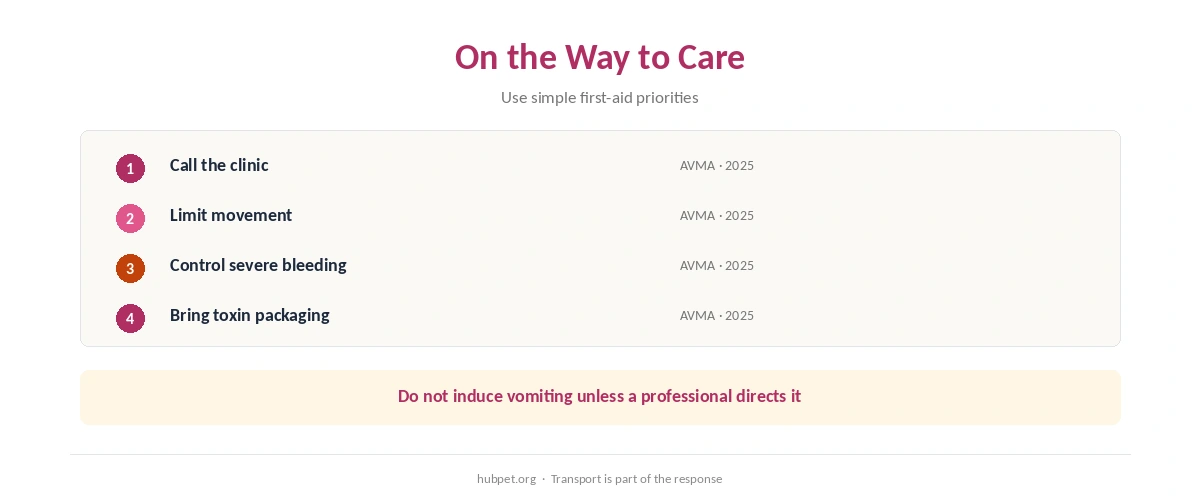
AVMA advises calling the veterinary hospital while you are on the way so the team can prepare (AVMA, 2025). It also advises limiting movement during transport when trauma is possible (AVMA, 2025). For severe bleeding, apply firm direct pressure with a clean cloth while traveling for care (AVMA, 2025). During a seizure, clear nearby hazards, avoid restraint, and keep hands away from the mouth (AVMA, 2025).
- Call your veterinarian or emergency hospital and say you are coming (AVMA, 2025).
- Keep an injured pet as quiet and contained as practical during transport (AVMA, 2025).
- With severe bleeding, apply firm direct pressure with a clean cloth while leaving for care (AVMA, 2025).
- During a seizure, clear hazards and keep your hands away from the mouth (AVMA, 2025).
- After suspected poisoning, bring the product, container, or other useful evidence (AVMA, 2025; ASPCA, 2019).
- Do not induce vomiting or give medication unless a veterinarian or poison-control professional directs you to do so (AVMA, 2025).
Dog and Cat Pet Emergency Signs That Are Easy to Miss
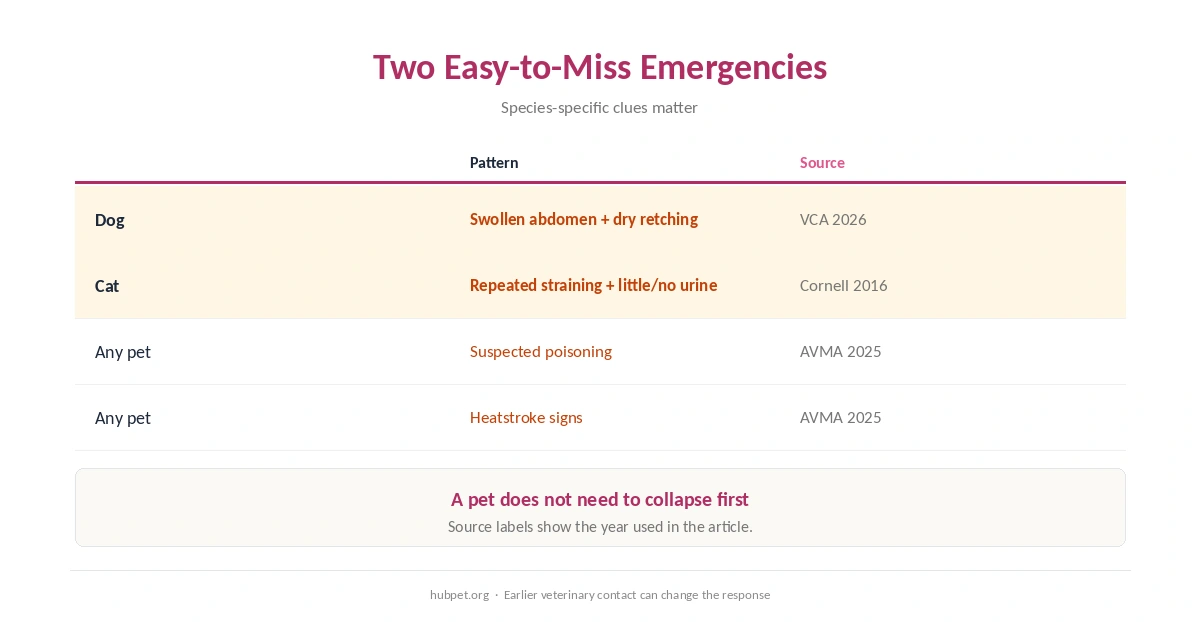
A swollen abdomen with repeated dry retching can signal GDV in a dog (VCA Animal Hospitals, accessed 2026). VCA says this pattern requires immediate veterinary attention (VCA Animal Hospitals, accessed 2026). A cat repeatedly straining but passing little or no urine may have an obstruction (Cornell Feline Health Center, 2016). Cornell calls suspected urethral obstruction an absolute emergency requiring immediate treatment (Cornell Feline Health Center, 2016). Therefore, act on these signs before collapse occurs (VCA, accessed 2026; Cornell, 2016).
Visible illness can lag behind a suspected poisoning exposure (ASPCA, 2019). ASPCA says some poison effects can be delayed, so owners should not wait for symptoms (ASPCA, 2019). Instead, contact a veterinarian or poison-control service immediately (ASPCA, 2019). See foods that are toxic to dogs for common food hazards in this safety block.
When to Call Your Vet About Pet Emergency Signs
Go now for seizures, collapse or fainting, or trouble breathing (Merck, accessed 2026; VCA, accessed 2026). Also go now for suspected poisoning or heatstroke signs (AVMA, 2025; ASPCA, 2019). A dog with abdominal distension and repeated dry retching also needs immediate care (VCA, accessed 2026). So does a cat straining without passing urine (Cornell, 2016). Merck also lists severe or constant pain for immediate care (Merck Veterinary Manual, accessed 2026). For context, see signs your pet is in pain. These pet emergency signs warrant rapid professional triage rather than home diagnosis (AVMA, 2025). For the related care topic, see how to Support a Pet After Surgery at Home.
Some new signs still need prompt veterinary assessment even when they are not on the go-now list (Merck, accessed 2026). Merck includes sudden behavior changes, persistent cough, and eye problems among signs needing timely care (Merck, accessed 2026). When in doubt, call your clinic or an emergency hospital for professional triage (AVMA, 2025).
How We Research
HubPet works from published veterinary guidance rather than personal anecdotes. On October 11, 2026, we read AVMA Pet First Aid (2025). We also read the Merck emergency table and VCA dog emergency guidance. For cats, we read Cornell urinary guidance (2016). For poisoning, we read ASPCA Poison Control (2019). Finally, see How We Research for the HubPet method.
Pet Emergency Signs FAQ
No. AVMA says not to induce vomiting or give medication without veterinary or poison-control direction (AVMA, 2025).
VCA says collapse should always be treated as a medical emergency (VCA Animal Hospitals, accessed 2026).
Bring the product or container (AVMA, 2025). ASPCA also recommends keeping packaging that identifies the substance (ASPCA, 2019).
Yes. AVMA directs owners to the closest veterinary hospital when bleeding is severe (AVMA, 2025).
No. Cornell describes urethral obstruction as an absolute emergency that needs immediate veterinary treatment (Cornell Feline Health Center, 2016).
The Bottom Line
Pet emergency signs support a short response: recognize a red flag, call ahead, and leave (AVMA, 2025). Merck, AVMA, VCA, Cornell, and ASPCA all support prompt veterinary contact for the signs above (sources read in 2026). Keep emergency-hospital and poison-control contact information easy to find (AVMA, 2025).