
This article is general information, not veterinary advice. If your pet seems unwell, is in pain or may have eaten something harmful, contact your vet or an animal poison control line right away. Read our vet disclaimer.
How to help a pet feel safe in a crate starts with changing what the enclosure predicts. For dogs, Dogs Trust and RSPCA guidance both recommend gradual, reward-based crate training and say the crate must never become punishment. For cats, FelineVMA guidance recommends positive carrier training so the cat learns to enter voluntarily.
A crate or carrier is not a shortcut for fear, separation problems, or unmet activity needs. The animal should be able to approach the space in small steps, and the door stays open at first. If the pet will not approach, the setup is too difficult and needs to become easier.
How to Help a Pet Feel Safe in a Crate Before Closing the Door
First, make the enclosure ordinary. Place it in a quiet part of the home near normal activity, not only when something stressful is about to happen. The calm-space guide can help you choose a low-pressure location, and the new-home adjustment guide is useful when the pet has only recently arrived.
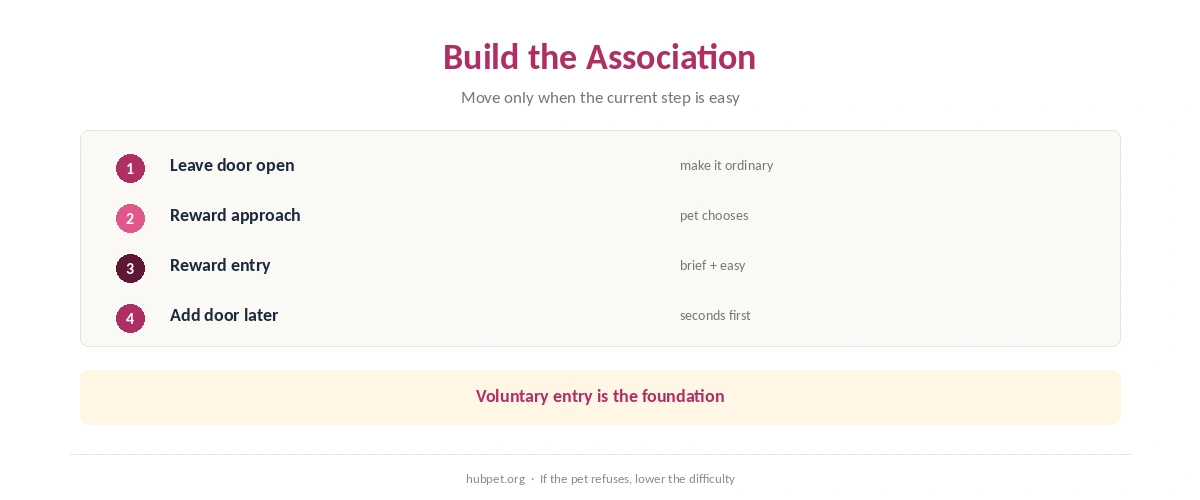
For a dog, secure the crate door open so it cannot swing and startle the dog. Add comfortable bedding if the dog does not shred or swallow it. Drop a reward near the entrance, then just inside, and let the dog leave whenever they want.
For a cat, FelineVMA guidance recommends leaving the carrier available as familiar furniture with soft bedding and preferred rewards. Some cats approach food, some choose play, and some prefer social contact. Therefore, use what that cat actually values instead of assuming food always works.
Positive reinforcement matters here. The positive-reinforcement guide explains how to reward the behavior you want, while the dog-training mistakes guide covers why rushing criteria can stall progress. For dogs new to training, basic training at home gives the same short-session structure.
How to Help a Pet Feel Safe in a Crate With the Door Closed
Only add the door after the animal is choosing to enter and remain briefly. Close it for a moment, reward calm behavior, and open it again before the animal becomes distressed. Then increase duration gradually instead of making a large jump. This is how to help a pet feel safe in a crate without turning the closed door into a sudden test.
For dogs that already know a calm station behavior, settle on a mat can be practiced near the crate before moving the mat inside. If the dog struggles specifically when people leave, use the separation-anxiety guide rather than assuming longer crate time will solve the problem.
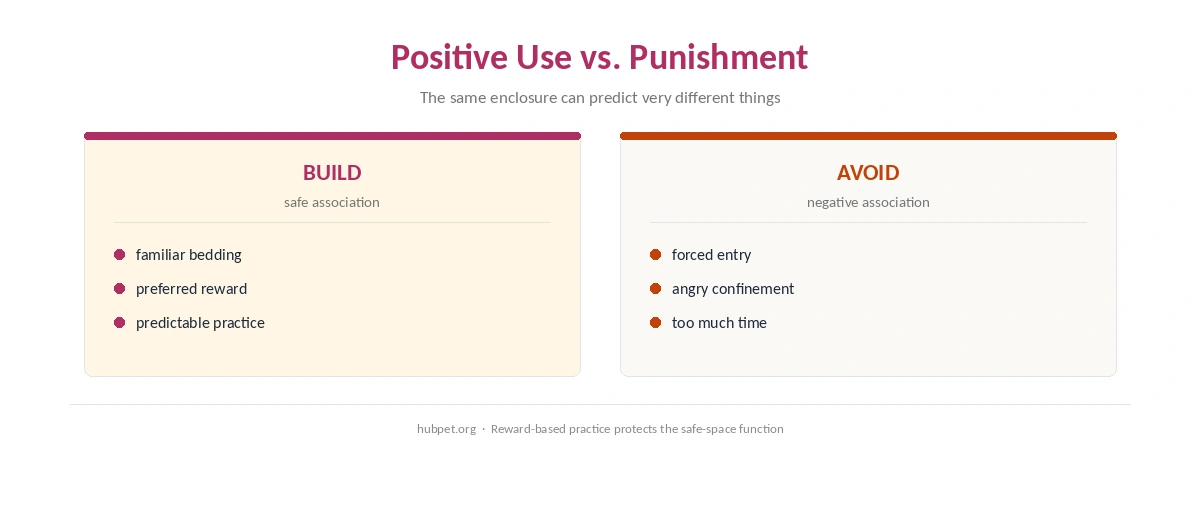
RSPCA guidance says crates must never serve as punishment. Dogs Trust also emphasizes that dogs need regular time outside confinement. Owners should keep absences within what the individual dog can handle. Those principles matter more than any generic time limit because age, training history, routine, and individual tolerance differ.
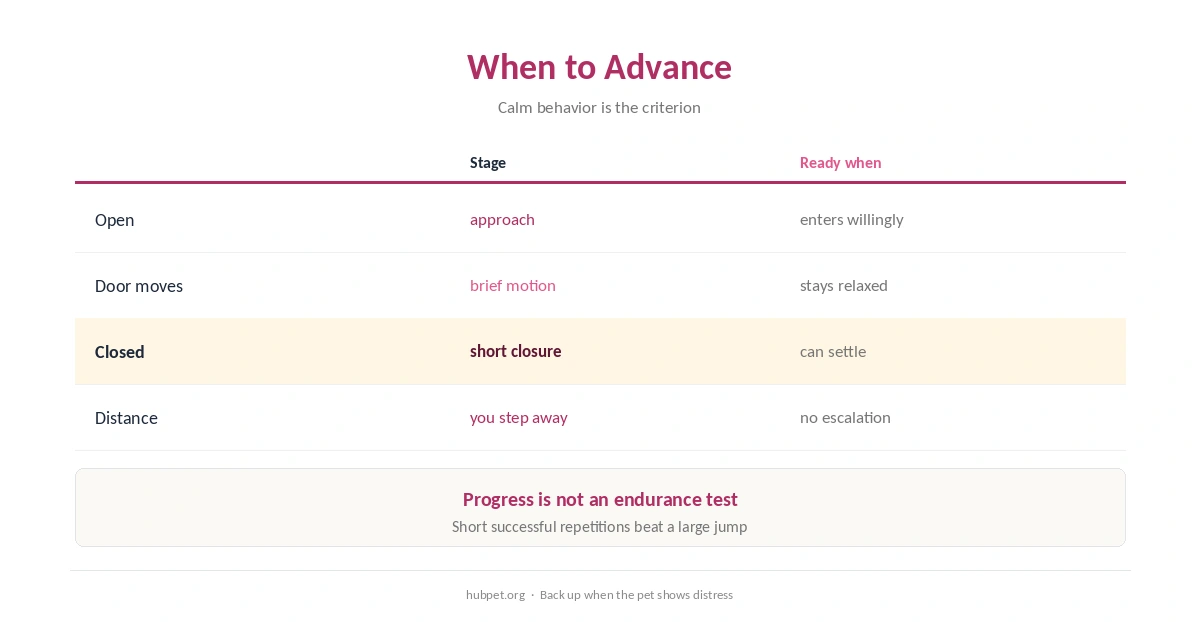
| Stage | What you do | Ready to advance when |
|---|---|---|
| Open enclosure | Reward looking, approaching, and voluntary entry | Pet enters without hesitation |
| Brief door movement | Touch or move the door, then reward | Pet stays relaxed |
| Door closed briefly | Close, reward calm behavior, reopen | Pet remains settled and can eat or rest |
| Short absence | Step away briefly, then return calmly | Pet stays comfortable without escalating |
Set Up the Crate or Carrier for Real Life
Practice when you are not in a hurry. The first-week dog checklist and first-week cat checklist both favor predictable routines over sudden demands. For travel or appointments, the visit-preparation checklist helps you rehearse the carrier before the day it is needed. That timing matters when you are learning how to help a pet feel safe in a crate because rushed sessions make criteria jump too quickly.
If guests or household activity raise arousal, move the enclosure away from the busiest path and use the distance ideas in the guest-anxiety guide. When the animal will be alone, review the home-alone safety checklist. Confinement should not replace exercise, elimination breaks, or normal daily care.
Watch what happens after the door opens. A pet that immediately bolts, refuses to return, pants heavily, vocalizes continuously, scratches frantically, or cannot settle is not ready for a harder step. Reduce duration and rebuild the positive association.
How We Research
HubPet reviewed crate and carrier guidance on October 11, 2026. We used Dogs Trust crate-training guidance, the RSPCA crate-training guide, and FelineVMA positive-reinforcement and carrier-training guidance. Our research process explains how we adapt species-specific recommendations without blending them into one rule.
Make the step easier. Leave the door open, move rewards closer to the entrance, and let the pet choose whether to approach.
No. A crate should not be used as punishment or as forced exposure. Work below the dog’s distress threshold.
FelineVMA guidance supports making the carrier a familiar part of the home so it does not predict only stressful trips.
Only if the animal is already comfortable entering and you keep the closure very brief. Otherwise, start with an open door.
Stop increasing difficulty. Discuss severe or persistent distress with your veterinary team or a qualified behavior professional rather than forcing longer confinement.
The Goal Is Voluntary Comfort, Not Compliance
How to help a pet feel safe in a crate is mostly about pacing. Make the space familiar, reward voluntary entry, add door movement gradually, and back up when the animal shows distress. A useful crate or carrier is one the pet can enter without a fight, not one they have learned they cannot escape.