
A dog toy has several possible jobs: inviting play with you, offering something to carry, supporting a gentle chew session or providing a calming familiar object. The right choice depends on the actual dog, not a generic breed label or a package claim such as “indestructible.” This buying guide compares major toy types, sizing, wear and supervision. For ingestion or dental concerns, review our veterinary disclaimer.
Think about what your dog does with a toy after the first exciting minute. Does the dog retrieve it, shred it, hoard it or try to swallow pieces? That observation guides selection far more reliably than color or novelty. For ideas about varying activities without accumulating new purchases, see our pet toy rotation guide.
Start with the dog’s real play behavior
Watch several ordinary play sessions before shopping. Some dogs enjoy chasing a moving target, some prefer shared tug games and others settle while carrying a soft object. A toy that delights one dog may overwhelm another. Age, mouth size, tooth condition and mobility can also change which actions feel comfortable.
Record the behaviors that cause trouble: ripping seams, swallowing stuffing, chewing off squeakers or guarding objects. Choose a toy you can manage safely in those situations. If the dog growls when someone approaches a valued item, avoid forcefully taking it away; our resource guarding guide explains safer approaches.
Match size to the mouth, not just the weight label
An item small enough to disappear into a dog’s mouth may pose a swallowing or choking risk. Check whether a ball can pass behind the teeth or whether a rubber toy compresses into a hazardous shape. Meanwhile, a toy that is enormous for a small dog may be difficult to grip or move comfortably.
Measure the actual toy and consider how the dog handles it during vigorous play. Packaging often uses broad weight ranges, which cannot account for jaw shape or chewing style. When in doubt, seek a size that the dog can carry without being able to swallow whole. Supervise new items until you know their failure pattern.
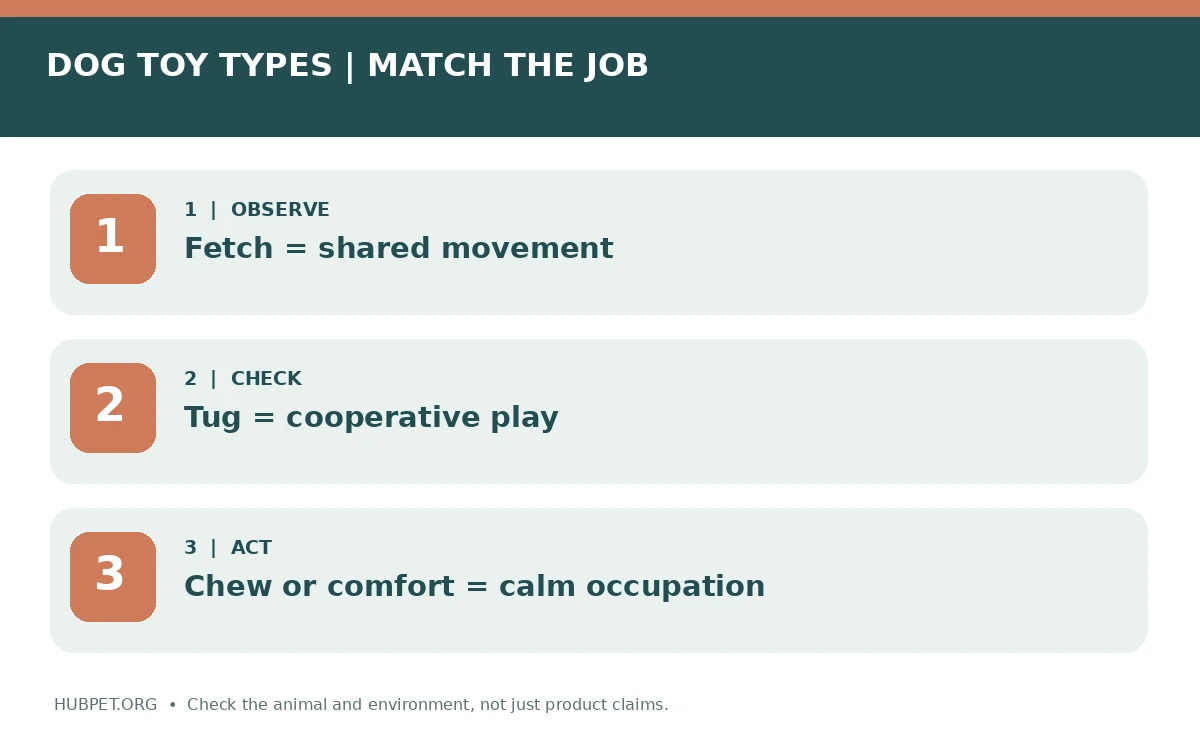
Compare chase and fetch toys
Balls, soft discs and other chase objects support movement and shared games. Consider the intended play surface and the dog’s physical condition. A hard object that bounces unpredictably near stairs or a road creates management problems. Choose a play area without traffic, sharp debris or slippery footing.
Many popular balls are suitable for throwing but not continuous chewing. A dog who peels a felt covering or breaks a squeaky ball should not be left alone with it. Short retrieval sessions with breaks may be more useful than endless high-speed sprints. Our play-and-rest guide discusses pacing.
Select tug toys for safe shared play
A tug toy needs enough length for hands and teeth to remain separated during normal play. Check reinforced seams and whether strands detach during shaking. Use smooth side-to-side movements at the dog’s natural head level, rather than lifting the dog off the ground or making sudden vertical jerks.
Teach a reward-based release cue by trading for a treat or another object. End games if the dog becomes frantic, begins biting hands or guards the item. Do not force a toy out of the mouth. For structured practice, our leave-it training guide offers related impulse-control exercises.
Understand the limits of chew toys
Chew products vary widely in firmness. Extremely rigid items may damage teeth in some dogs, while soft products can fragment under strong chewing. Avoid assuming that harder always means safer. If you cannot comfortably assess firmness or your dog has dental disease, ask a veterinary professional about appropriate textures.
Inspect for sharp edges, cracked rubber and pieces that loosen at joints. The dog should be able to use the toy without consuming chunks. Remove a toy immediately if pieces separate, and contact a veterinarian promptly if you suspect ingestion. Our chewing-management guide covers household alternatives.

Treat plush and squeaky toys as supervised items
Stuffed animals can be satisfying to carry or cuddle. Yet eyes, ribbons, seams, stuffing and small squeakers may become hazards when a dog dissects them. A soft item is not automatically safe for sleep or unsupervised confinement. Choose simple sewn shapes and check whether seams withstand the dog’s play style.
If a dog begins opening a seam, take the toy away without turning the exchange into a chase. Repairing decorative seams at home may not restore safe construction. Replace it or select a different play category. Humane World advises supervising squeaky toys and discarding damaged ones rather than relying on claims of durability.
Use food-dispensing toys thoughtfully
Hollow rubber toys and treat-release devices can slow access to part of a meal and invite exploration. Size the opening and difficulty so food is accessible without prolonged frustration. Use food from the dog’s normal ration where possible. Clean all food-contact surfaces according to the maker’s instructions.
Food toys are not suitable for every dog or every household. Dogs who guard food may need separate rooms and an individualized plan. Remove devices when the dog chews off pieces or becomes upset. For new feeding activities, review our feeding routine guide rather than adding uncontrolled extra calories.
Inspect materials and construction before use
Look for a clear manufacturer, complete material information and cleaning guidance. Examine glued ornaments, loose loops, brittle hard plastic and protruding attachment points. A product marketed as natural may still splinter or break. Likewise, a label that says pet-safe cannot replace watching a strong chewer use the item.
Pay attention to age and dental needs. A very young puppy, adult power chewer and senior dog with worn teeth may need different textures. If you notice mouth bleeding, sudden refusal to chew or a fractured tooth, stop the activity and seek veterinary advice instead of swapping products repeatedly.
Set supervision and storage rules for each toy type
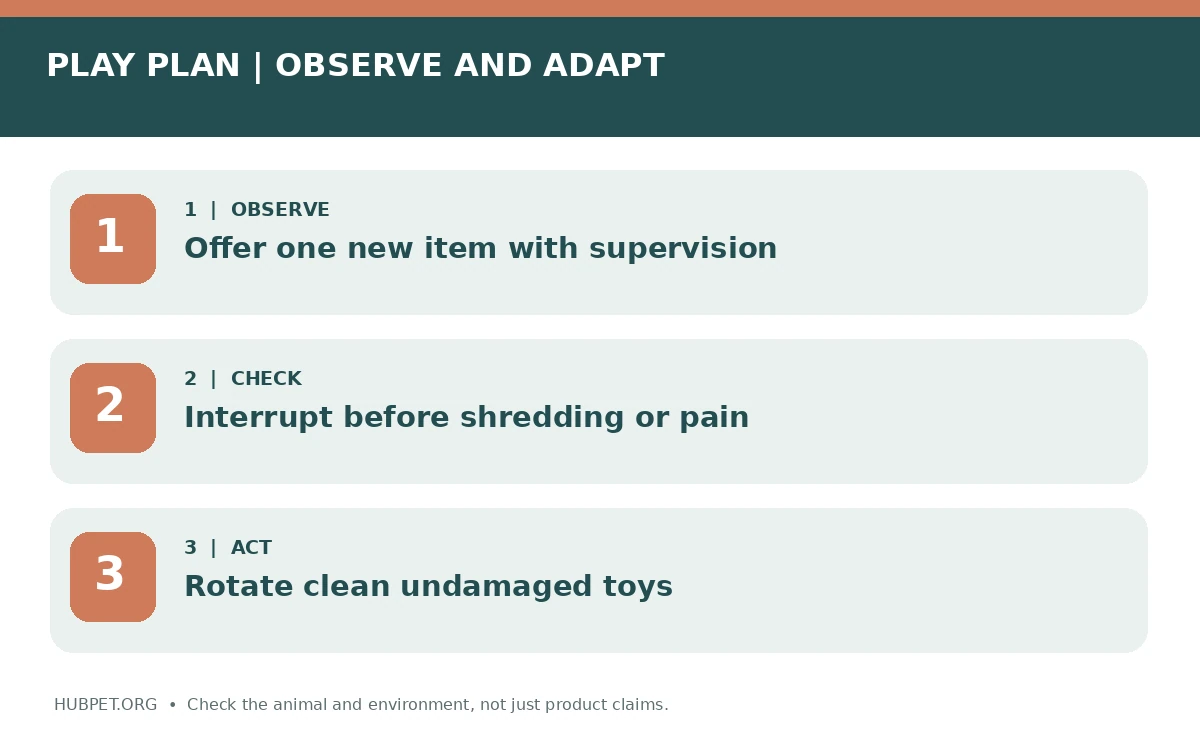
Sort toys into supervised-only and potentially lower-risk categories based on the dog’s behavior, not a universal list. String, ropes, stuffing and pieces that detach deserve particular caution. Put high-risk items away after play. Inspect familiar toys periodically because chewing damage accumulates gradually.
In homes with several pets, monitor competition for popular objects. Separate play sessions can prevent conflict, particularly around food dispensers. Choose storage that keeps broken pieces out of reach. See our multi-pet household checklist for broader space and resource management.
Buy for a use case, then reassess
Before checkout, identify one specific purpose: a short supervised fetch game, calm carrying, a shared tug session or meal enrichment. Compare actual dimensions, material, cleaning access and replacement cost. Start with a single suitable option rather than a large bundle of unknown textures.
Watch the first session closely and record which movements the dog chooses. A safe toy should remain intact and allow relaxed engagement. If the dog tries to swallow pieces, shows pain or becomes possessive, remove it and reconsider the category. Every toy requires regular assessment because all products have limitations.
How We Research
We prepared this guide using animal welfare guidance and practical questions owners can ask about size, materials, supervision, fit and safe use. We did not purchase or independently test products, and we do not rank brands or claim veterinary endorsement. On October 26, 2026, our editorial review considered these sources. Learn more about HubPet and our editorial approach. This material does not replace advice for a specific animal from its veterinarian.
Sources
Humane World for Animals: How to Pick the Best and Safest Dog Toys. Accessed October 26, 2026.
American Humane Society: Choosing Safe Toys for Pets. Accessed October 26, 2026.
ASPCA: Canine DIY Enrichment. Accessed October 26, 2026.
If your dog could fit the item far back into the mouth, swallow it whole or compress it into a choking hazard, choose a safer size and supervise play.
No. Very hard items may injure teeth, while soft items can tear into swallowable fragments. Match texture to the dog and seek veterinary guidance for dental concerns.
Only after assessing your dog’s behavior and the item’s construction. Dogs who shred fabric or swallow stuffing should not have access while unsupervised.
Remove it promptly. Loose squeakers, torn seams, cracked rubber and detached pieces can create ingestion or choking risks.
There is no fixed ideal count. A small, thoughtfully rotated selection often gives variety while making regular damage checks easier.