
An interactive dog toy should give a dog a solvable problem, not an endless obstacle. Sliding lids, rolling feeders, scent-search objects and supervised cooperative games all offer different experiences. The deciding question is whether the dog can make progress without panic, destructive chewing or unsafe ingestion. This guide focuses on difficulty, mechanics and trial use. Read our veterinary disclaimer for concerns about swallowing or behavior changes.
Unlike a general toy-selection guide, this page concentrates on how a challenge works from the dog’s point of view. You will learn to identify a workable starting level, check moving parts and increase complexity with care. Our home enrichment corner guide offers a practical place to use these activities.
Define what “interactive” means for the dog
Some toys require the dog to move a lid, tip a container or press a component to release a reward. Others encourage searching by scent or bring the owner into the game. A device with lights and motors is not necessarily more interactive from the animal’s perspective than a simple food-filled object.
Look for a clear action-and-feedback loop: the dog performs a natural motion and something rewarding or interesting happens. If the outcome is random and startling, the activity may produce confusion rather than enrichment. Choosing a predictable first challenge helps you observe problem-solving without extra pressure.
Start with a puzzle the dog can solve quickly
A first puzzle should let the dog find at least some reward without complicated sequences. Show the location of food, leave a lid partially open or roll a feeder gently to demonstrate movement. Your role is to create a successful introduction, not to test intelligence. Reward exploration and stop before repeated pawing becomes frantic.
Dogs differ in confidence, learning history and mobility. A nose-driven dog may enjoy searching a snuffle surface; another may like rolling an object. Manufacturers use different definitions for difficulty labels such as level two. Judge the dog’s actual response rather than buying by a number printed on packaging.
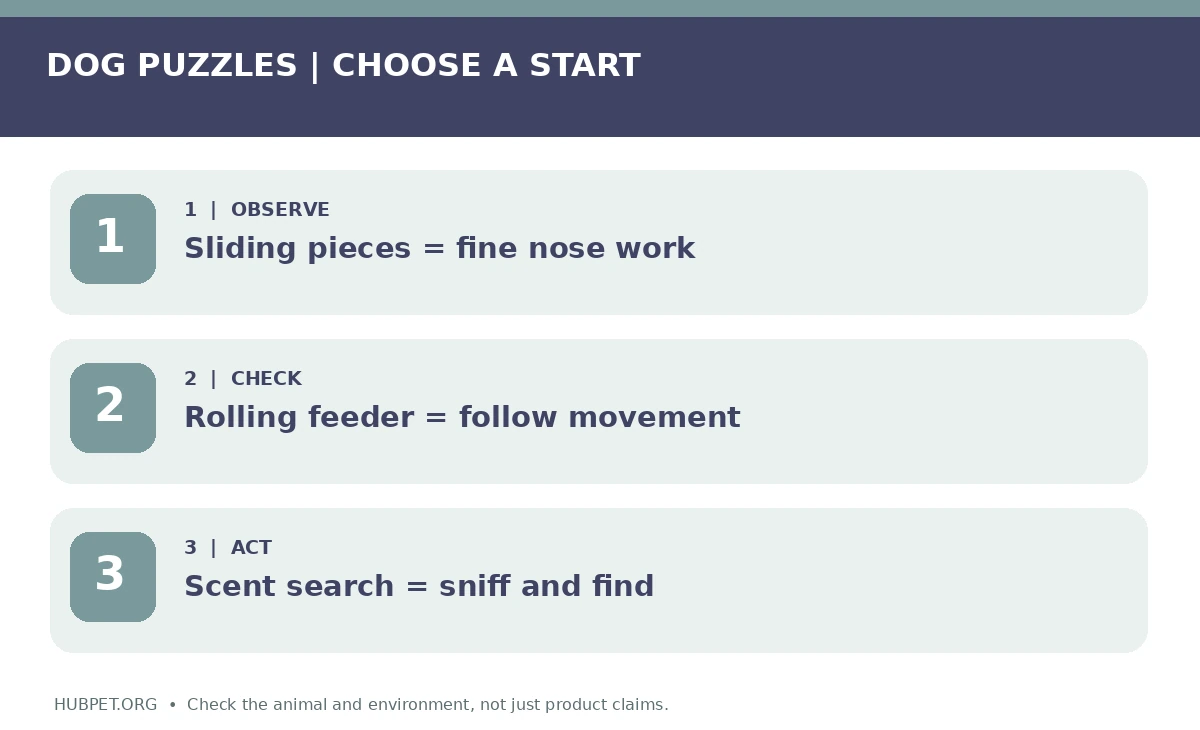
Compare sliders, flip panels and treat wheels
Board puzzles with sliders may remain in place on a hard floor, but small lids can create detachment risks. Choose panels that stay captive in their tracks and cannot trap nails or toes. If the board rocks, a slip-resistant base helps prevent sudden movement when the dog pushes with its nose.
Flip doors or rotating wheels can reward deliberate action, but they also add hinges and edges that need inspection. Try moving every part yourself before offering the device. If components pop out easily, do not leave it with a vigorous chewer. No clever mechanism outweighs a swallowable moving piece.
Consider rolling feeders and hollow toys separately
Rolling feeders can distribute a ration across the floor through an opening. They work for dogs that enjoy following movement, but may collide with furniture or become stuck under appliances. Select openings that match the food size and allow cleaning; a closed cavity that traps wet food is not a practical long-term choice.
Hollow rubber toys can hold part of a meal with less chasing, although a dog may become frustrated if the opening is too narrow. Avoid unverified food recipes or sticky fillings for animals with dietary restrictions. Use the dog’s regular ration and ask a veterinarian about snacks when a medical diet applies.
Inspect detachable parts and material strength
List every component you can see: plugs, sliding pieces, bells, squeakers, screws and caps. If a dog could pry off a component and swallow it, choose a different toy or restrict it to tightly controlled practice. Inspect seams and moving joints before each use. Replace damaged items promptly rather than relying on temporary glue repairs.
Interactive toys still obey normal chew-toy safety rules. A dog who repeatedly bites the board instead of solving the task may need a simpler design and closer supervision. Our guide to chewing alternatives explains why providing an appropriate outlet matters more than punishment.

Fit the activity to the dog’s body and senses
Large knobs may be easier for a dog with limited fine paw control, while sliding trays may challenge a dog with a short muzzle. A senior dog who has trouble standing should not need to brace painfully to reach a puzzle. Place activities on non-slip footing and select a height that allows a comfortable posture.
Vision or hearing changes do not prevent enrichment, but they can alter which cues work. A scent-based search may suit some dogs better than flashing lights or rapid electronic movement. If the dog suddenly struggles with previously familiar tasks, seek veterinary advice instead of assuming the animal simply needs entertainment.
Protect mealtimes and household relationships
Treat puzzles may delay access to food and can become highly valued resources. In a multi-dog home, offer food activities in separate quiet areas and collect empty devices before reuniting pets. If a dog guards food or growls near a puzzle, avoid reaching in to remove it. Ask a qualified behavior professional for a safe management plan.
Food-based challenges still contribute calories. Portion part of the normal meal into the toy instead of repeatedly adding treats. For pets that must eat on a strict schedule or have medical feeding instructions, prioritize the veterinary plan. Our feeding schedule guide covers predictable routines.
Read frustration signals rather than the marketing level
Look for relaxed sniffing, exploratory paw movements and brief pauses. Repeated barking at the toy, frantic biting or walking away can show that the task is too hard or unappealing. If the dog cannot obtain an obvious first reward, make the activity easier. You can open a compartment or offer a simpler food-search game.
Do not keep increasing difficulty merely because the manufacturer offers more levels. Familiar success has value. Rotate a solvable selection rather than forcing a dog through complex steps every day. Our calm-play guide can help you watch arousal during games.

Clean food-contact surfaces and dry them fully
Choose smooth access to corners and cavities. Check whether the manufacturer allows a dishwasher or specifies hand washing. Food residue under rotating parts can spoil or attract pests. A puzzle that you cannot safely disassemble may require a simple dry-food-only use case rather than sticky or moist filling.
After cleaning, dry the device completely and confirm that you have reinstalled and secured each removable part. Check for softened glue or cracks caused by heat. Replace the toy if cleaning leaves a smell or rough edges. Hygiene and ease of inspection deserve as much attention as how many tricks the device performs.
Build a progression plan without pressure
Begin with an easy success in a quiet room. On the next session, change one variable such as a partly closed lid or a slightly more complex location. Keep the session short and stop while the dog remains interested. If frustration appears, reverse the change. That is useful feedback, not a training setback.
Before buying, confirm the device fits your dog’s mouth and paws, stays stable and has no loose swallowable pieces. Choose a returnable design and supervise early sessions. A puzzle that the dog enjoys safely at an easy setting offers more enrichment than a spectacular device the dog cannot use.
How We Research
We prepared this guide using animal welfare guidance and practical questions owners can ask about size, materials, supervision, fit and safe use. We did not purchase or independently test products, and we do not rank brands or claim veterinary endorsement. On October 26, 2026, our editorial review considered these sources. Learn more about HubPet and our editorial approach. This material does not replace advice for a specific animal from its veterinarian.
Sources
Humane World for Animals: How to Pick the Best and Safest Dog Toys. Accessed October 26, 2026.
American Humane Society: Choosing Safe Toys for Pets. Accessed October 26, 2026.
ASPCA: Canine DIY Enrichment. Accessed October 26, 2026.
They serve different jobs. A safe interactive challenge may add problem-solving opportunities, while a simple fetch or comfort toy may suit other needs.
Easy enough that the dog can achieve a quick reward with minimal help. Increase one step at a time only when the dog remains relaxed.
Do not assume it is safe. Check the maker’s instructions and your dog’s chewing behavior; detached parts and food guarding may require direct supervision.
Stop, simplify the task and offer an appropriate chewing outlet. Persistent frantic biting can mean the puzzle is too frustrating or unsuitable.
Food dispensed from them contributes to daily intake. Use measured portions and follow veterinary feeding guidance when a prescribed diet applies.