
This article is general information, not veterinary advice. If your pet seems unwell, is in pain or may have eaten something harmful, contact your vet or an animal poison control line right away. Read our vet disclaimer.
A multi-pet household checklist should protect access, escape routes, predictable routines, and each animal’s ability to opt out of interaction. The 2024 FelineVMA intercat tension guidelines emphasize recognizing subtle tension and distributing resources. Dogs Trust guidance for dogs and cats recommends separation, safe cat spaces, separate feeding, and supervised calm interactions.
Use this multi-pet household checklist as a setup review, not as proof that every animal should become close friends. Some pets coexist comfortably with little direct contact. If you are still in the introduction stage, start with the new-pet introduction checklist before expecting normal household freedom. For the matching checklist, see pet Stress Reduction Checklist.
Multi-Pet Household Checklist: 12 Things to Review
- Give each pet a resting place that another animal does not have to pass closely to reach.
- Give cats hiding choices and elevated routes that dogs cannot easily block or follow.
- Offer food so one pet cannot routinely crowd another away from a meal.
- Put water in more than one practical location when pets would otherwise compete for access.
- Place cat litter areas so another pet cannot trap or ambush a cat at the entrance or exit.
- Manage toys and chews that trigger guarding or conflict instead of leaving them out unsupervised.
- Keep doors, gates, rooms, or other barriers ready when pets need a break from each other.
- Let introductions and reunions move at the pace of the more worried animal rather than on a deadline.
- Reward calm behavior around another pet without forcing greetings or shared play.
- Give each pet species-appropriate activity and individual interaction instead of relying on another pet for entertainment.
- Teach household members the early signs of staring, blocking, hiding, chasing, guarding, or escalating arousal.
- Plan to contact a veterinarian or qualified behavior professional if conflict becomes sudden, severe, or unsafe.
Many checklist items become easier when you arrange the home around movement rather than just objects. A calm pet space, an enrichment corner, and good litter-box placement reduce situations where animals must squeeze past each other for something important.
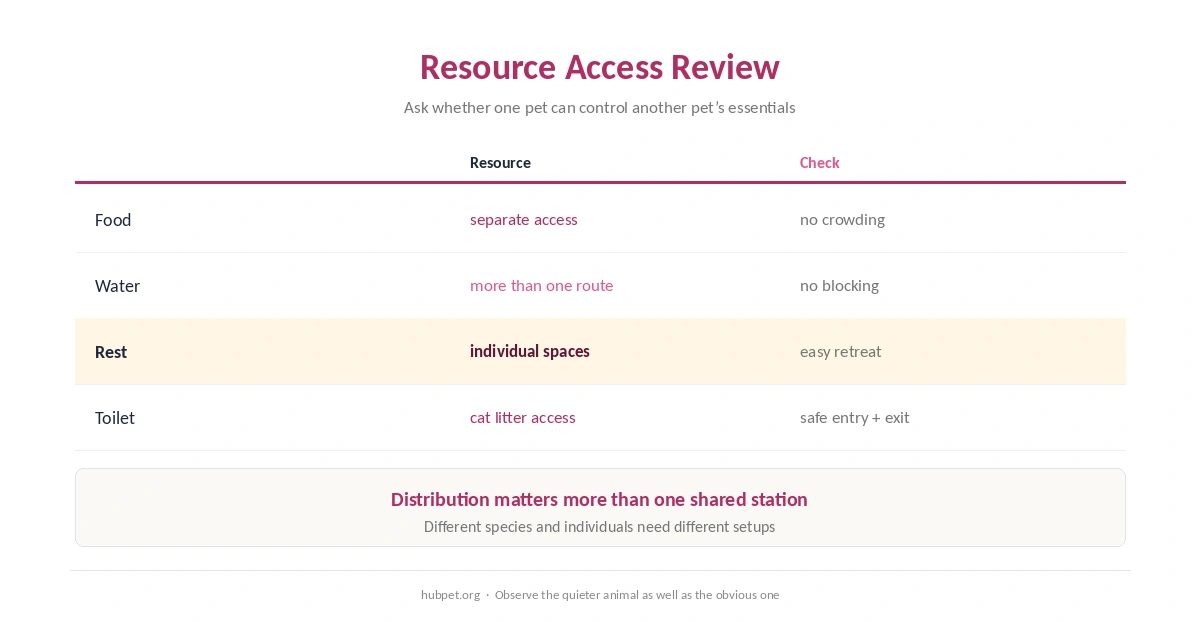
Why the Multi-Pet Household Checklist Focuses on Access
Cats do not necessarily want to share every core resource. Merck’s feline social-behavior review updated in 2025 notes that cats may time-share resources when they do not prefer one another as associates. The 2024 FelineVMA guidelines likewise warn that intercat tension may appear as subtle staring or blocking, not just obvious fighting. Use the cat stress guide and the sudden-hiding guide to watch the quieter animal, not only the one making noise.
Dog-cat homes need different movement options. Dogs Trust guidance recommends letting the cat approach at their pace, using barriers when supervision is not possible, feeding pets separately, and giving cats high places and hiding options. The practical sequence in the dog-cat introduction guide fits that same principle.
| Household pattern | What to change first | Related HubPet guide |
|---|---|---|
| One pet follows another everywhere | Create breaks and blocked-off rest areas | Help Pets Get Along |
| Cat avoids a route to litter or food | Add access points and reduce blocking | Litter Box Placement |
| Conflict starts around toys or food | Manage the item and separate access | New Pet Introduction Checklist |
| Pets become overexcited together | Pause interaction and reinforce calm behavior | Settle on a Mat |
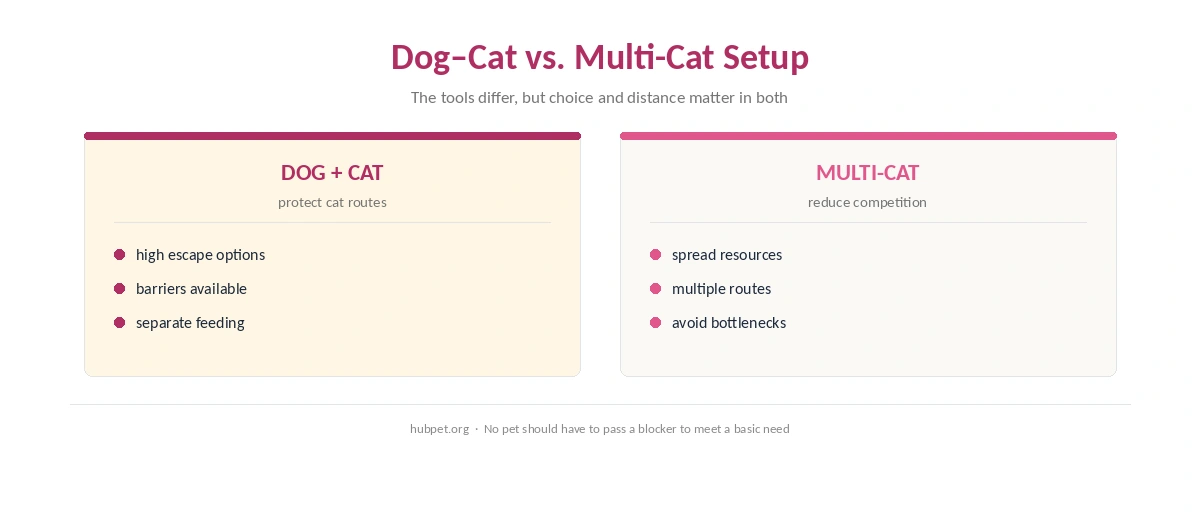
Daily Habits for a Multi-Pet Household Checklist
Predictability helps you notice change. A multi-pet household checklist also works better when everyone knows the normal routine. Use the daily dog checklist, the daily cat checklist, and the weekly pet-care checklist to track essentials without making the schedule rigid. Pay attention when a pet suddenly stops using a normal space, avoids another animal, or changes eating or elimination.
Give animals separate ways to spend energy. Dogs may benefit from sniffing, short training, and calm settling; cats need hunting-style play, climbing, scratching, and hiding opportunities. Indoor dog activities, indoor cat stimulation, and toy rotation can help prevent every interesting activity from becoming a shared competition.
When pets are together, reward the boring moments: looking away, resting, sniffing independently, walking past without chasing, or choosing another spot. Mat-settle training can give a dog a clear station while a cat moves through the room, and positive reinforcement basics keeps the plan humane.
When Household Tension Needs Help
The 2015 AAHA behavior guidelines recommend veterinary assessment when a behavior change may have a medical contributor. Call your veterinarian when aggression or avoidance appears suddenly or when normal eating, drinking, elimination, sleep, or mobility changes. If there are injuries, repeated fights, stalking, resource blocking, or one animal cannot safely use parts of the home, professional behavior guidance is appropriate. The signs-of-pain guide and the emergency-signs page can help separate a behavior-management question from a medical concern.
Do not punish growling, hissing, or warning behavior. Those signals tell you that the current setup is too difficult. Increase distance, separate safely, and address the trigger rather than forcing the animals back together.

How We Research
HubPet reviewed multi-pet household guidance on October 11, 2026. We used the 2024 AAFP/FelineVMA intercat tension guidelines, Dogs Trust dog-and-cat household guidance, and the 2020 survey of 2,492 multi-cat households. Our research process explains how we turn species-specific welfare guidance into practical home checklists.
Separate access to key resources, safe rest areas, escape routes, barriers, supervised interactions, individual enrichment, and a plan for tension are the core items.
No. Comfortable coexistence with choice and safe access can be a successful outcome even when animals do not seek close contact.
Separate feeding is often easier to manage because it prevents crowding, food stealing, and conflict around meals.
Watch for staring, blocking, stalking, hiding, route changes, fleeing, or one pet waiting until another leaves before using a resource.
Seek help for repeated fights, injuries, unsafe guarding or stalking, major resource blocking, sudden behavior change, or a situation management cannot keep safe.
The Bottom Line on the Multi-Pet Household Checklist
A multi-pet household checklist works best when it asks whether every animal can eat, drink, rest, eliminate, move, play, and retreat without another pet applying pressure. Build the environment around access and choice, reinforce calm behavior, and treat repeated conflict as a setup problem to investigate rather than a personality flaw.