
A cat leash is not simply a smaller dog leash. Its weight, clip, length and handling all matter, but the cat’s willingness matters more. Many cats dislike restraint and unfamiliar outdoor places, so buying a leash does not mean you should walk your cat. This guide helps you evaluate equipment while putting welfare first. See our veterinary disclaimer for health concerns.
If your cat hides, freezes or struggles with a harness indoors, postpone the leash decision. Cats Protection notes that many cats prefer to explore at their own pace, and safe indoor enrichment may suit them better. Our cat stress guide offers useful body-language clues before you attempt any new activity.
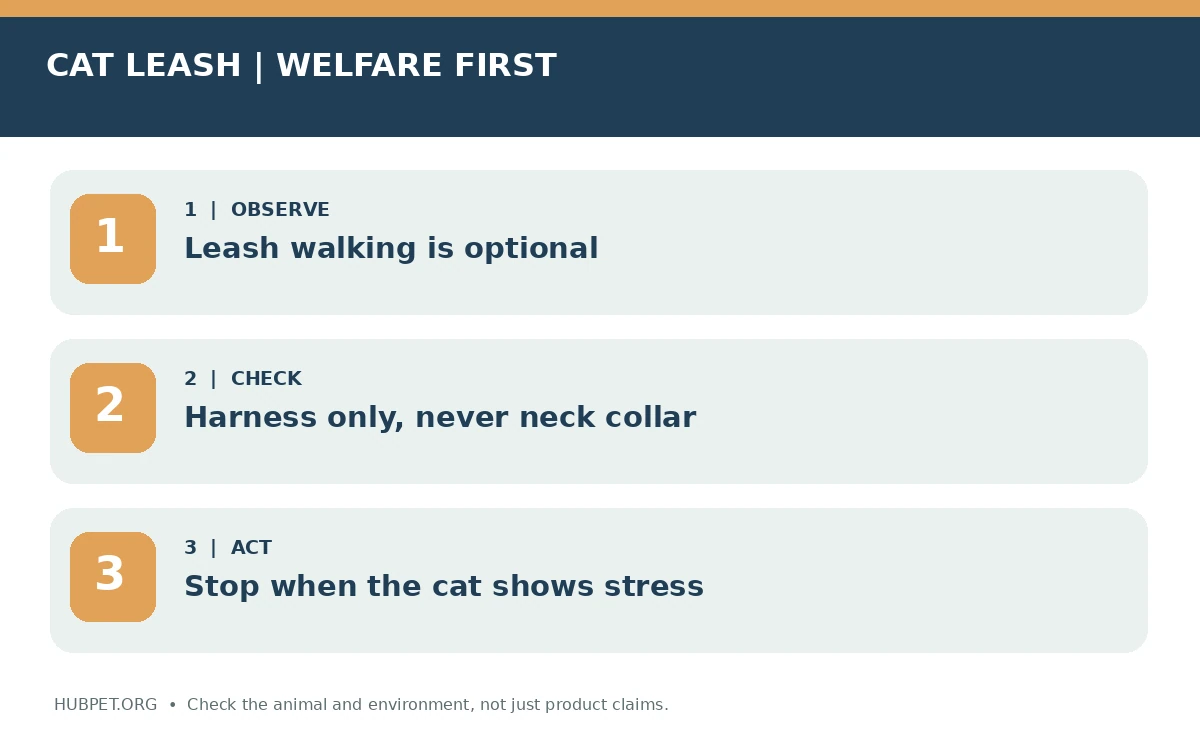
Decide whether lead walking makes sense at all
Begin with the cat rather than the product. Does your cat investigate unfamiliar items willingly, tolerate gentle handling and remain curious in controlled settings? A bold cat may still feel overwhelmed outdoors. A timid animal, newly adopted cat or cat with a history of escape attempts is unlikely to benefit from a rushed walking plan.
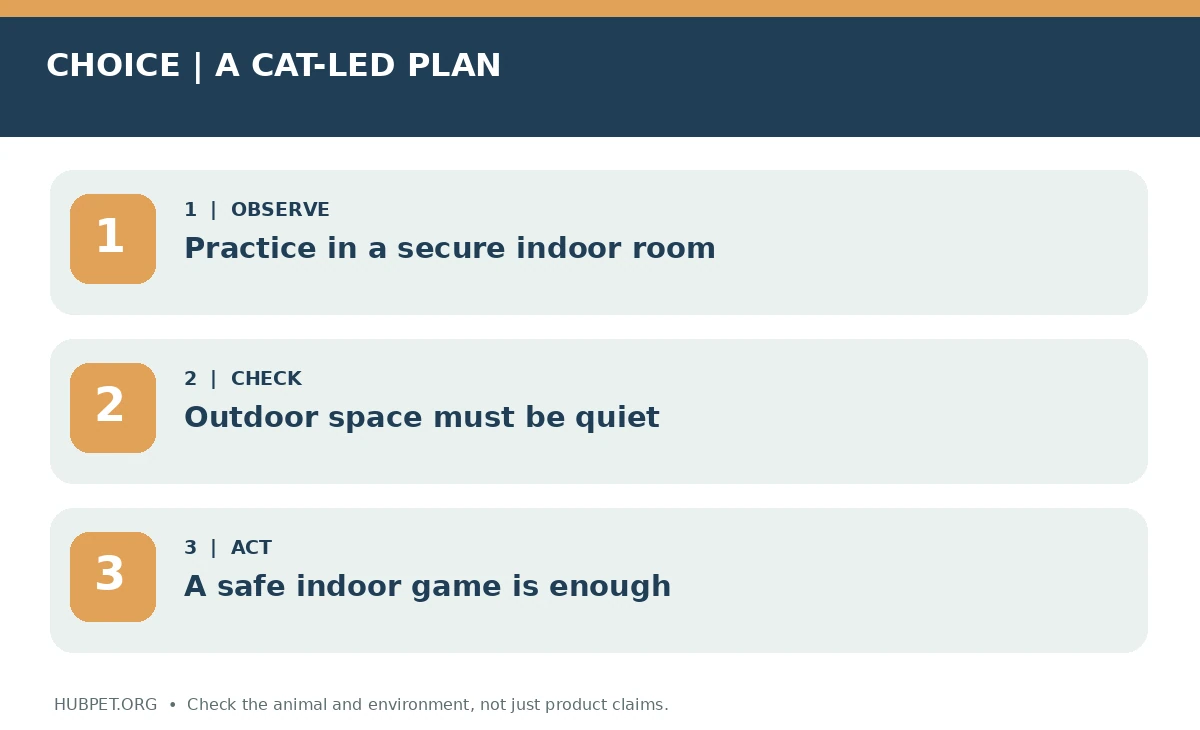
Blue Cross and Cats Protection caution that walking on a lead can be stressful for many cats. Consider a secure window perch, climbing furniture or scent games instead. A quiet enclosed outdoor area may provide a different option if it is properly secured. Declining to use a leash is a valid, welfare-centered decision.
Attach a leash to a fitted harness, not a collar
A leash clipped to a collar can place pressure on a cat’s delicate neck or slip off during a startled retreat. Choose a cat-specific body harness that allows normal movement, then connect the lead to the attachment designated by its maker. Do not improvise around the throat, chest or front legs.
A secure fit needs to survive normal crouching and turning, but no harness is completely escape-proof. Test movement indoors before ever opening an exterior door. Our low-stress handling guide can support short, voluntary practice sessions without forcing contact.
Look for a lightweight clip that closes reliably
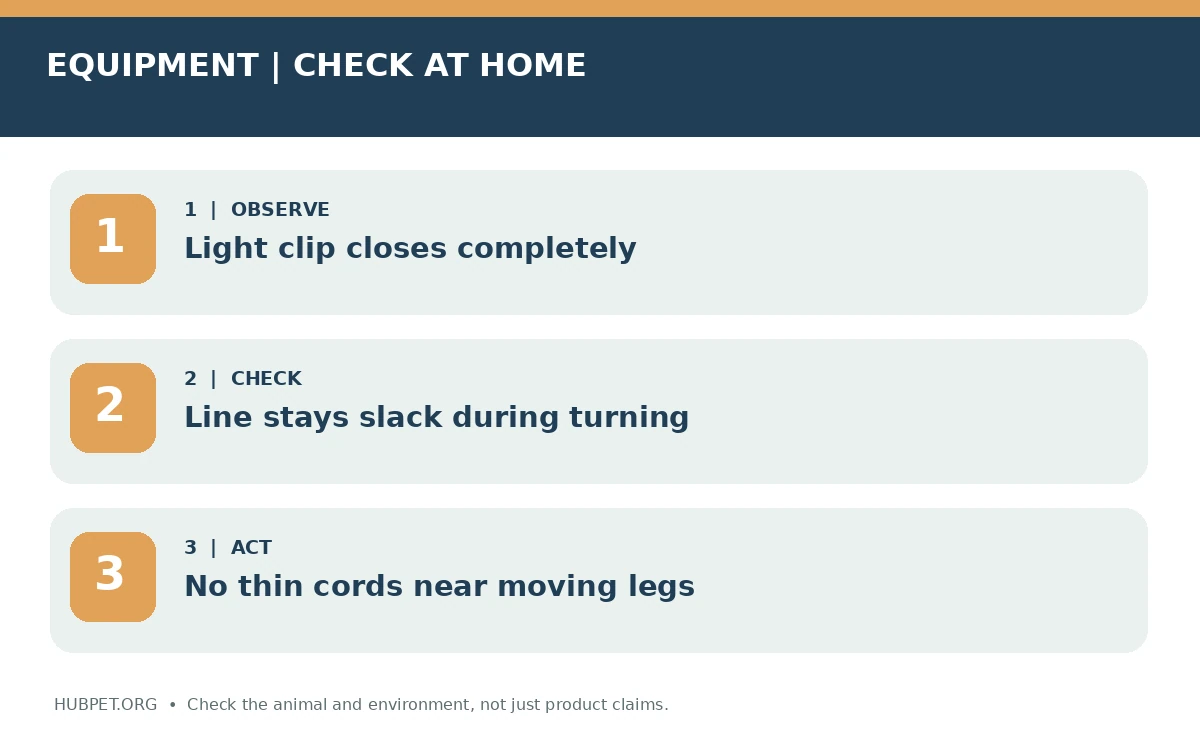
The clip should match the harness ring and move without pinching fur. Check the spring gate with your fingers before every session; it should shut completely and resist opening from sideways contact. A bulky metal snap may bang against a small cat or twist the harness out of position.
Compare hardware on the actual cat if possible, not only on a package illustration. If a rotating swivel is included, verify that it turns smoothly and cannot separate from its base. Replace the leash when the gate sticks, cracks appear or stitching near the clip begins to fray.
Choose manageable length instead of maximum range
A leash needs enough slack for the cat to turn and inspect a small area without constant neck or body tension. Very short leads can create repeated pulling. Very long lines can wrap around furniture, legs or low branches before a handler notices. Indoor practice with an ordinary fixed-length lead is a sensible starting point.
Avoid assuming retractable mechanisms are safer because they extend automatically. A thin retractable cord can tangle or tighten suddenly, while a spring reel may make alarming sounds. Select a line you can handle with steady loose control. Never attach an unattended cat to a fixed point.
Check material, edges and grip
Light flat webbing often lies more predictably than a narrow slippery cord. Whatever material you consider, inspect folded edges and attachment stitching. A soft handle helps you maintain control without winding the leash tightly around your wrist. Choose visibility that suits the environment, especially near dusk.
When the leash gets wet, check whether the material stretches or becomes hard to grasp. Clean it as directed and let it dry before storage. Skip decorative charms near the cat, as dangling pieces can snag fur or frighten a cautious animal. Hardware simplicity matters more than stylish colors.
Introduce the leash indoors in calm steps
Let the cat see and sniff the loose leash while you reward voluntary interest. Next, briefly clip it to a harness the cat already wears comfortably. Keep the line slack and follow the cat through a quiet, uncluttered room. A cat does not need to walk beside your leg or perform a dog-style heel.
Watch for crouching, tail thrashing, pinned ears and repeated hiding. These are reasons to stop, remove the equipment and return to easier activities. If the cat accepts short sessions, rehearse unclipping before the cat becomes distressed. Our indoor enrichment guide provides alternatives on days when lead practice is not welcome.
Avoid turning an outdoor trip into a surprise
If the cat genuinely accepts the setup, choose a quiet, enclosed location well away from cars, dogs and crowds. Check current vaccination and parasite prevention needs with a veterinarian. Carry a secure familiar carrier as a place to retreat, and plan to end the visit immediately if the cat is frightened.
Never drag a cat into open space, pull it away from hiding or allow strangers to rush up for greetings. Cats need control over pace and distance. If outside access produces fear, return indoors and stop the experiment. A successful enrichment plan can remain entirely indoors.
Recognize escape risks before testing outdoors
Cats can reverse out of some harnesses even when the chest appears snug while walking forward. In a secure room, observe natural turns and backward steps without pulling. Check that the harness does not slip toward the ears and the lead cannot unclip when the cat twists. Secure the home door before practice.
No product label guarantees escape prevention. Keep identification and microchip information up to date where appropriate. Avoid using a leash as the only barrier between your cat and a busy road. An enclosed space plus a transport plan offers more protection than extra leash length.
Store and maintain the leash between sessions
After each session, remove both harness and leash. Cats can chew or become tangled in trailing lines if left unsupervised. Examine the strap for pulled threads, tooth marks and loose stitching. Check clips and swivel joints before replacing the leash in a closed drawer or secured container.
If the cat persistently bats at or bites the leash, this may be curiosity or discomfort rather than training failure. Put the item away and offer suitable play objects. See our toy rotation guide for low-pressure enrichment that does not involve restraint.
Use a cat-led shopping checklist
Before purchase, confirm that indoor harness acceptance already exists. Then assess clip weight, reliable closure, lead width, handle comfort, cleanability and the return policy. Plan a supervised indoor trial with no external-door exposure. The leash should serve a chosen, low-stress activity rather than define it.
Ask what you will do if the cat freezes, backs out or encounters a dog. If you lack a safe answer, do not proceed outdoors. Outdoor walks are optional; the animal’s response is the deciding factor. A patient indoor routine often offers more control and less risk than an ambitious walking goal.
How We Research
We prepared this guide using animal welfare guidance and practical questions owners can ask about size, materials, supervision, fit and safe use. We did not purchase or independently test products, and we do not rank brands or claim veterinary endorsement. On October 26, 2026, our editorial review considered these sources. Learn more about HubPet and our editorial approach. This material does not replace advice for a specific animal from its veterinarian.
Sources
Cats Protection: Keeping Cats Safe Outside. Accessed October 26, 2026.
Blue Cross: Walking a Cat. Accessed October 26, 2026.
PDSA: Walking a Cat on a Lead: Is It a Good Idea?. Accessed October 26, 2026.
Not necessarily. Many cats find restraint and unfamiliar outdoor places stressful. Safe indoor enrichment may be a more comfortable option.
For lead walking, connect to a properly fitted cat-specific harness rather than a collar so leash tension does not concentrate on the neck.
They can create sudden tension and tangling risks. A manageable fixed-length leash is usually easier to monitor during calm indoor practice.
Unclip it, end the session calmly and return to brief voluntary introductions. Do not drag or carry a struggling cat into an outdoor area.
Confirm that the spring gate closes completely, the clip fits the harness ring and the connection stays seated during normal indoor turning.