
This article is general information, not veterinary advice. If your pet seems unwell, is in pain or may have eaten something harmful, contact your vet or an animal poison control line right away. Read our vet disclaimer.
Do cats get jealous of other pets? Research does not yet justify a simple yes. In a 2020 experiment with 52 cats, household cats reacted more intensely to a realistic toy cat that their owner had petted than to a nonsocial object. However, the authors explicitly said the missing jealousy-related behaviors prevented firm conclusions that cats experience jealousy.
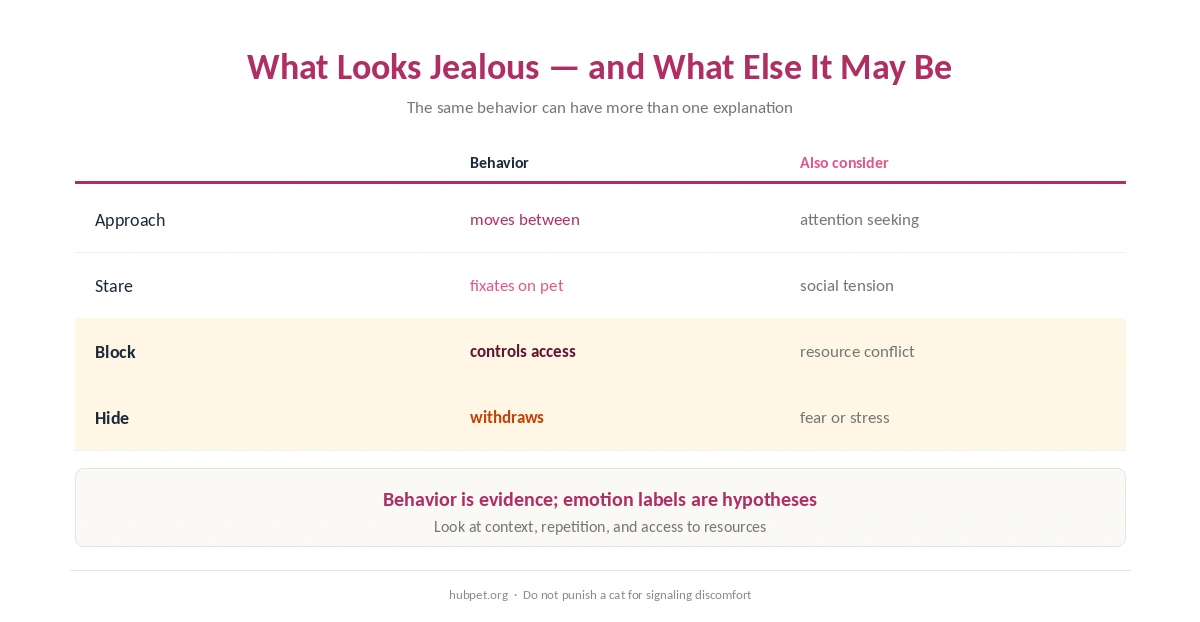
That distinction matters at home. Do cats get jealous of other pets when they block, stare at, or approach a housemate during attention? Those behaviors may instead reflect social competition, stress, resource conflict, or simple interest. Observe the trigger and the effect on both animals. The same evidence-first approach appears in the dog jealousy article, where studies also stop short of proving a human-identical inner experience.
Do Cats Get Jealous of Other Pets According to Studies?
The 2020 Bucher and colleagues study tested cats while an owner or unfamiliar person petted either a realistic stuffed cat or a furry cushion. Household cats showed more intense reactions toward the potential social rival after the owner interaction. Still, the cats did not show the full pattern the researchers had predicted, so the paper describes possible cognitive foundations rather than confirmed feline jealousy.
There is much stronger evidence that relationships between cats vary and that intercat tension can be subtle. The 2024 FelineVMA intercat tension guidelines describe signs such as staring, blocking, chasing, fleeing, hissing, and physical conflict. Those are observable behaviors; none requires us to know whether the cat feels “jealous.”
| What an owner might call jealousy | Other plausible explanation | Useful question |
|---|---|---|
| Cat pushes between you and another pet | Attention seeking or social competition | Can both animals disengage freely? |
| Cat blocks a doorway or resource | Intercat tension or resource control | Is one cat losing access? |
| Cat chases after you pet another cat | Arousal, play, or conflict | Does the other cat flee or hide? |
| Cat rests nearby while you pet another pet | Normal monitoring or social interest | Is anyone actually distressed? |
Do Cats Get Jealous of Other Pets or Compete for Resources?
Multi-cat homes work better when essential resources are easy to reach without confrontation. Merck’s feline social-behavior review updated in 2025 notes that many cats prefer not to share core resources. When cats do not prefer one another as associates, they may time-share access. The setup in the litter-box placement guide and the enrichment-corner guide can reduce bottlenecks. For a separate evidence-focused question, see are Cats Naturally Independent and Distant?.
Relationship quality also depends on the introduction and the individual cats. A 2020 survey covered 2,492 multi-cat households. Owners reported staring more often than the other listed conflict signs, and better initial introductions correlated with later harmony. However, no single household variable strongly predicted the relationship. If you are adding a cat, use the two-cat introduction guide and the introduction checklist rather than expecting immediate friendship.
Cats also need routes away from dogs and people. The pets-get-along guide, the dog-cat introduction guide, and the calm-space guide all use distance and choice instead of forced proximity. If one cat repeatedly loses access to food, water, litter, rest, or people, address that access problem first.
What to Do About Jealousy-Like Cat Behavior
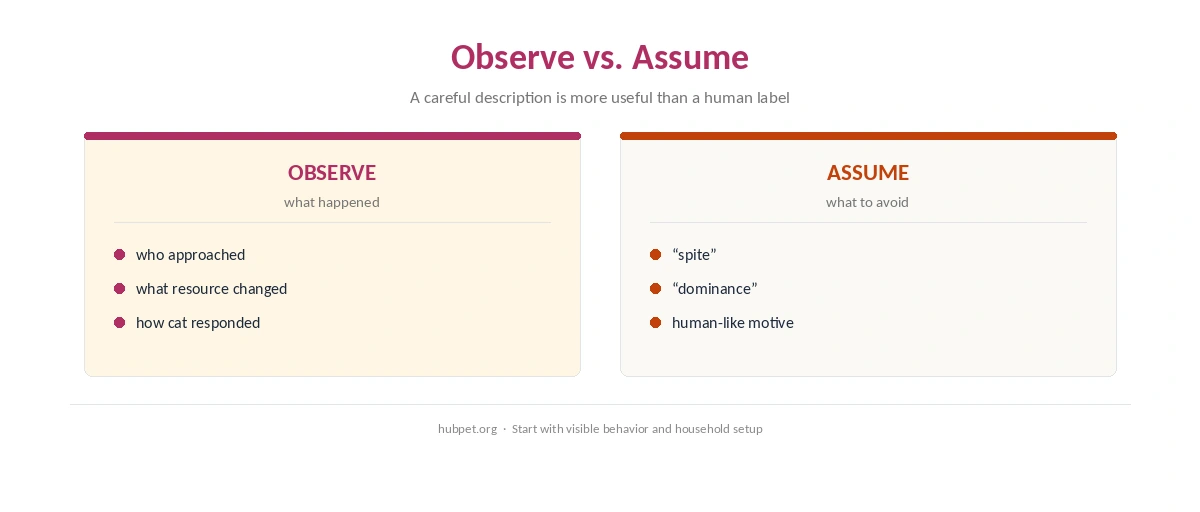
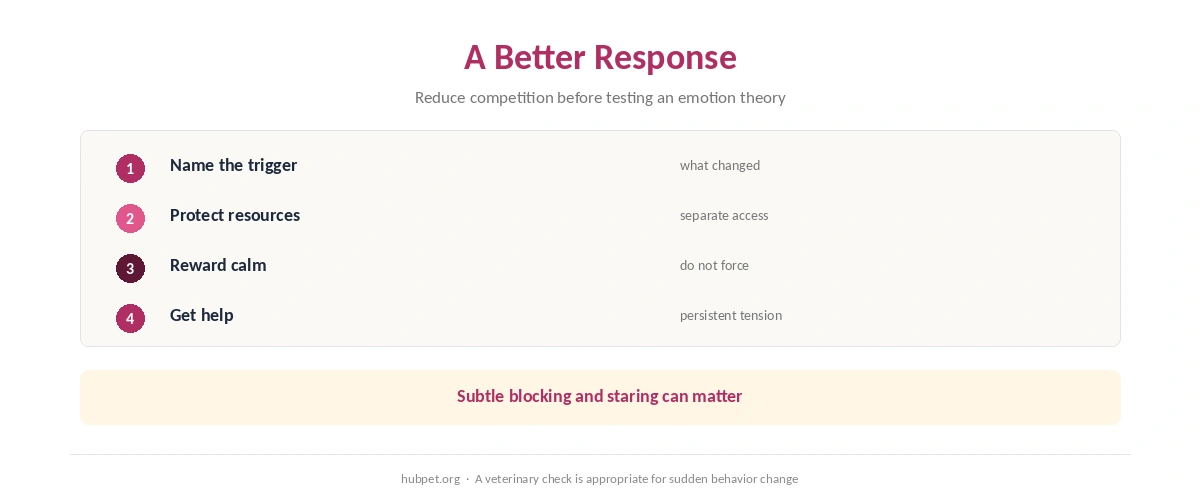
First, identify the exact sequence. Note who approaches, where the interaction happens, whether the other animal moves away, and which resource draws them together. The observation style in the cat stress guide and the sudden-hiding guide helps distinguish a brief interruption from a pattern. Then check whether that pattern changes another cat’s daily behavior.
- Give each pet easy access to food, water, rest, toilet areas, and safe retreat options appropriate to the species.
- Avoid forcing pets to share a lap, bed, feeding spot, doorway, or play session.
- Reward calm approaches and calm disengagement instead of scolding a cat for moving closer.
- Interrupt building tension by increasing distance or redirecting to an appropriate activity before conflict escalates.
- Keep attention predictable enough that pets do not have to crowd each other to obtain every interaction.
Punishment does not tell you why the behavior happened and can add fear. Do cats get jealous of other pets less often when they have more enrichment? Current evidence does not establish that claim. Still, the indoor-cat stimulation guide, the toy-rotation guide, and the boredom guide offer separate activities without making pets compete for one spot.
When Conflict Needs Professional Help
Arrange veterinary assessment when aggression appears suddenly or a cat may be painful or ill. Also call when behavior changes occur alongside appetite, elimination, mobility, or other health changes. Merck’s behavior guidance updated in 2024 emphasizes ruling out medical causes when feline behavior changes. Start with the signs-of-pain guide if you need a reminder of why new aggression is not automatically “jealousy.”
Seek help from a qualified behavior professional when fights repeat, injuries occur, or one animal loses access to essentials. Seek help as well when household management cannot keep everyone safe. The goal is not to decide which cat is “the jealous one.” Instead, restore safe access and reduce the situations that repeatedly trigger conflict.
How We Research
HubPet reviewed feline social-competition research on October 11, 2026. We used the Bucher et al. 2020 cat-rival experiment, the 2024 AAFP/FelineVMA intercat tension guidelines, and the 2020 survey of conflict and affiliative behavior in multi-cat homes. Our research process explains why we use “jealousy-like” when the evidence does not establish the subjective emotion.
Cats can show behaviors that look jealousy-like, but current research does not prove they experience jealousy exactly as humans do.
It can include approaching, blocking, staring, chasing, or interrupting interactions, but those behaviors also have other possible explanations.
Equal minutes are not a proven requirement. Focus instead on safe access, individual preference, and interactions that do not force competition.
No. Increase space, manage resources, and reinforce calm behavior rather than adding fear or conflict.
Call when aggression is sudden, severe, associated with possible pain or illness, or when a cat’s eating, elimination, mobility, or normal behavior changes.
The Bottom Line: Do Cats Get Jealous of Other Pets?
Do cats get jealous of other pets? A 2020 study found a response pattern consistent with part of a jealousy hypothesis, but the authors did not find enough evidence for a firm conclusion. At home, “jealousy-like” is a useful shorthand only if it leads you back to observable triggers, resource access, safety, and the relationship between the actual animals.