
This article is general information, not veterinary advice. If your pet seems unwell, is in pain or may have eaten something harmful, contact your vet or an animal poison control line right away. Read our vet disclaimer.
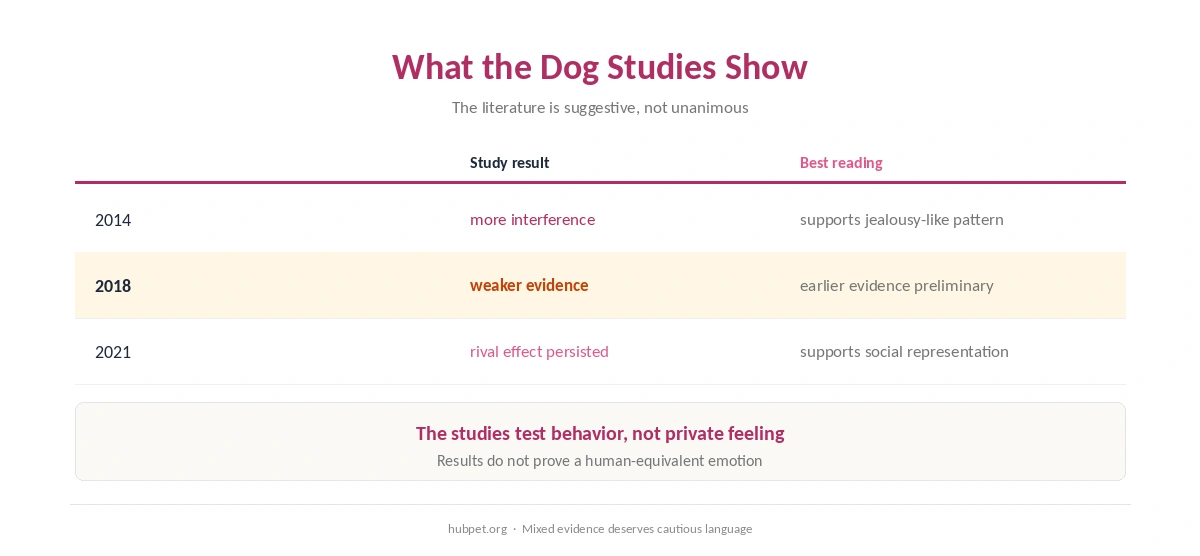
Do dogs really get jealous? Experiments show jealousy-like behavior in some social situations, but the evidence does not prove that dogs experience jealousy exactly as humans do. A 2014 study of 36 dogs found more attention-seeking and interference when owners showed affection to a realistic fake dog than to nonsocial objects. Later studies produced a more mixed picture.
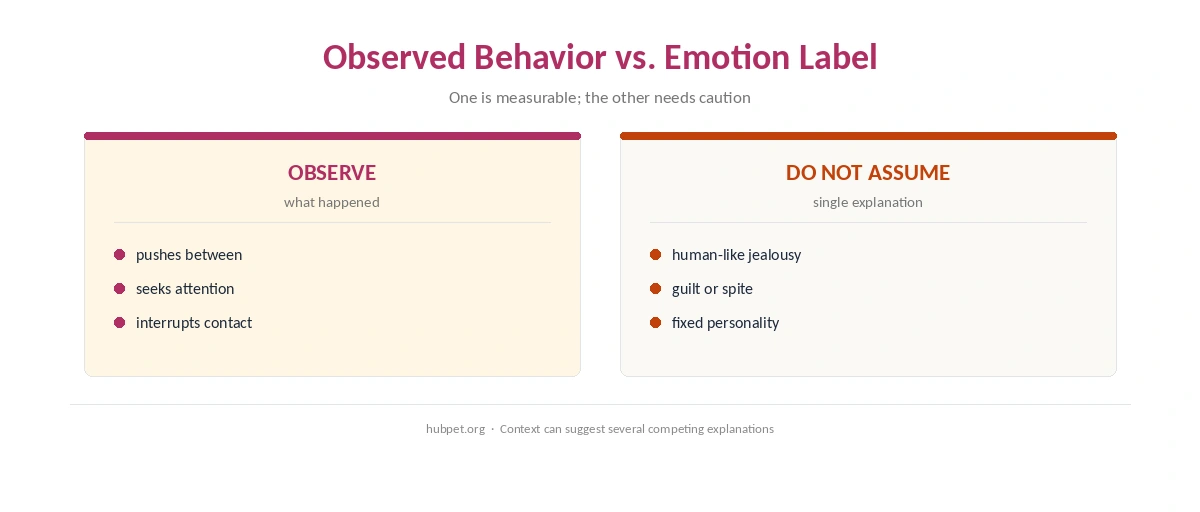
The careful answer is therefore “possibly, in a basic social form.” Researchers can measure what dogs do, such as pushing between an owner and a rival, pulling toward the interaction, or monitoring the owner. They cannot directly verify the dog’s private emotional experience. That distinction matters when owners interpret everyday behavior.
Do Dogs Really Get Jealous? What the Experiments Found
Harris and Prouvost’s 2014 PLOS ONE experiment used 36 dogs. The dogs were more likely to push or touch the owner and the fake dog when the owner treated the fake dog affectionately. They also tried to get between the owner and the apparent rival more often in that condition. The authors described the results as support for a “primordial” form of jealousy, not proof of human-like jealousy.
However, a 2018 PLOS ONE study tested dogs with owners and unfamiliar people attending to fake rivals. The study did not find convincing evidence that jealousy caused the dogs’ responses. One limitation was that the dogs may not have treated the fake dogs as genuine social rivals. The authors explicitly said the earlier experimental evidence remained preliminary.
Then, a 2021 Psychological Science study tested 18 dogs and reported three signatures that the authors interpreted as jealousy-related. Dogs pulled more strongly when their owner interacted with a perceived social rival, even when that interaction moved out of sight. That study supports the idea that dogs can represent a rival social interaction, but it still does not tell us that their subjective experience matches human jealousy.
| Study | What it found | What it cannot prove |
|---|---|---|
| Harris & Prouvost, 2014 | More interference and attention-seeking toward an apparent dog rival | That dogs feel jealousy exactly like humans |
| Prato-Previde et al., 2018 | No convincing jealousy pattern with fake rivals across two experiments | That dogs never experience jealousy |
| Bastos et al., 2021 | Behavior consistent with representing a jealousy-inducing social interaction | The private quality of the emotion itself |
Do Dogs Really Get Jealous in Everyday Life?
When owners ask do dogs really get jealous, everyday behavior alone cannot prove the emotion. A dog may push between people, seek attention, bark, hover, or try to interrupt contact with another pet. Similar behaviors can also reflect excitement, learned attention-seeking, uncertainty, resource competition, or frustration. The dog guilt myth guide uses the same evidence-first rule: behavior is easier to observe than an internal label.
Context helps. When the dog follows you from room to room, the why dogs follow people page explains several ordinary reasons for proximity-seeking. During jumping at greetings, use the jumping guide rather than treating the behavior as proof of jealousy. When two pets compete around a person, the helping pets get along guide focuses on management and separate access to valued resources.
For dog-cat households, the dog-cat introduction guide is a better safety tool than testing whether a dog is “jealous.” Keep interactions structured and prevent chasing or crowding. If the dog becomes overexcited around another pet, use a familiar settle-on-a-mat behavior to create distance without punishment.
What to Do About Jealousy-Like Behavior
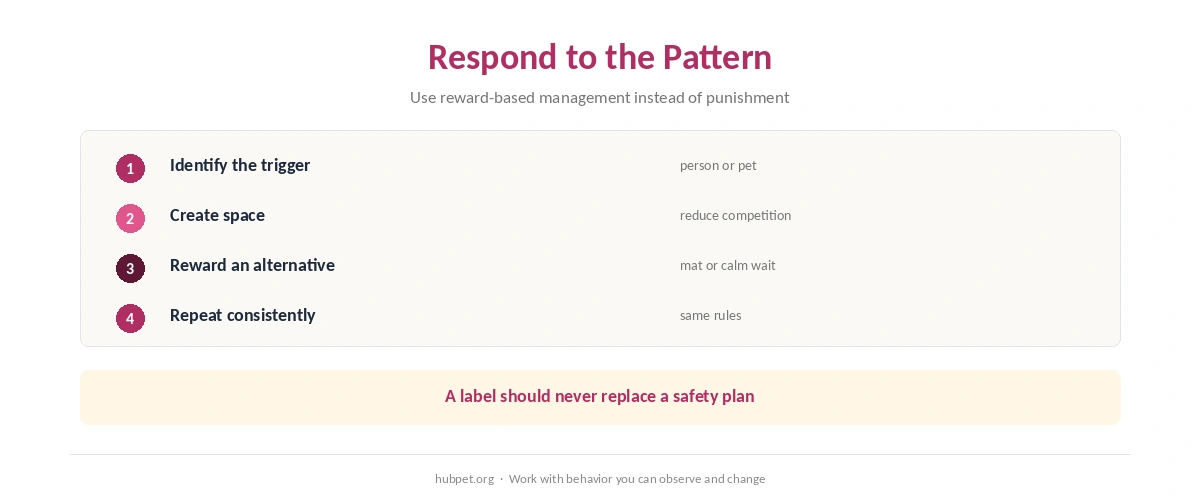
So, do dogs really get jealous in a way that changes how you should respond? The safest plan is to work with the observable behavior rather than punish an emotion label. AVSAB’s 2021 humane-training position recommends reward-based methods for behavior change and says aversive methods are not necessary. Use positive reinforcement to reinforce the behavior you want instead, such as resting on a mat, staying on the floor, or waiting calmly while another pet receives attention.
- Identify the exact situation that starts the behavior instead of labeling the dog’s personality.
- Prevent crowding around food, toys, resting places, or close social contact when tension is rising.
- Reward a calm alternative behavior before the dog escalates into pushing, barking, or jumping.
- Give pets separate opportunities for attention so one animal does not have to compete for access.
- Keep sessions short and stop if either animal becomes tense or repeatedly tries to leave.
- Get qualified help if the pattern includes aggression, guarding, or escalating conflict.
For common attention-seeking patterns, the begging guide shows how to stop reinforcing a behavior accidentally. The training-mistakes guide also explains why inconsistent rewards can make unwanted behavior harder to predict.
If behavior around another dog becomes tense outdoors, use the distance and management ideas in the reactive-dog guide. A jealousy label should never replace a safety plan.
How We Research
HubPet reviewed the primary dog-jealousy literature on October 11, 2026. We read Harris and Prouvost’s 2014 PLOS ONE study, the 2018 PLOS ONE replication-style work by Prato-Previde and colleagues, and Bastos and colleagues’ 2021 Psychological Science experiment. Our research process explains how we handle mixed evidence.
Some experiments support jealousy-like responses to a social rival, while other experiments have not found convincing evidence. The research remains mixed.
Dogs may interrupt or seek attention during social interactions, but a specific behavior does not prove a specific emotion. Context matters.
No. It is compatible with jealousy-like behavior, but it can also reflect attention-seeking, excitement, or competition for access.
No. AVSAB’s 2021 position supports reward-based methods and advises against aversive training.
Get qualified behavior help when the pattern includes aggression, guarding, repeated conflict, or situations you cannot manage safely.
The Best Label Is the One You Can Test
Do dogs really get jealous? The strongest answer is that dogs can show behavior consistent with jealousy-like social competition, but experiments do not settle the question of human-like subjective emotion. Watch the trigger, the behavior, and what changes it. That approach leads to a useful plan without pretending the science is more certain than it is. A related myths-and-facts page is can Pets Sense When You're Upset?.