
This article is general information, not veterinary advice. If your pet seems unwell, is in pain or may have eaten something harmful, contact your vet or an animal poison control line right away. Read our vet disclaimer.
How to introduce two cats is to start with a separate transition room and scent exchange. Add visual access only when both cats stay calm, and move backward if tension rises.
The AAFP step-by-step guide says introductions can take days to months or longer (AAFP, 2024). Each cat should feel comfortable with the current step before the process advances.
How to Introduce Two Cats: Prepare Separate Resources First
Before the cats meet, AAFP recommends recent veterinary checkups (AAFP, 2024). Set up a transition room for the newcomer before direct contact begins.
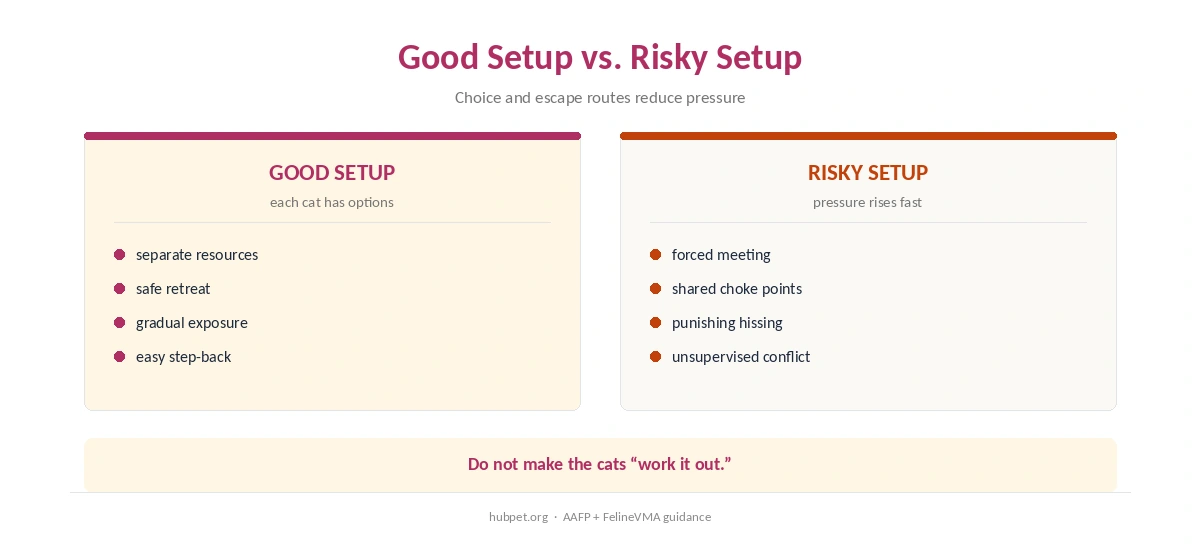
Give that room separate food, water, litter, hiding places, scratching surfaces, toys, and vertical space (AAFP, 2024). FelineVMA also recommends separated resources because competition can increase fear and stress (FelineVMA, 2026).
Build that setup before any face-to-face meeting. Use a calm space, pet-proof the home, and check toxic houseplants while the transition room is still easy to change. This removes avoidable hazards before the cats face social pressure.
| Stage | What the cats experience | Move forward when |
|---|---|---|
| Separate rooms | No direct contact | New cat explores and settles |
| Scent exchange | Bedding or soft items are swapped | Scent no longer triggers tension |
| Barrier / visual access | Cats see each other safely | Both remain calm |
| Supervised contact | Short direct sessions | Interactions stay relaxed |

How to Introduce Two Cats Step by Step
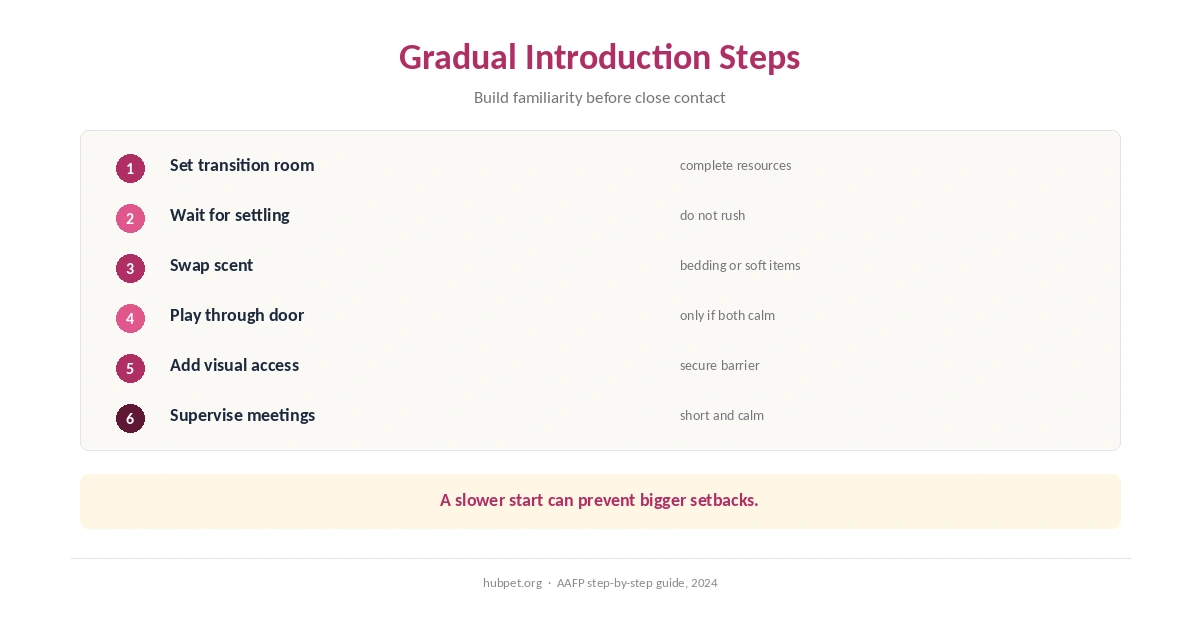
- Start the new cat in a quiet transition room with a complete set of resources (AAFP, 2024).
- Wait until the newcomer is exploring and using the room comfortably before advancing.
- Swap bedding or other soft items so each cat can investigate the other’s scent without direct contact (AAFP, 2024).
- Use play or another positive activity on opposite sides of a closed door if both cats remain comfortable.
- Add controlled visual access through a secure barrier only after scent steps are going well (AAFP, 2024).
- Begin short supervised contact when both cats can remain calm at the barrier.
- If hissing, growling, blocking, chasing, or avoidance increases, return to the previous comfortable stage (AAFP, 2024; VCA, accessed 2026).
How to introduce two cats is easier when you watch stress in both animals instead of measuring success by whether they share a room. Use cat stress signs and indoor cat environmental needs as separate reference points. Keep litter boxes, resting places, food, water, and scratching areas dispersed so one cat cannot easily block another.
Do not confuse social tension with normal play. Cat zoomies can be normal, while repeated stalking or blocking around resources is a different pattern. If toileting changes during the introduction, use the litter-box problem guide because medical and social causes can overlap.
How to introduce two cats works best when comfort, not the calendar, decides the pace. A setback means the next session should become easier.
When to Pause and Get Professional Help
Pause the introduction if either cat stops eating normally, hides persistently, eliminates outside the litter box, or shows escalating aggression or distress. AAFP lists these as signs that the current step may be too difficult (AAFP, 2024).
Contact your veterinarian for persistent problems or injury. For severe bleeding, collapse, breathing trouble, or another emergency sign, use pet emergency signs and seek urgent care (AVMA, 2025).
Daily routines still matter during the process. The daily cat care checklist, low-stress brushing guide, and cat nail-trimming guide can help keep routine care predictable while the cats are adjusting.
How We Research
HubPet uses veterinary and feline-welfare sources rather than personal anecdotes. Sources read on October 11, 2026: AAFP 2024 and VCA. We also checked FelineVMA 2026 and AVMA 2025. See How We Research for our method.
How to Introduce Two Cats FAQ
There is no fixed deadline. AAFP says the process can take days to months or longer, and each step should wait until both cats are comfortable (AAFP, 2024).
No. AAFP and VCA recommend a gradual process using separation, scent, barriers, and supervised contact rather than a forced meeting (2024–2026).
Do not punish. If tension rises, stop the interaction and return to the last stage that both cats handled comfortably (AAFP, 2024).
Yes. Feline guidance recommends multiple separated resources so one cat cannot block another’s access (FelineVMA, 2026).
Call for persistent stress, appetite change, house soiling, injury, or escalating conflict. AAFP also recommends a recent health check before introductions begin (2024).
The Bottom Line
How to introduce two cats is a process of controlled choice. Separate first, exchange scent, add visual contact, and then supervise direct meetings. Let comfort decide the pace. If tension rises, step backward rather than forcing progress (AAFP, 2024; VCA, accessed 2026).