
This article is general information, not veterinary advice. If your pet seems unwell, is in pain or may have eaten something harmful, contact your vet or an animal poison control line right away. Read our vet disclaimer.
How to help pets get along starts with preventing forced contact and giving each animal enough space and resources. PDSA advises slow, supervised dog–cat introductions, while FelineVMA’s 2024 intercat guidance emphasizes gradual introductions and resource separation for cats. For a related behavior guide, see why Pets Act Differently with Children.
How to Help Pets Get Along by Managing Space First
First, separate new or tense pets before asking them to share a room. For dogs and cats, PDSA recommends a safe room, scent exposure, then visual contact through a barrier before closer supervised meetings (accessed 2026). For cats, the 2024 FelineVMA guidelines use a similarly gradual process and warn that new-cat introductions commonly trigger intercat tension.
Use separate calm spaces so each pet can retreat. Also follow pet-proofing basics to make barriers, gates, and escape routes safer. If the pair is specifically a dog and cat, the detailed dog-to-cat introduction guide gives the step-by-step sequence.
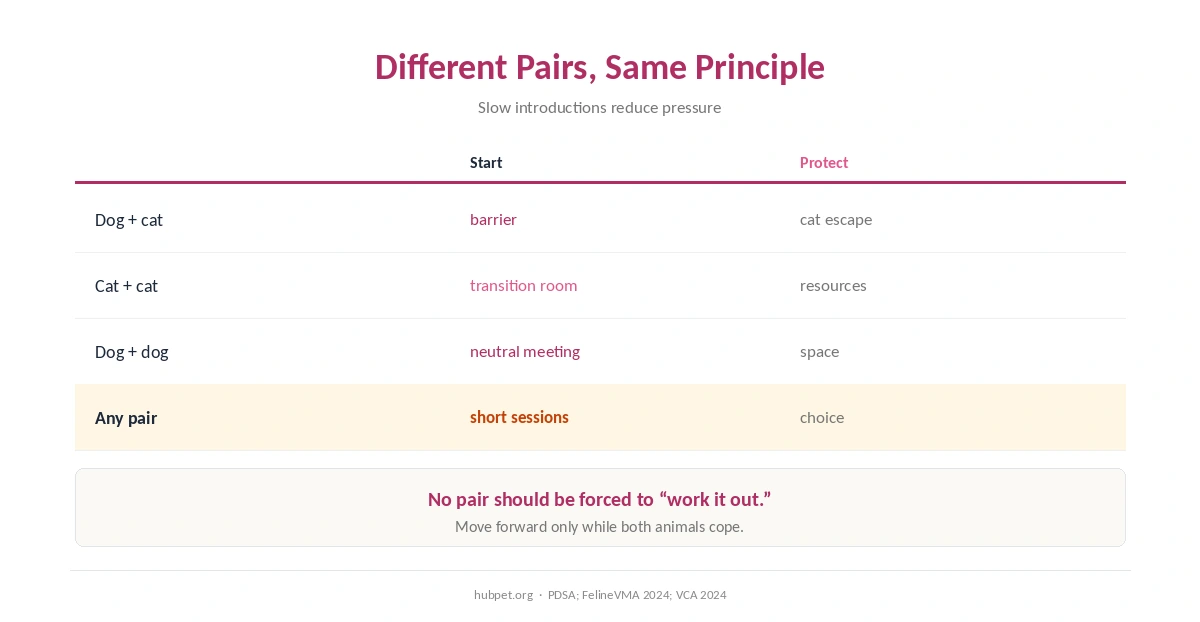
| Household pair | Start with | Important resource rule |
|---|---|---|
| Dog + cat | separate rooms, scent, barrier | cat needs escape and height |
| Cat + cat | transition room, scent, gradual visual access | duplicate key resources |
| Dog + dog | neutral introduction and supervised home entry | reduce competition around valued items |
How to Help Pets Get Along During Shared Time
Next, make shared sessions short enough that everyone can stay calm. PDSA says never force dogs and cats to spend time together, while VCA recommends loose, comfortable dog introductions and close supervision around resources (VCA, 2024).
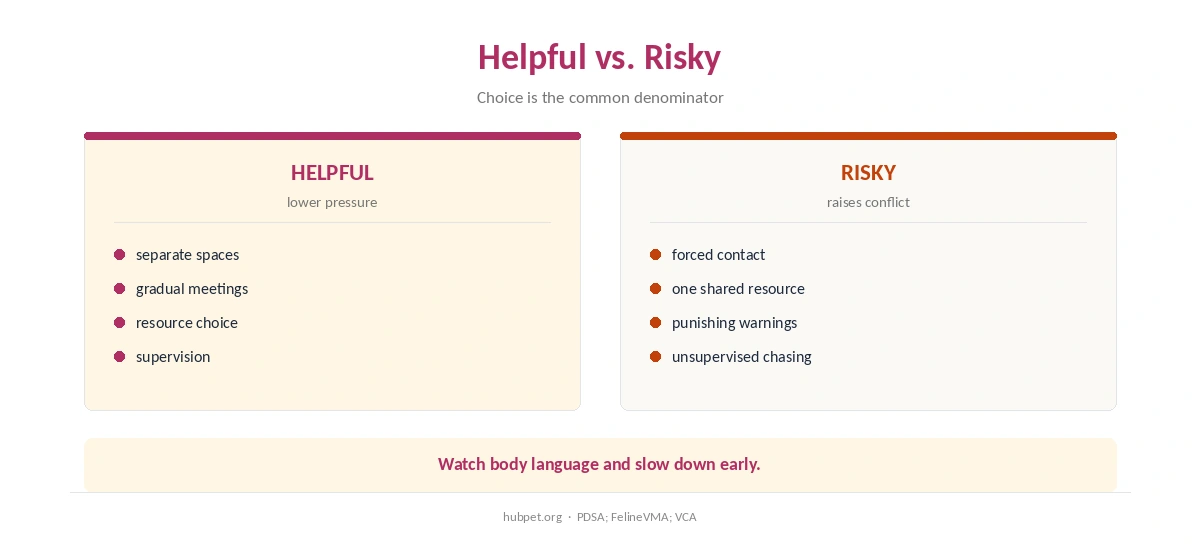
- End the session while both pets are still coping rather than waiting for conflict.
- Give cats vertical escape options and separate resting places.
- Feed pets separately when food creates competition or excitement.
- For two cats, use the gradual two-cat introduction plan and distribute litter, food, water, resting, and play resources.
- For two dogs, reward relaxed behavior and avoid scolding warning signals such as growling; VCA advises redirecting and giving space instead (2024).
- Keep training reward-based with positive reinforcement and basic dog skills.

However, not every pair needs to become close friends. A practical goal is safe coexistence with choice. If a dog reacts strongly to another animal outdoors, use the reactive-dog walking plan instead of treating a household introduction as the same problem.
Watch the individual animal rather than a label. The breed-and-aggression evidence guide explains why breed alone cannot predict one dog’s behavior. For cats, signs of stress can reveal tension before overt fighting starts.
How to help pets get along also means accepting neutral coexistence as success. Two animals can share a home safely without sleeping together, playing together, or seeking close contact.
In practice, how to help pets get along is mostly about controlling pressure before conflict starts. More space, more resource choice, and shorter sessions are safer than trying to speed up friendship.
When to Call Your Vet or a Behavior Professional
Contact your veterinarian if aggression or avoidance appears suddenly, if an animal seems painful or unwell, or if conflict causes an injury. For severe bleeding, breathing trouble, collapse, seizures, or another immediate crisis, use pet emergency signs and seek urgent care.
For persistent chasing, fighting, guarding, or intense fear, involve a qualified behavior professional. If separation from people is also a major trigger, the separation-anxiety guide covers that different pattern. Meanwhile, daily dog care can help keep routine and enrichment stable while introductions progress.
How We Research
HubPet uses veterinary, welfare, and behavior sources rather than personal anecdotes. We read these sources on October 11, 2026: PDSA dog–cat introduction guidance, PDSA dog–dog introduction guidance, FelineVMA 2024 Intercat Tension Guidelines, VCA second-dog guidance, updated 2024, AVSAB Humane Dog Training position. See How We Research for our method.
How to Help Pets Get Along FAQ
No. PDSA and FelineVMA recommend gradual introductions with separation and controlled exposure.
No. Safe, low-stress coexistence with separate resources is a reasonable goal.
Do not punish warning signals. Increase distance, reduce pressure, and use reward-based plans instead.
There is no fixed timetable. Move forward only while the animals remain comfortable, and return to an easier stage when tension rises.
Seek help for repeated fighting, chasing, injuries, intense fear, or situations you cannot manage safely. Start with a veterinarian when health or pain may contribute.
The Bottom Line
How to help pets get along is less about making them interact and more about controlling pressure. Separate first, add contact gradually, duplicate important resources, supervise shared time, and get professional help when fear or aggression stays high.