
This article is general information, not veterinary advice. If your pet seems unwell, is in pain or may have eaten something harmful, contact your vet or an animal poison control line right away. Read our vet disclaimer.
Are cats naturally independent and distant? Not as a universal rule. Domestic cats can live solitarily or socially, and individual sociability varies with development, experience, environment, and the specific relationship. A 2022 review of domestic-cat sociality describes that flexibility rather than a single “independent” personality shared by all cats.
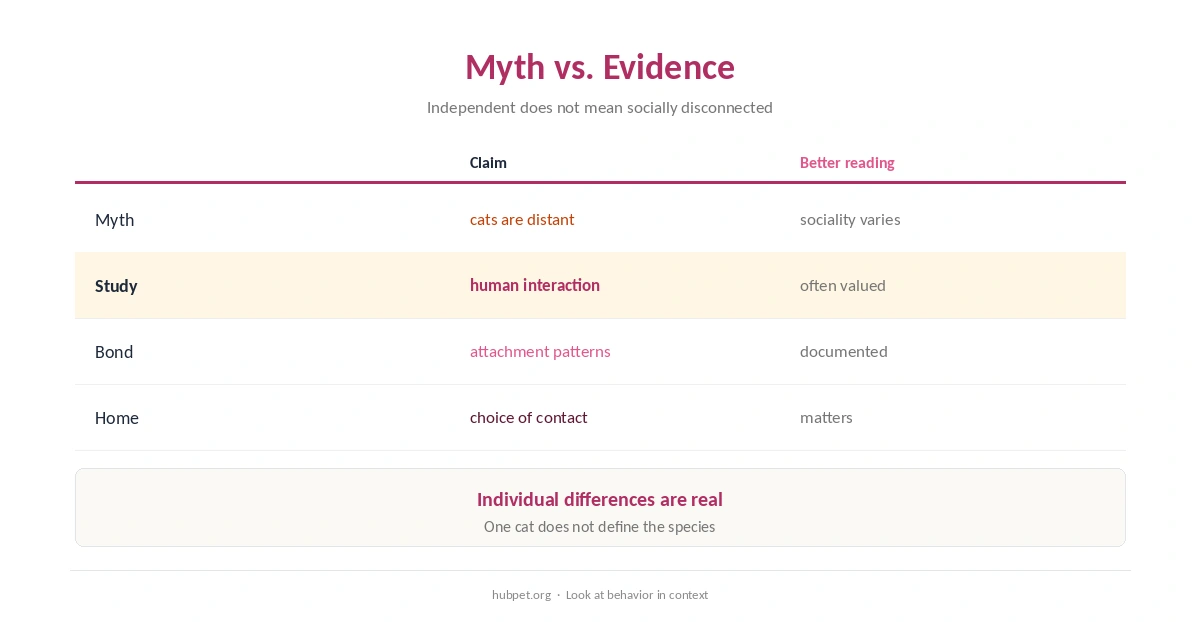
The myth persists because cats often control the timing and style of interaction. That is different from being unable to form close bonds. Research has documented human-directed social preferences and attachment-like patterns, while practical feline-welfare guidance treats positive, predictable human interaction as a core environmental need.
Are Cats Naturally Independent and Distant? What Studies Actually Show
A 2017 preference study offered adult pet and shelter cats choices among social interaction, food, toys, and scent stimuli. Human social interaction was the most-preferred category for the majority of cats that completed the preference assessment, but the authors also emphasized clear individual variation. That result fits what owners see in cats and loneliness and slow-blink communication. So, are cats naturally independent and distant in every home? The evidence does not support that blanket claim.
A 2019 Current Biology study reported distinct attachment patterns between cats and human caregivers using a secure-base test. The work does not mean every cat wants constant physical contact. Instead, it challenges the idea that cats cannot form meaningful attachment relationships. The same distinction matters when reading jealousy-like behavior in cats or what purring does and does not mean.
| Myth | What evidence supports instead | Practical takeaway |
|---|---|---|
| Cats are naturally distant | Sociability varies widely | Learn the individual cat’s preferred interaction style |
| Cats do not need people | Human interaction can be highly valued | Offer predictable, voluntary social time |
| A social cat wants constant touch | Preference depends on context | Let the cat start and end contact |
| A shy cat is unaffectionate | Fear can suppress approach behavior | Build safety before asking for closeness |
Are Cats Naturally Independent and Distant in Everyday Homes?
The FelineVMA 2025 indoor-cat statement includes positive, consistent, predictable human-cat social interaction among the five pillars of a healthy feline environment. That does not require hugging or constant handling. It means making safe interaction available and responding to the cat’s choices. In daily life, asking whether cats are naturally independent and distant works better when you look at the individual cat instead of the stereotype.
Watch what the cat approaches voluntarily. A cat may choose to sit nearby, follow a person from room to room, rub, blink slowly, play, or rest on a shared surface. Pages such as why cats sit on laptops and why cats sit in boxes show how context changes interpretation. The prey-gift guide is another example of behavior that does not map neatly onto a human personality label.
Shy or newly adopted cats may need more control over distance. Use support for shy cats, the new-home adjustment guide, and stress-reduction basics before deciding that a cat “does not like people.” Early fear, unfamiliar surroundings, and social history can all change what you see.
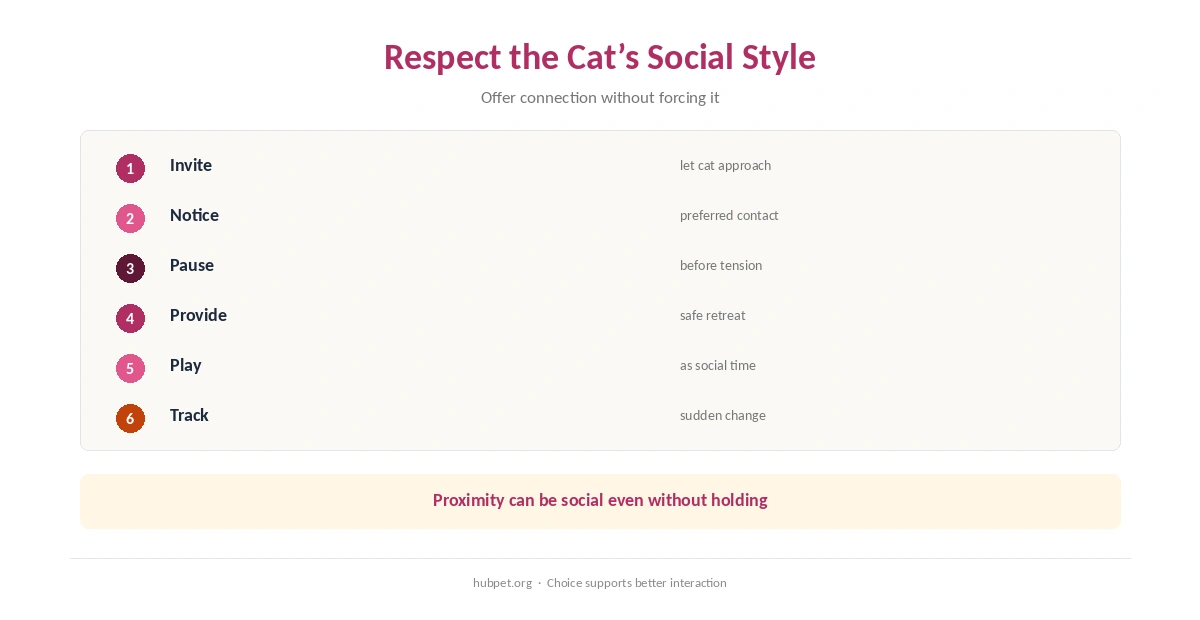
- Offer social contact at predictable times instead of repeatedly pursuing the cat.
- Let the cat approach and leave rather than blocking an exit.
- Use play, proximity, grooming, and brief touch as different forms of interaction.
- Notice which people, rooms, and times of day produce relaxed behavior.
- Give every cat a safe retreat where social contact is optional.
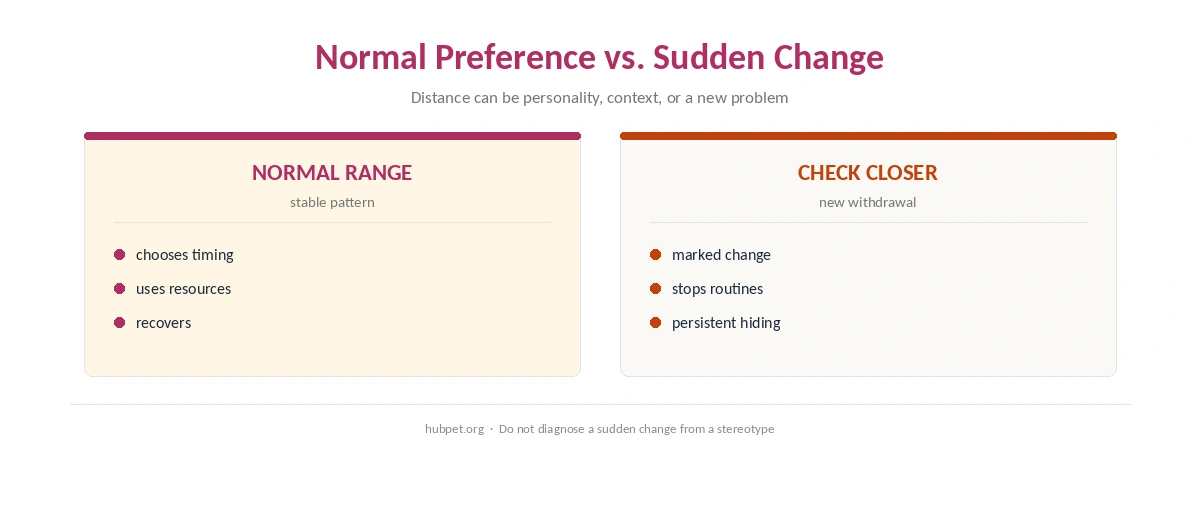
- Treat a sudden change in sociability as information rather than a personality verdict.
Social Cats, Solitary Cats, and Multi-Cat Homes
Cats are also selective about other cats. Social flexibility does not mean every pair should become friends. Use gradual cat introductions, the new-pet introduction checklist, and multi-pet resource planning to reduce forced proximity.
When indoor cats have safe places, separated resources, hunting-style play, and predictable human contact, they have more ways to choose interaction. That is why indoor cat stimulation and indoor-cat boredom prevention are part of the social picture, not separate from it. For a closer look at the related behavior pattern, see why Cats Choose Favorite People.
If a cat suddenly withdraws, becomes unusually irritable, or stops engaging in normal routines, contact your veterinarian. A change in social behavior can have many causes, and an online article cannot determine whether the cause is medical, environmental, or behavioral.
How We Research
HubPet reviewed these sources on October 11, 2026: the 2022 review of cat sociality, the 2017 cat preference study, the 2019 attachment study, and the FelineVMA 2025 position statement. Read more about our research process.
Cats can show more control over social contact, but research does not support treating all cats as uniformly distant or unable to form attachment relationships.
Yes. Proximity, play, rubbing, following, and short voluntary contact can all be social behavior.
A 2017 study found human social interaction was the most-preferred category for the majority of cats tested, but individual preferences varied.
Cats can have strong context-dependent preferences. Letting the cat choose timing can make interaction more predictable and comfortable.
Not automatically. Cats vary in their social preferences. Adding another cat can create stress when introductions move too fast or resources create competition.
The Bottom Line: Are Cats Naturally Independent and Distant?
Are cats naturally independent and distant? Some cats are less socially demonstrative than others, but the species is socially flexible. Judge the individual cat by voluntary behavior, context, and change over time instead of the stereotype.