
Why cats choose favorite people has no single proven answer. Research shows that many cats value human social interaction, can form attachment bonds with caregivers, and respond to human attention. However, studies also show large individual differences, so a cat’s preferred person is better understood as a pattern of familiarity, predictability, interaction style, and learned history than as a universal formula.
A 2017 preference study found that human social interaction was the most-preferred category for the majority of cats that completed the assessment, although preferences varied widely. A 2019 Current Biology study reported distinct attachment patterns toward human caregivers. Neither study identifies a single trait that makes someone every cat’s favorite.
Why Cats Choose Favorite People: Short Answer
Why cats choose favorite people is likely about repeated positive interactions and individual preference. A person who is predictable, respects the cat’s space, and provides valued interaction may become especially important. The article on cat social flexibility explains why this fits better than the stereotype that cats are simply distant.
Familiarity alone is not the whole story. A 2019 study of cat sociability found that human attention influenced proximity and contact, while familiarity did not significantly change sociability in the pet-cat group. Therefore, a cat can form a strong caregiver bond without acting warmly toward every familiar person.
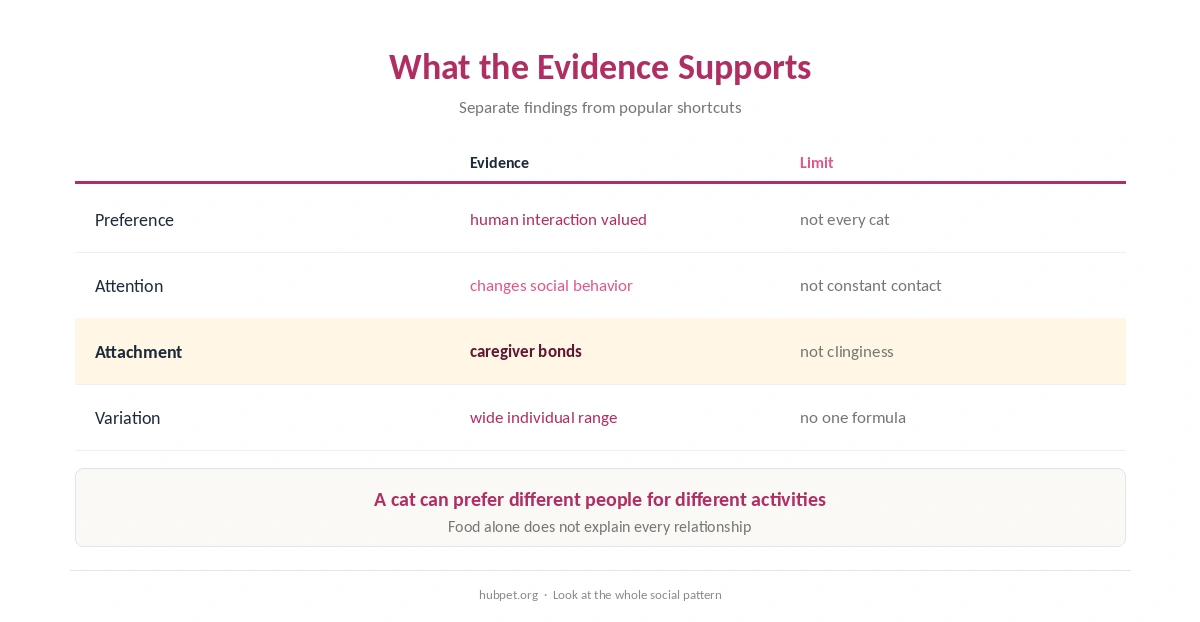
| Possible factor | What evidence supports | What not to assume |
|---|---|---|
| Positive history | Cats can value human social interaction | Every cat wants the same type of contact |
| Attention | Attentive humans can change social behavior | Constant attention is always preferred |
| Attachment | Studies document caregiver attachment patterns | Attachment equals clinginess |
| Individual style | Studies show wide variation | One rule predicts every favorite person |
Why Cats Choose Favorite People: What Studies Can and Cannot Tell Us
The 2017 preference experiment compared human interaction, food, toys, and scent. Human social interaction ranked first for many cats, but not all. That result supports the idea that people can be highly valuable social partners. It also matches research on pets using human emotional cues, which shows that animal responses to people can be sensitive to context.
The 2019 attachment study used a secure-base style test and found distinct attachment patterns. However, attachment does not mean a cat will seek constant handling. Cats may show affiliation through proximity, following, sleeping nearby, play, greeting, or choosing the same room. This is useful context for why cats sit on laptops, where proximity can have several motivations.
Another 2019 study found that attentive humans drew more proximity from cats. Still, the study also reported wide variation among individuals. Therefore, feeding, petting frequency, or time at home alone cannot explain why cats choose favorite people.
What a Cat May Prefer in a Person
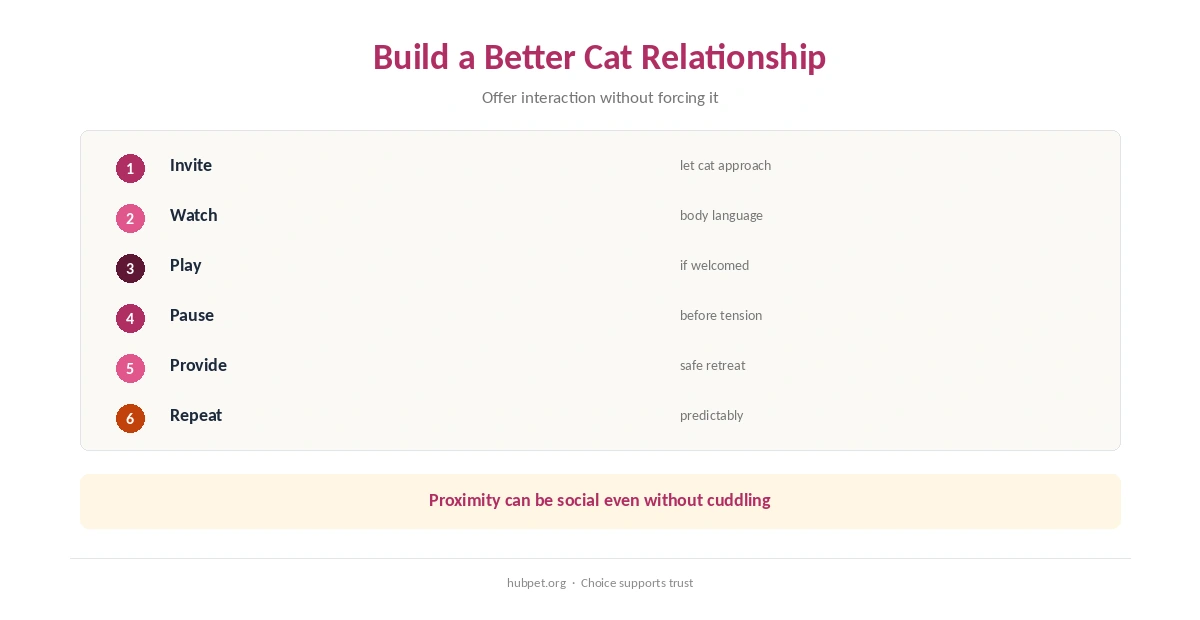
Many cats respond well when they can control the start and end of contact. Offer a hand, pause, and let the cat decide whether to approach. The same choice-based principle appears in support for shy cats and the petting-bite guide, where pushing past the cat’s signals can make interaction less comfortable.
Play can also build a social routine without requiring touch. Use short, appropriate play sessions and let the cat disengage. The guides to indoor cat stimulation and toy rotation can help vary activity while respecting individual preferences.
Environment matters too. A cat with safe high places and retreat options can choose when to be social. The pages on safe climbing spaces and high-place preferences explain how vertical territory can add control and observation.
Favorite Does Not Mean Exclusive
A cat can have different relationships with different people. A cat may prefer one person for play, another for quiet rest, and another around predictable feeding. That flexibility also helps explain why jealousy-like cat behavior does not prove a simple human-style ranking system. For a related behavior guide, see why Cats Meow at Their Owners.
Likewise, a cat that chooses one person more often is not automatically rejecting everyone else. Give relationships time and keep interactions low-pressure. In multi-pet homes, the multi-pet household checklist can help separate social needs from competition for shared resources.
When to Get Professional Help With Cat Social Behavior
Consider a qualified feline behavior professional if fear, conflict, or avoidance prevents normal household life and does not improve with more choice and safer interactions. Do not force contact to test whether the cat can “get over it.” A professional can help map triggers, resources, and interaction patterns without relying on personality labels.
If the main issue is a newly adopted or newly introduced cat, start with the new-pet introduction checklist and predictable routines before assuming the cat has permanently selected or rejected a person.
How We Research
HubPet reviewed these sources on October 11, 2026: the Vitale Shreve et al. 2017 cat-preference study, the Vitale et al. 2019 attachment study, the Vitale and Udell 2019 sociability study, and the FelineVMA 2025 indoor-cat needs statement. Read more about our research process.
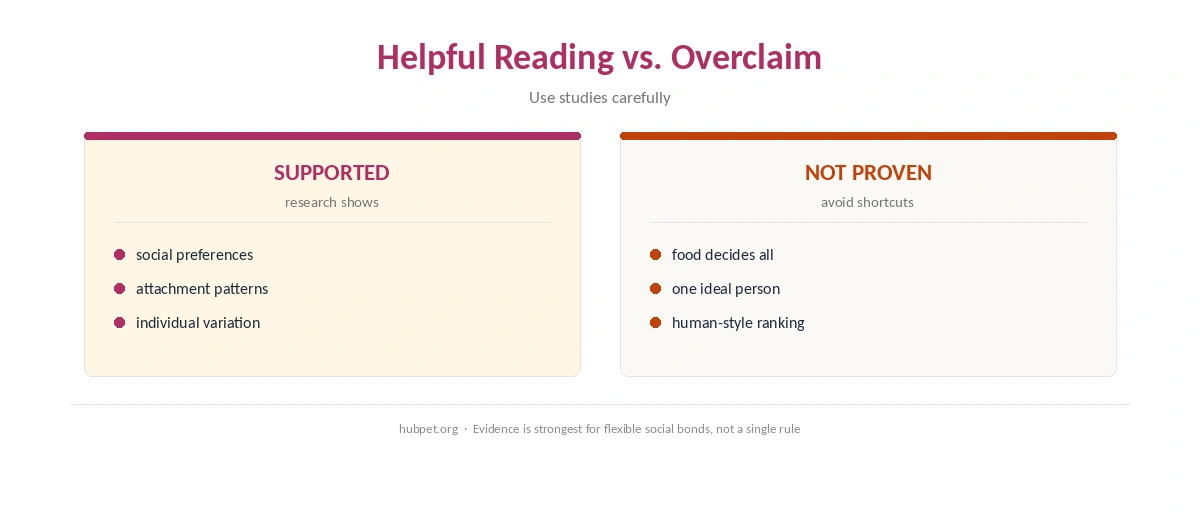
Many cats show clear social preferences, but research does not provide one universal test for a single favorite person.
Food can matter, but studies show human social interaction can rank highly in preference tests, and individual cats vary.
Yes. Attachment and affiliation can appear as proximity, following, greeting, play, or choosing to rest nearby.
Be predictable, preserve escape options, let the cat initiate contact, and pair your presence with calm, positive experiences.
Different people can fill different social roles. Preference is not necessarily a single ranking across every type of interaction.
The Bottom Line on Why Cats Choose Favorite People
Why cats choose favorite people is best explained by a mix of social preference, learning history, predictability, and individual style. Research supports strong cat-human bonds, but it does not support one simple recipe. Respecting choice and reading the individual cat gives a better answer than assuming food, dominance, or constant cuddling decides the relationship.