
This article is general information, not veterinary advice. If your pet seems unwell, is in pain or may have eaten something harmful, contact your vet or an animal poison control line right away. Read our vet disclaimer.
Why dogs tilt their heads does not have one proven explanation. A 2022 Animal Cognition study found more head tilting in dogs that had learned toy names when they heard a relevant object label, which suggests a link with processing meaningful information in that specific task (Sommese et al., 2022).
Why Dogs Tilt Their Heads When They Hear Something Meaningful
Researchers tested why dogs tilt their heads in one specific learning task. They observed 40 dogs during object-label tests (Sommese et al., 2022). Seven dogs that had learned toy names tilted more often when asked to fetch a named toy. Individual dogs also tended to favor the same tilt side across tests. The authors called the work exploratory, so it does not give one meaning to every everyday tilt.
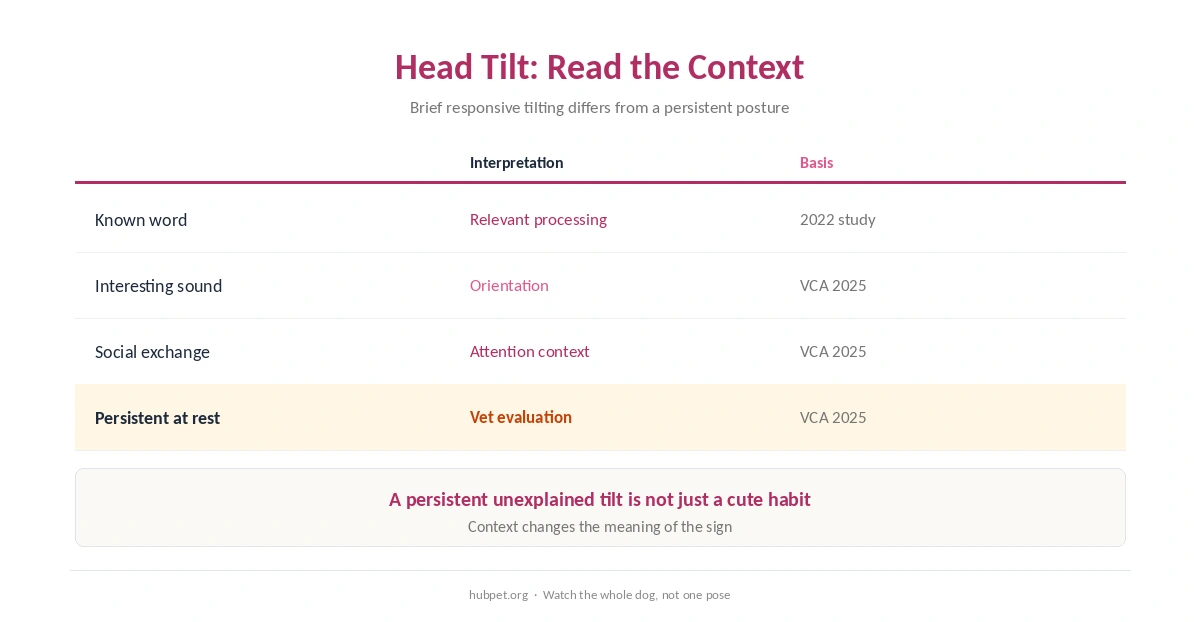
Why dogs tilt their heads may also involve ordinary hearing, visual, social, or learned contexts. VCA discusses those possibilities in its clinical explanation (updated 2025). They are not one proven universal cause. A brief responsive tilt can accompany attention or communication, and the reason can vary.
| Situation | What it may mean | Evidence level |
|---|---|---|
| Hearing a learned word | Processing relevant information | Exploratory study, 2022 |
| Interesting sound | Orienting to sound | VCA 2025 |
| Looking at a person | Attention / communication context | VCA 2025 |
| Persistent tilt all day | Possible medical problem | VCA 2025 |
Why Dogs Tilt Their Heads Is Not the Same as a Medical Head Tilt
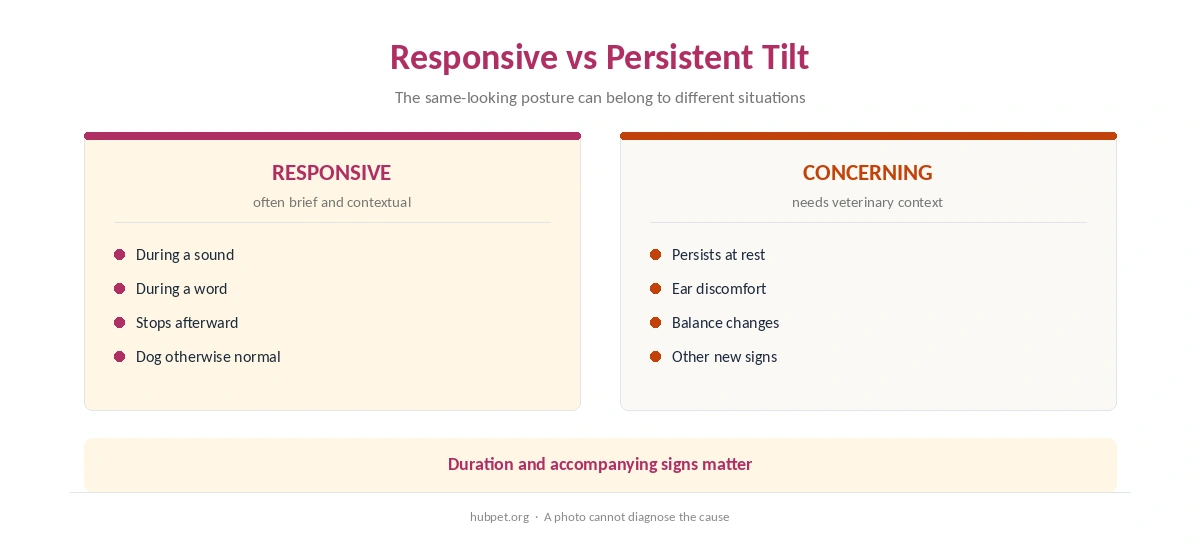
Why dogs tilt their heads during a conversation is different from why a dog may hold the head to one side at rest. VCA says a consistent head tilt can occur with ear disease or neurologic problems (updated 2025). Therefore, VCA advises a veterinary evaluation when the tilt continues outside communication.
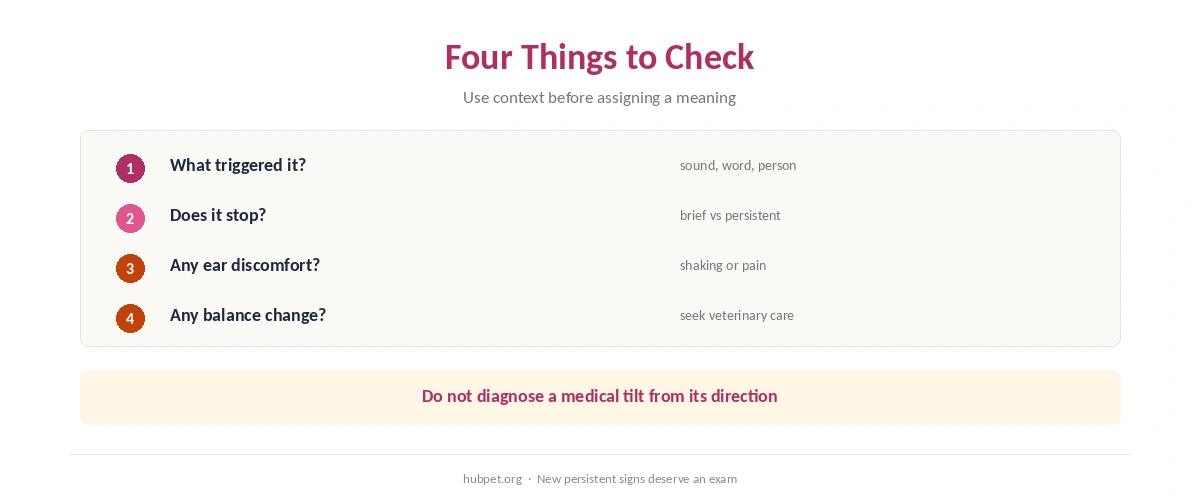
Therefore, context matters more than cuteness. Check whether the dog walks normally and responds to sound. Also note whether eating, balance, and usual behavior have changed. Do not diagnose the cause from the direction of the tilt.
- Notice whether the tilt appears only during a sound, word, or social interaction.
- Look for ear discomfort, head shaking, balance changes, or a tilt that persists at rest.
- Use safe ear-care guidance for routine care, but do not clean a painful ear as a substitute for an exam.
- Compare signs of pain if handling or movement seems uncomfortable.
For normal communication, read the whole dog rather than one pose. The tail-wagging guide explains why a single movement is not a complete emotion label, and the guilty-look article makes the same point about facial and body cues. A related myths-and-facts page is do Dogs Only See in Black and White?.
In addition, training can make certain cues more meaningful. Basic dog training and sit both build clear cue histories. The barking guide shows why context matters around sounds and triggers.
Daily observation helps separate a familiar social habit from a new change. Use the daily dog care checklist over time. For training context, positive reinforcement and recall practice show how learned cues gain meaning.
When a Head Tilt Needs a Veterinarian
VCA advises veterinary care for a consistent head tilt that occurs outside communication (updated 2025). Ear infection or neurologic disease may cause this sign. If the dog collapses, has a seizure, cannot stand normally, or has another urgent sign, use pet emergency signs and seek urgent veterinary care.
How We Research
HubPet uses veterinary and research sources rather than personal anecdotes. We read these sources on October 11, 2026: Sommese et al. head-tilting study, Animal Cognition, 2022, VCA head-tilt explanation, updated 2025. See How We Research for our method.
Why Dogs Tilt Their Heads FAQ
A 2022 exploratory study found frequent tilting in dogs that knew toy labels when they heard a relevant label. That supports an attention or information-processing link in that task, not a universal explanation.
Not necessarily. Ordinary responsive tilts can occur during attentive listening or social interaction. One tilt does not identify one emotion.
The 2022 study found stable individual side preferences across tests. Researchers have not settled why an individual dog may favor one side.
A persistent tilt that continues outside communication, especially with ear discomfort, balance problems, or other new signs, deserves veterinary evaluation.
Rewarding attention can make a social behavior more likely, but do not deliberately ignore a new persistent tilt that may be medical.