
This article is general information, not veterinary advice. If your pet seems unwell, is in pain or may have eaten something harmful, contact your vet or an animal poison control line right away. Read our vet disclaimer.
Do dogs only see in black and white? No. Controlled color-vision work found that dogs have dichromatic color vision, meaning they use two cone classes rather than the three typical in humans (Neitz, Geist, and Jacobs, 1989).
Do Dogs Only See in Black and White? What the Study Found
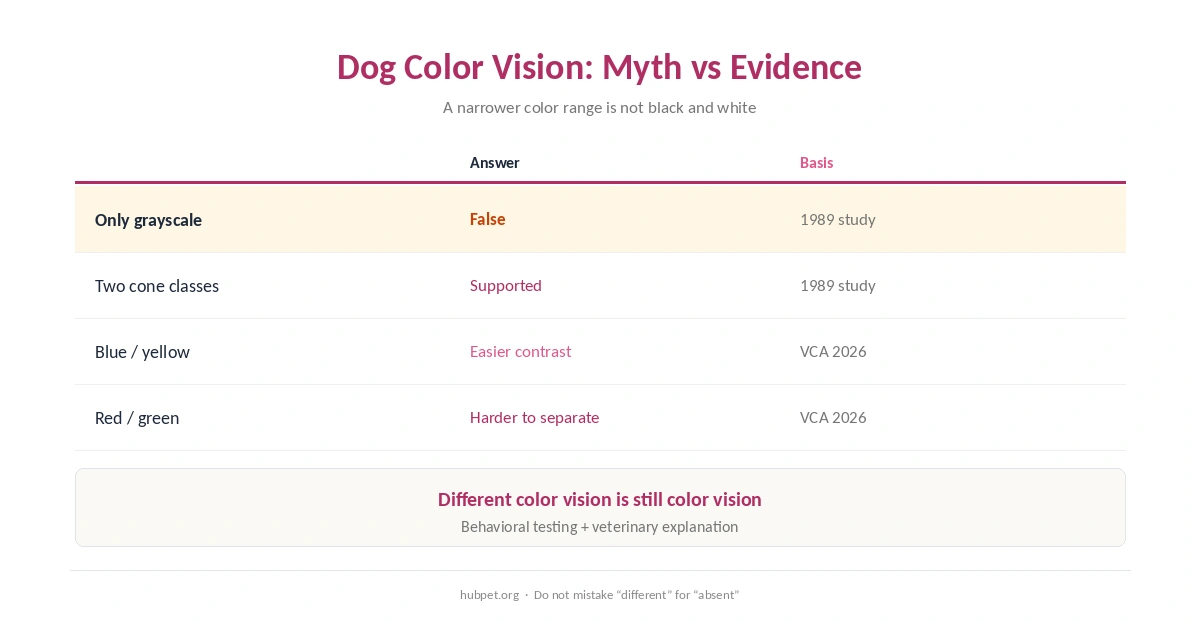
Do dogs only see in black and white according to the classic experiment? No. The 1989 study tested three dogs with behavioral color-discrimination tasks and found results consistent with two cone photopigment classes. That supports color vision, not a grayscale-only world. VCA says dogs can distinguish blue and yellow, while red, orange, and green are harder for them to separate as humans do (accessed 2026).
| Claim | Evidence-based answer | Source |
|---|---|---|
| Dogs see only gray | False | Neitz et al. 1989 |
| Dogs have two cone types | Supported | Neitz et al. 1989 |
| Blue and yellow are easier to distinguish | Supported | VCA, accessed 2026 |
| Dog vision is just “bad human vision” | Oversimplified | VCA, accessed 2026 |
Do Dogs Only See in Black and White in Everyday Life?
Do dogs only see in black and white in daily life? No. VCA notes that blue stands out well to dogs, while red can appear much darker. Yellow, orange, and green can also look more similar to dogs than they do to most humans (accessed 2026).
Do dogs only see in black and white under different lighting? No. Lighting, movement, visual acuity, eye health, and brightness can all change what stands out. The useful conclusion is narrower color vision, not no color vision.
- Use blue or yellow when you want color contrast to help a toy stand out.
- Do not rely on red-versus-green color coding as the only cue for a dog.
- Remember that smell, movement, location, and learned cues also guide a dog.
- Treat a new navigation or vision problem as a health concern, not a color-vision quirk.

Color vision is only one small part of how dogs communicate and learn. The tail-wagging myth and guilty-look evidence are similar reminders not to translate one human interpretation directly onto a dog.
For everyday learning, rely on clear cues and reinforcement rather than color alone. See basic dog training at home, positive reinforcement, teaching sit, and teaching stay for examples.
Likewise, normal sensory differences should not explain away a new health change. The dry-nose myth shows the same principle: one visible feature rarely tells the whole story. Keep daily care observations consistent. For a sudden serious change, use pet emergency signs.

How We Research
HubPet uses veterinary and research sources rather than personal anecdotes. We read these sources on October 11, 2026: Neitz, Geist, and Jacobs color-vision study, 1989, VCA dog color-vision explanation, accessed 2026. See How We Research for our method.
Do Dogs Only See in Black and White FAQ
No. The 1989 behavioral study found canine color vision consistent with two cone classes, or dichromatic vision.
VCA says dogs distinguish blue and yellow better than the red-green range that humans separate more easily (accessed 2026).
No. The dog can still see the object through brightness, shape, movement, smell, and other cues; its color does not look the same as it does to most humans.
Color can be one cue, but do not make red-versus-green contrast the only signal. Clear position, shape, movement, sound, and reward history can matter too.
That is not explained by normal dichromatic vision. A new vision or navigation change should be discussed with a veterinarian.