
This article is general information, not veterinary advice. If your pet seems unwell, is in pain or may have eaten something harmful, contact your vet or an animal poison control line right away. Read our vet disclaimer.
Can pets sense when you’re upset? Research supports a narrower answer than “they know exactly how you feel.” Dogs and cats can use human emotional cues, but the studies do not show mind reading. A 2016 study of dogs found that dogs matched human and dog faces with vocalizations of the same emotional valence.
Cats show a more modest pattern. In a 2015 cat social-referencing study, most tested cats looked back and forth between their owner and an unfamiliar object, and their behavior shifted to some extent with the owner’s positive or negative message.
Can Pets Sense When You’re Upset? What Dogs Notice
Can pets sense when you’re upset through several channels? Dogs can combine visual and auditory information. The 2016 study found cross-modal matching of visual and auditory emotional information. A 2024 study using owners experiencing genuine happiness, sadness, or neutrality also reported different dog responses across the owner’s emotional states. However, the authors did not equate those responses with human-style empathy.
That distinction matters. A dog may come closer, look away, become quieter, or change task performance. Those responses can reflect posture, face, voice, movement, odor, or learned context. The guides to tail-wag meaning and dog responses to hugging make the same point: one signal should not be read in isolation.
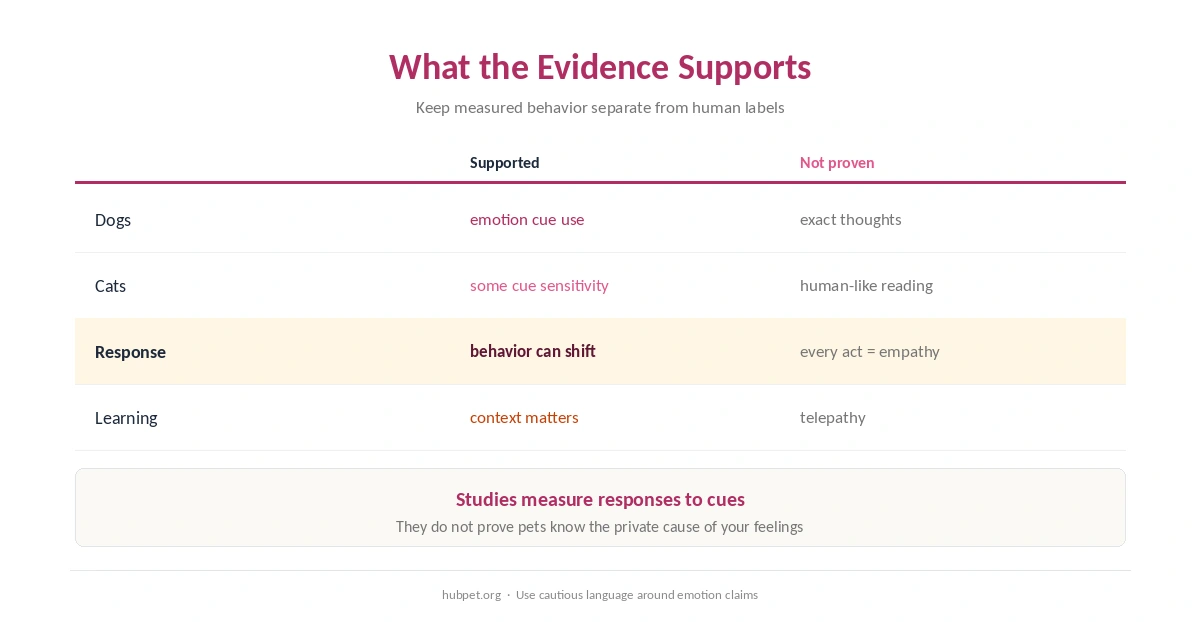
| What research supports | What it does not prove |
|---|---|
| Dogs discriminate emotional cues | Dogs know the exact cause of your feelings |
| Cats use some owner emotional information | Cats interpret emotions exactly like people |
| Pets may change behavior around upset humans | Every comforting behavior is empathy |
| Learning and familiarity can matter | A pet can read thoughts |
Can Pets Sense When You’re Upset? What Cat Studies Show
A 2016 study of domestic cats found only modest sensitivity to human emotion cues, especially from owners. A 2020 cat emotion-recognition study found that cats could match some visual and vocal emotional signals. Therefore, “cats do not notice human emotion” is too strong, but so is “cats always know when you are sad.” A useful companion behavior page is why Cats Choose Favorite People.
Can pets sense when you’re upset in the same way across species? Cat behavior still needs context. Slow blinking can be part of positive cat-human communication, as explained in the slow-blink guide. Purring is also not a simple happiness meter; see the purring myth guide. If a cat withdraws, use the stress-sign guide rather than assigning a human motive.
Dogs also show social responses that owners can over-interpret. The guides to the guilty-look myth, jealousy-like behavior in dogs, and the spite myth show why a familiar human label can exceed what an experiment measured.
How to Respond When a Pet Changes Around Your Mood
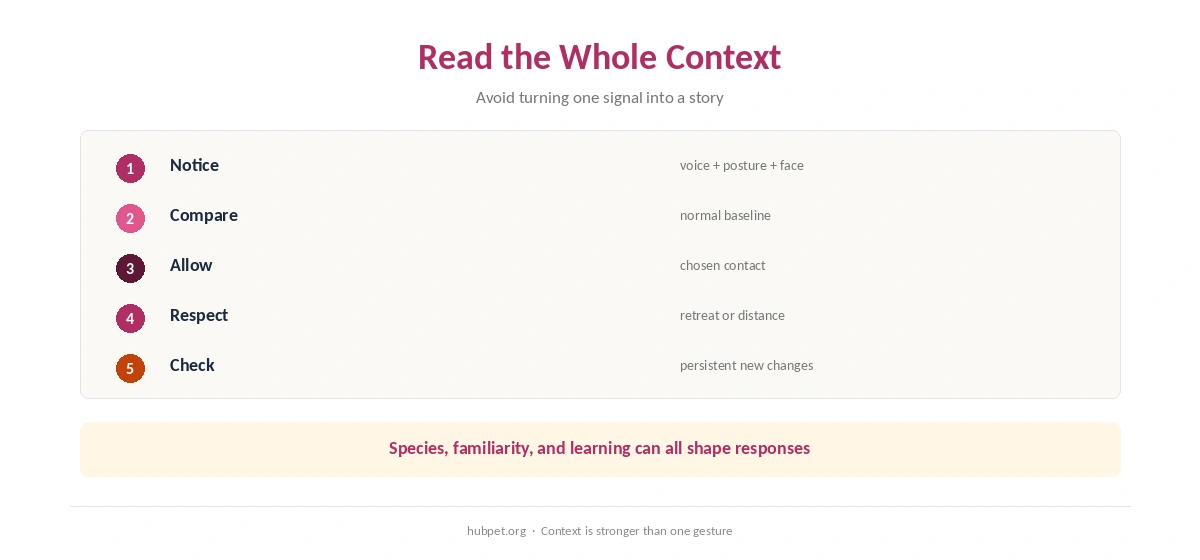
Keep the response simple. If a pet approaches calmly, allow contact the pet seems to choose. If the pet moves away, respect that distance. The calm-cat guide and fearful-dog guide explain how choice and lower pressure support animals that seem unsettled.
Do not assume every behavior change is about your emotional state. A dog that follows more closely may simply be responding to changed routine or attention; see why dogs follow people. A head tilt is also not proof of concern; the head-tilt guide reviews the limits of that interpretation. A related myths-and-facts page is do Dogs Only See in Black and White?.
If a pet becomes persistently withdrawn, stops normal activities, or shows a marked new behavior change, contact a veterinarian rather than explaining it only as emotional mirroring. The site’s pain-sign guide covers why behavior changes can have medical contributors.
How We Research
HubPet reviewed these studies on October 11, 2026: Albuquerque et al., 2016, dog emotion recognition, Merola et al., 2015, cat social referencing, Galvan and Vonk, 2016, cat emotion cues, and Quaranta et al., 2020, cat emotion recognition. Our research process separates measured behavior from human emotional labels.
Possibly. Pets can use posture, facial expression, movement, and other contextual cues. Research does not show that they know the private cause of your emotion.
Dogs can discriminate and respond to human emotional cues, including sadness-related changes in experiments. That is not the same as proving human-like empathy.
Cat studies show some sensitivity to owner emotional cues, but effects are generally subtler than popular claims suggest.
The pet may respond to changes in voice, posture, movement, attention, or routine. The exact motivation cannot be known from one behavior.
Not necessarily. Respect the pet’s space. If avoidance becomes persistent or comes with other new behavior changes, contact your veterinarian.
The Bottom Line: Can Pets Sense When You’re Upset?
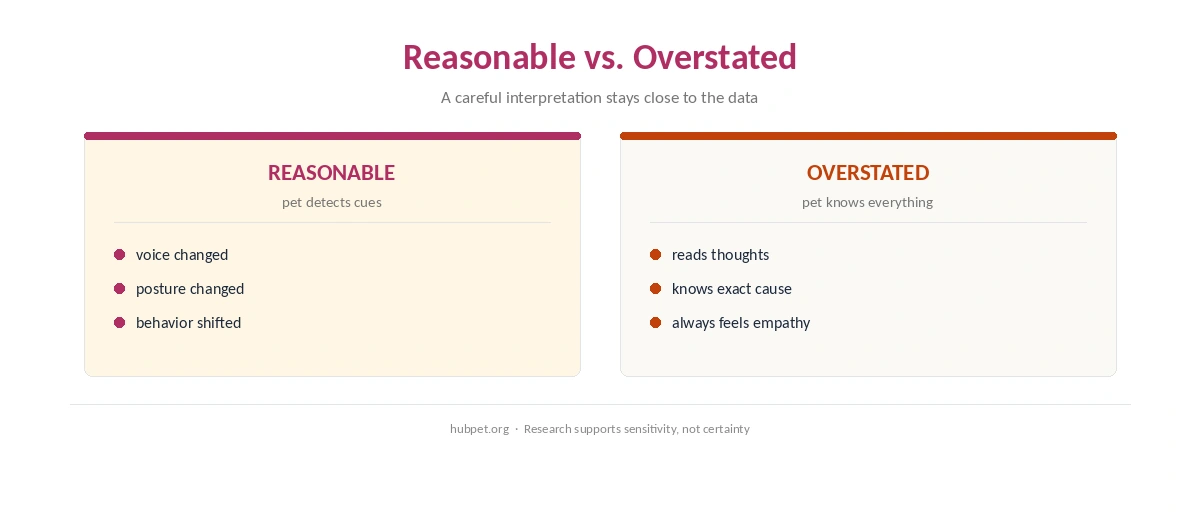
Can pets sense when you’re upset? Dogs and cats can notice and use human emotional signals, but research does not support mind-reading claims. Read the whole behavior pattern, respect the pet’s choice, and avoid turning one response into a story the study never tested.