
This article is general information, not veterinary advice. If your pet seems unwell, is in pain or may have eaten something harmful, contact your vet or an animal poison control line right away. Read our vet disclaimer.
Why cats meow at their owners depends on context rather than one universal message. ASPCA guidance lists greetings, attention, food, access, and other needs among common reasons cats vocalize toward people, while Merck Veterinary Manual guidance updated in 2025 notes that excessive vocalization can also appear with behavior or medical problems.
Why Cats Meow at Their Owners: Common Everyday Contexts
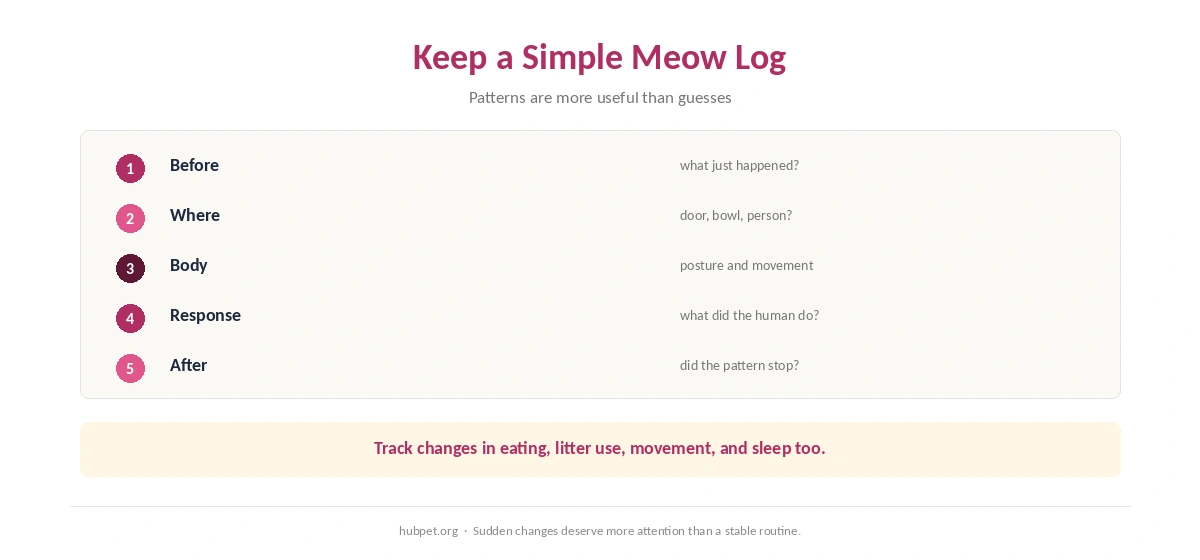
A meow can become part of a learned social routine. If a person reliably talks, opens a door, plays, or serves food after a vocalization, the behavior can keep working. That does not mean every meow is a demand. Compare it with the cat’s posture, location, time of day, and what happened immediately before.
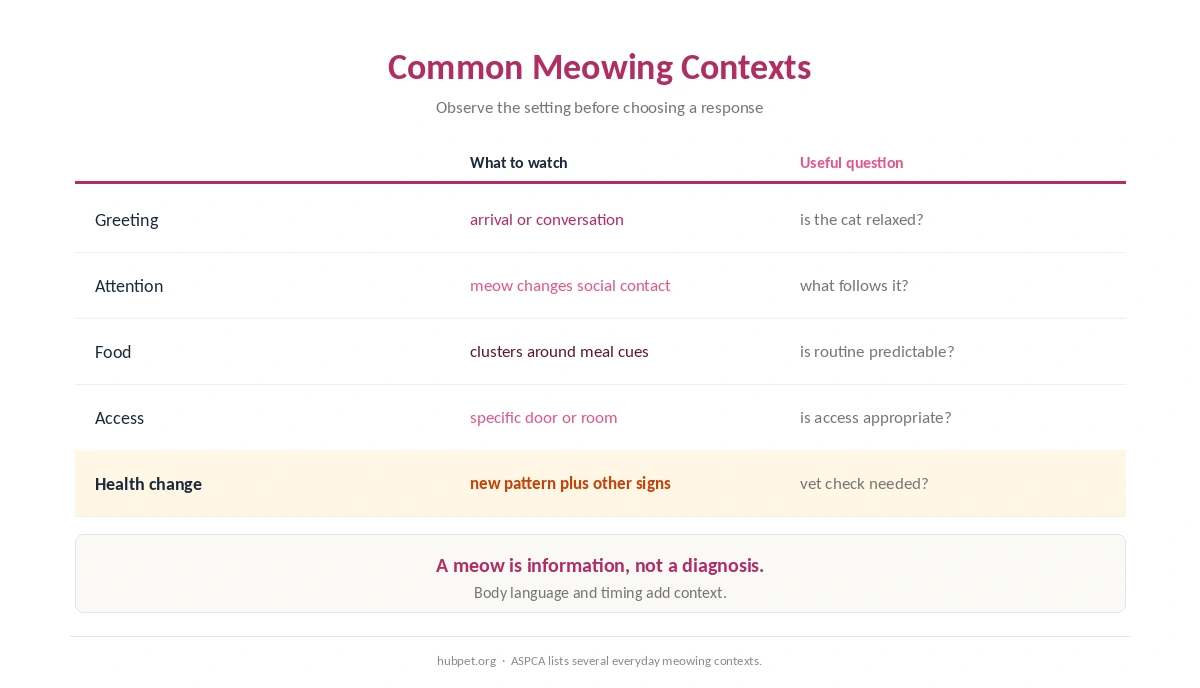
Greeting is one common context in ASPCA guidance. Some cats vocalize when a person arrives or speaks to them. One reason why cats meow at their owners can therefore be a repeated social routine. For other social signals, our slow-blink guide explains why you should read one behavior with the rest of the body rather than translate it as a fixed sentence.
Why Cats Meow at Their Owners for Attention, Food, or Access
ASPCA guidance also lists attention and food as common contexts. A cat may learn that meowing near a kitchen, door, toy, or person changes what happens next. Use scheduled feeding and predictable routines when anticipation itself is driving repeated requests.
- Look at the location. A meow by a closed door suggests a different context from one beside a toy or food area.
- Check the timing. Note whether vocalization clusters around waking, meals, arrivals, play, or nighttime.
- Watch the body. Tail, ears, posture, movement, and willingness to approach add useful context.
- Record what happens next. Human responses can reinforce a pattern even when that was not the intention.
- Check basic needs first. Confirm water, litter access, comfort, and environmental safety before treating the sound as attention-seeking.
- Notice sudden change. A new or much stronger vocal pattern deserves a different level of attention.
Boredom or limited stimulation can add another layer, but do not assume it from sound alone. Use indoor cat enrichment and our boredom evidence guide to improve the environment without claiming that boredom explains every vocal cat.
Why Cats Meow at Their Owners More After a Change
Household changes can alter routines, access, social contact, and resting patterns. Another reason why cats meow at their owners can be a changed routine, but the sound does not identify a single emotion. For a stressed pattern, compare behavior with cat stress signs and use low-pressure stress support.
Social needs also vary among individual cats. Our cat loneliness review explains why one human emotion cannot account for every attachment-related behavior. For everyday observation, the daily cat care checklist can help you notice changes in eating, grooming, play, and litter habits alongside vocalization.
| Context | What to observe | Useful response |
|---|---|---|
| Greeting | Occurs around arrivals or conversation | Respond calmly when body language stays loose |
| Attention | Stops after social contact or play | Offer planned interaction and reinforce calm alternatives |
| Food anticipation | Clusters around food cues | Keep a predictable feeding routine |
| Access request | Occurs at a specific door or room | Check whether access is safe and appropriate |
| Possible distress or illness | Sudden increase plus other changes | Arrange veterinary assessment |
When to Call Your Vet About New Meowing
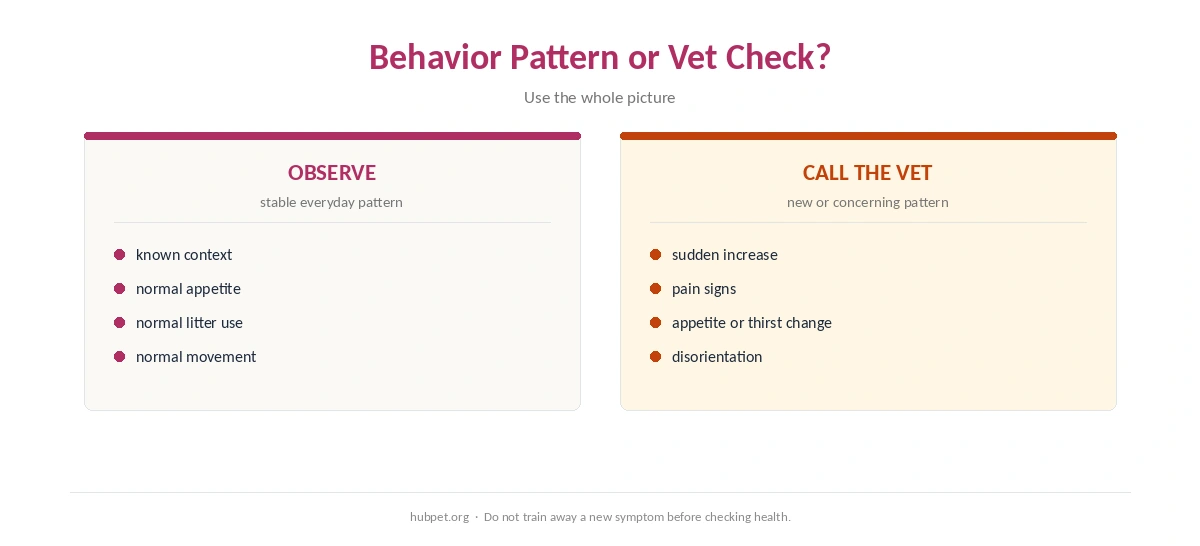
Contact a veterinarian when vocalization changes suddenly or comes with appetite, thirst, urination, mobility, sleep, or behavior changes. Merck Veterinary Manual guidance updated in 2025 recommends ruling out medical contributors when behavior changes. Our pain-sign guide can help you describe observations without guessing the diagnosis.
Older cats can also show new vocalization with sensory, cognitive, or medical changes, according to ASPCA guidance and veterinary references. Do not assume this is normal aging. For broader senior support, see supporting an aging cat at home. If the cat has a true emergency sign, use our emergency guide and seek urgent care.
How We Research
HubPet reviewed sources on October 11, 2026. We used the ASPCA guide Meowing and Yowling and Merck Veterinary Manual cat behavior guidance updated in 2025. Read our editorial method on How We Research.
ASPCA guidance lists greeting as one common context. Look at the cat’s body language and what happens after the vocalization.
Cats can learn that vocalizing around food cues changes human behavior. A predictable feeding routine can reduce uncertainty, but a sudden appetite change needs veterinary attention.
First check basic needs and health context. If you have checked basic needs and the pattern reliably seeks attention, reinforce quiet alternative behavior rather than scolding.
A sudden increase can have behavioral or medical causes. Contact a veterinarian, especially if eating, drinking, urination, mobility, sleep, or general behavior also changed.
Sometimes vocalization occurs around social contact, but a meow does not prove loneliness. Consider the whole pattern of behavior, routine, enrichment, and health.
Why Cats Meow at Their Owners: Bottom Line
Why cats meow at their owners is best answered by observing context. Greeting, attention, food, access, routine changes, stress, and health can all be relevant, but the sound alone does not prove which one applies. If the pattern is new or comes with physical changes, involve a veterinarian rather than trying to train the sound away.