
Introducing a kitten to an older cat calls for more than deciding whether the adult looks friendly. Kittens can be persistent playmates, while a mature cat may want long stretches of undisturbed rest. The safer plan protects the older cat’s territory and routines, gives the kitten its own room, and moves from scent to visual contact before short shared sessions. This guide focuses on mismatched energy levels, escape routes, feeding differences, and how to prevent playful pursuit from turning into stress. Affection between cats is possible, but peaceful coexistence is a valuable goal on its own. For health and safety concerns, see our veterinary disclaimer.
Protect the older cat’s familiar territory
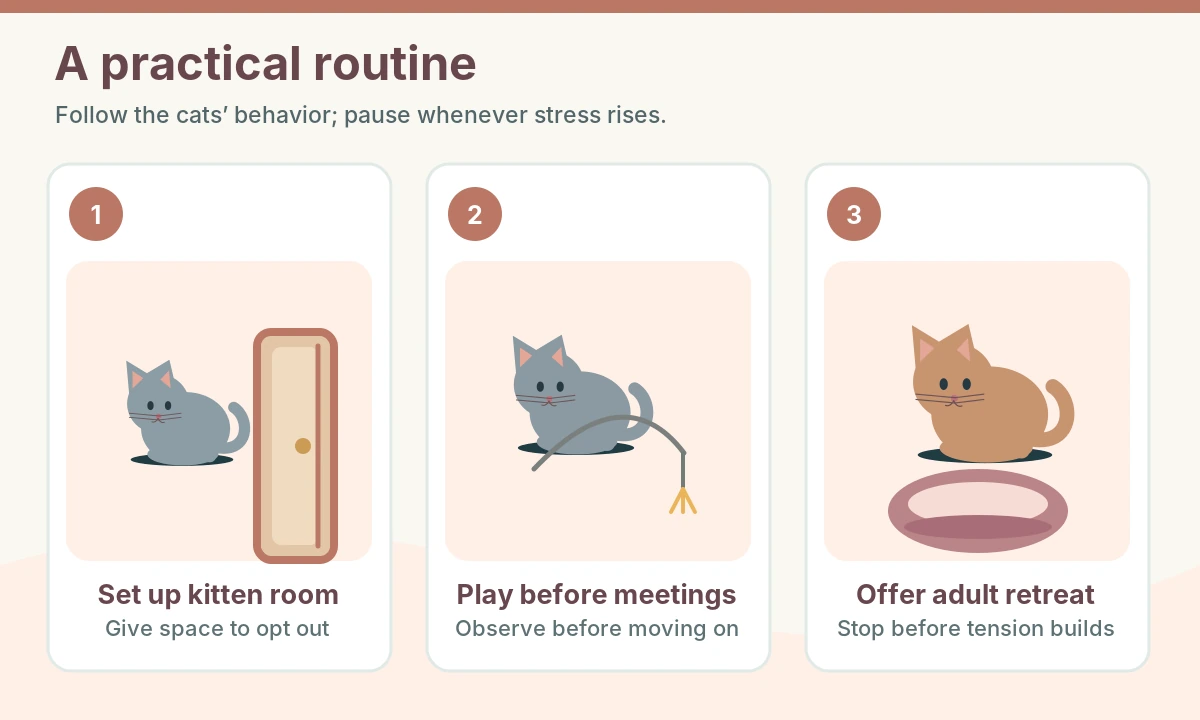
Before the kitten comes home, decide which quiet resting spots, feeding areas, and litter boxes remain easily accessible to the resident cat. A newcomer should start in a separate secure room with its own essentials. Avoid moving the adult’s favorite bed or water bowl simply to make a corner for the kitten. Cats Protection recommends maintaining consistency and providing separate resources during introductions. Observe whether the adult can continue eating, sleeping, and using the litter box normally. If the household becomes noisier, add a calm retreat that family members and the kitten cannot interrupt.
Create a complete kitten sanctuary
The kitten’s starting room needs a low-entry litter tray, accessible water, age-appropriate food, a washable resting spot, a scratcher, play toys, and safe places to hide. Check windows, cables, small objects, and gaps behind appliances. Close the door securely before opening the carrier so an energetic kitten cannot run into the resident cat. Allow the kitten to leave the carrier on its own. A separate room does not punish a cat; it lets a young animal learn where to eat, toilet, and rest while the adult retains predictable access to the rest of the home.
Start with smells, not an exciting reveal
Exchange soft cheek-scent cloths or familiar bedding only when both cats feel well and calm. Put the item in an open location, not directly inside a food bowl or blocked hallway. If either cat stares, growls, hisses repeatedly, or flees, remove the item and slow down. Do not carry the kitten up to the adult for a nose-to-nose greeting. An adult who would normally avoid a kitten may react defensively when escape is impossible. Build several relaxed scent experiences before arranging visual contact through a secure door or gate.

Use play to lower the kitten’s intensity
A short, supervised wand-toy session can give a playful kitten an outlet before a planned visual meeting. Keep the toy away from the adult cat’s face and never use hands as moving targets. Finish with a calm activity and let the kitten settle before approaching a barrier. Play does not guarantee that a kitten will stop chasing, but it can reduce the pressure of an interaction driven by excess excitement. Continue to give the older cat one-on-one attention on its own schedule. Do not use play to coax the adult out of hiding if it would rather rest.
Design high and low escape routes
The adult cat may appreciate a stable raised perch, while the kitten needs safe floor-level hideouts and a clear route back to its room. Check that shelves, furniture, and steps are secure and suitable for each cat’s mobility. Do not assume an older cat can jump high without discomfort. Arrange two paths around shared furniture so one cat cannot stand in the only exit. Keep litter boxes and water locations away from dead-end corners. A gate should have kitten-proof gaps, and an adult retreat should not require crossing the kitten’s favorite play area.
Make the first visual moments brief
When scent sessions stay calm, use a secure transparent or mesh barrier that prevents contact. Allow both cats to choose whether to approach. Watch for relaxed observation and easy disengagement, not just silence. A fixed stare, low crouch, tail lashing, lunging, or repeated pawing means the session is too difficult. Cover the sight line or calmly guide the cats back to their separate spaces without touching or punishing them. Do not allow an excited kitten to squeeze through a gate, and never hold either cat in your arms to force a closer view.
Separate feeding and rest even after progress
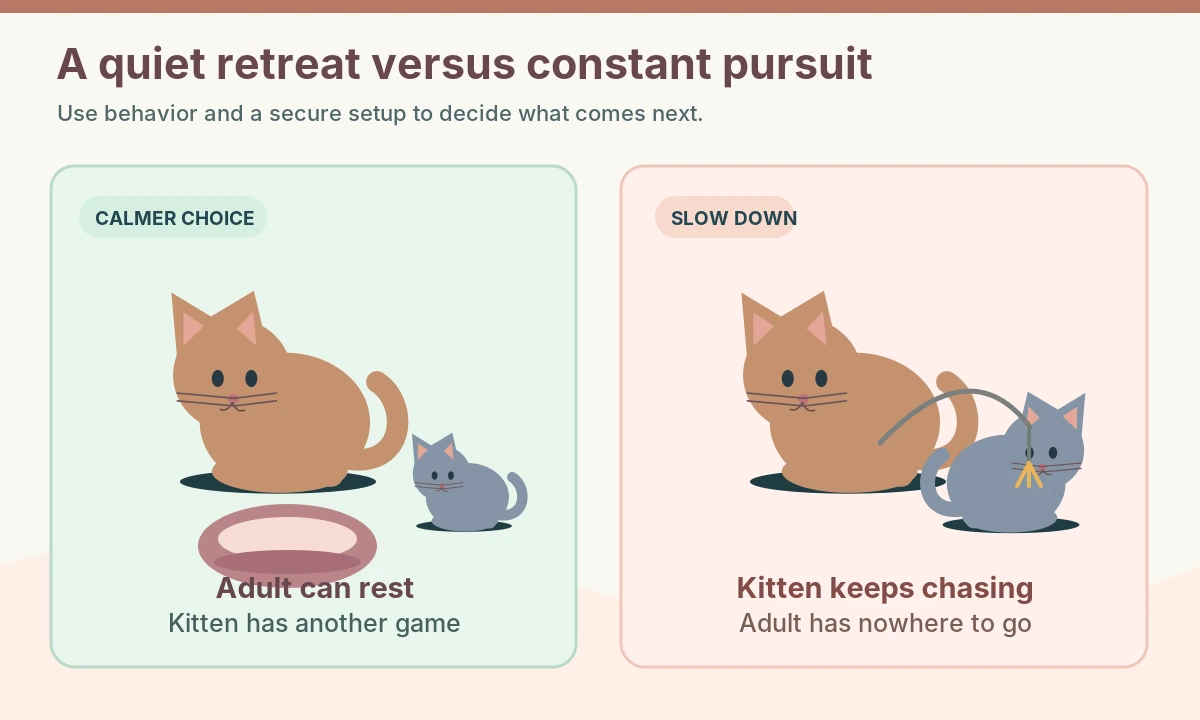
Young and adult cats may have different food requirements, and either may attempt to steal meals. Feed separately and ask a veterinarian which diet suits each life stage. Keep several sleeping spots, litter boxes, and scratching surfaces available so the older cat does not need to defend a single resource. A kitten may jump into the adult’s bed while the adult is sleeping; redirect with a toy or provide an alternative play area instead of scolding. During the early weeks, separate the cats when you cannot supervise. Calm sessions do not prove unsupervised access is safe.
Read corrections without punishing either cat
An older cat may hiss or give a quick warning swat when a kitten ignores its space. That signal should make you increase distance and redirect the kitten, not punish the adult. Repeated chasing, pinning, screaming, biting, or blocking access to food and litter is not normal friendly play to leave unresolved. Interrupt safely by creating visual separation, not by putting hands between the cats. Return the kitten to its separate room and review the layout. If you notice injury, appetite loss, or sustained fear, consult a veterinarian and consider a qualified feline behavior professional.
Advance according to behavior, not age
Two kittens of similar energy may adjust faster than a kitten and a quiet senior cat, but there is no universal timeline. Watch whether both cats can eat, groom, rest, and disengage easily around one another. Start shared-room sessions for short periods with multiple escape routes and meaningful supervision. End while behavior is relaxed; do not prolong a session because the cats have not hissed yet. If the adult hides more or the kitten stalks it, reduce the challenge. Progress might mean the adult can nap while the kitten plays elsewhere without disturbing it.
Check the adult cat’s comfort and health
A mature cat with painful joints, impaired vision, hearing changes, or another medical concern may need a different room layout and slower handling. Sudden irritability, litter-box avoidance, reduced eating, or changes in movement warrants a conversation with a veterinarian rather than attributed automatically to jealousy. Ask about routine preventive care for the newcomer before shared spaces and objects. A calm adult cannot be responsible for supervising or entertain the kitten. The human household is responsible for enrichment, safe separation, and gradual introductions that give both animals a real choice.
How We Research
We compared animal welfare and humane-society guidance on sanctuary rooms, scent exchange, barriers, resource distribution, and cat body language. These stages offer practical ideas, not a fixed timetable. For individual concerns, speak with a veterinarian or qualified feline behavior professional. We did not test or certify any training barrier, product, or treatment. We reviewed the source guidance in October 2026. Individual cats may need a slower approach. Learn more about our methods on the About HubPet page.
Sources
Cats Protection — Introducing Cats & Kittens (reviewed October 2026).
Seattle Humane — Cat to Cat Introductions (reviewed October 2026).
American Humane — Introducing Cats to Cats (reviewed October 2026).
Safety note: If either cat suffers an injury, becomes ill, stops eating, or shows persistent distress or aggression, contact a veterinarian. Do not separate fighting cats with bare hands, use physical punishment, or force contact.
No. Some adult cats tolerate kittens quickly, while others need weeks of gradual introductions or prefer separate resting spaces.
Do not allow repeated pursuit. Redirect the kitten to a safe toy and provide the adult with an unobstructed retreat.
Yes. Separate stations help prevent stealing and competition, especially because kittens and adults may have different dietary needs.
A hiss communicates discomfort. Give more space and slow the introduction; repeated intimidation or fighting deserves professional advice.
Only after repeated calm shared sessions with easy escape and no chasing or guarding. Some pairs will need continuing separation when unattended.