
Feeding cats across a closed door can make the presence of an unfamiliar cat feel more predictable, but the placement of the bowls matters more than a catchy schedule. A resident cat and newcomer should eat in separate rooms, each with a clear way to retreat. If either cat freezes at the door or refuses food, the bowls are too close or the exercise is happening too soon. This guide shows how to find a workable starting distance, monitor both animals, and avoid turning meals into a contest over a doorway. For health and safety concerns, see our veterinary disclaimer.
Complete the private-room setup first
Before using a door as a feeding boundary, confirm that the newcomer has an equipped room and the resident cat has its own accessible territory. The separating door should close securely, without gaps a kitten could crawl through or paws could become trapped in. Both cats need their own water, litter box, and resting locations. A meal at the doorway should never replace a cat’s normal access to food. If either animal has just arrived, give it time to settle and eat reliably in private before beginning association exercises. Stability matters more than speed.
Begin with bowls well back from the door
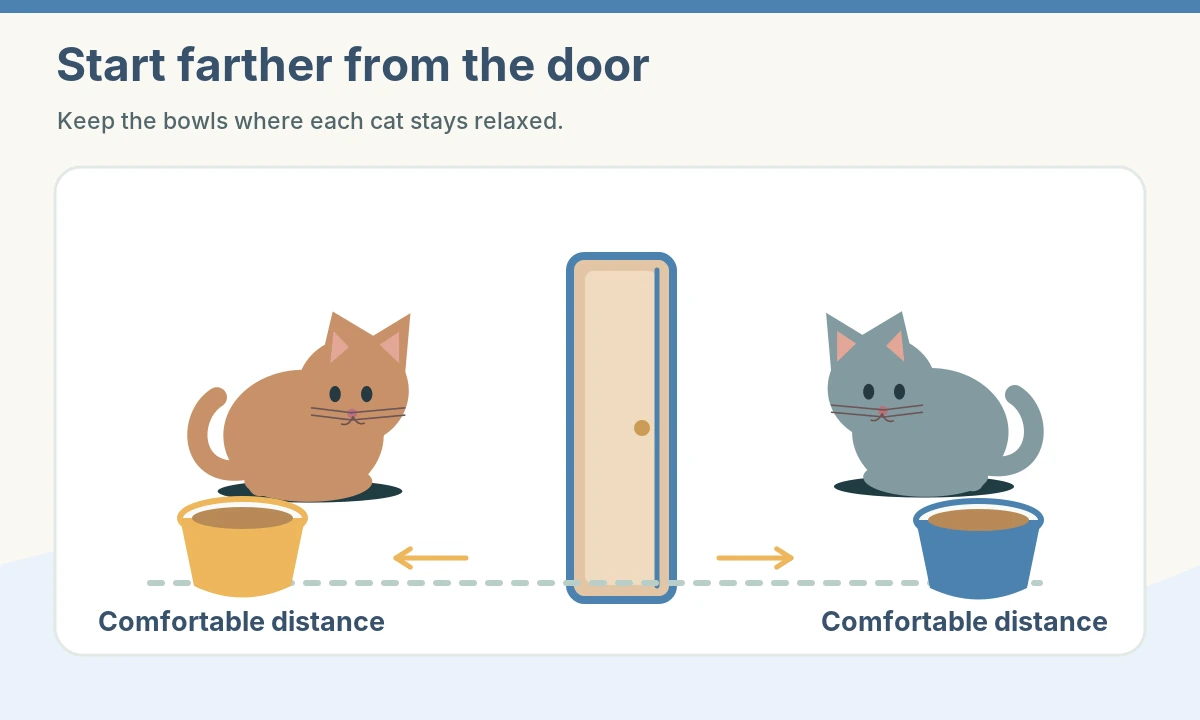
Put each cat’s meal in a comfortable spot within its own space, away from the closed door. ‘Across the door’ does not mean bowls must touch the threshold. Choose an initial distance that lets each cat approach its bowl normally, eat, and leave without monitoring the gap. Measure progress by behavior rather than feet or inches, because room layout and individual sensitivity differ. If the resident cat typically eats in the kitchen, maintain that routine if possible. Avoid moving all household feeding stations at once just to conduct the exercise.
Watch more than whether food disappears
A cat may consume food while still feeling tense. Look for pacing, intense watching of the door, sudden pauses, flattened ears, crouching, vocalizing, or leaving the bowl repeatedly. Calm eating usually includes a flexible body and an ability to move away afterward without a rush. Watch each cat separately if only one person is available, using reliable observation rather than pretending you can see through a solid door. Never hold a cat in place to complete a portion. A comfortable cat can choose to end the exercise without losing its regular meal.
Move closer only after steady sessions
After several relaxed meals, shift a bowl a small distance nearer the door, then reassess before making another change. You might need to move only one cat’s bowl because their comfort levels differ. Small changes keep the exercise reversible. If staring or refusal appears, restore the previous successful distance instead of adding more tempting food to push through fear. There is no requirement for both bowls to reach the threshold. In some homes, cats achieve calmer introductions with bowls remaining well back from the doorway while the cats practice scent exchange elsewhere.
Choose food that supports a normal routine
Use each cat’s familiar diet and meal schedule. A highly exciting treat can sometimes increase arousal around a barrier, and sudden dietary changes can complicate stool or appetite observations. Offer a small reward for voluntary relaxed behavior if suitable, but avoid making one cat compete for food with the other. Never withhold meals to make a cat hungry enough to approach the door. Cats with a medical diet, appetite problems, or a history of not eating should follow the veterinarian’s feeding advice first, even if that means skipping doorway exercises.
Keep doorways, hands, and bowls safe
Do not open the door while both cats crowd against it. A sudden door swing can cause a collision or escape, especially when someone carries bowls through the hall. Set meals down, close and latch the door, and only then invite the cats to eat. Pick up bowls after each cat moves away. If a cat paws under the door or guards the crack, increase distance and consider an opaque draft blocker that cats cannot chew or pull through. Keep fingers out of gaps and do not allow either cat to bat at the other through an opening.

Pair meals with neutral scent work
A cloth carrying the other cat’s cheek scent can sit in the room during a separate calm session. It can stay away from food. This offers information without forcing a cat to choose between hunger and investigating an unfamiliar smell. Watch whether the animal returns to ordinary behavior after a short sniff. If the cloth triggers tension, remove it and keep meal practice easier. The cat introduction process uses several skills—relaxing alone, tolerating new scents, and then brief visual exposure—rather than treating the food bowl as a magic shortcut.
Do not force visual contact during dinner
Even if both cats eat calmly near a closed door, opening it for a surprise sighting changes the difficulty abruptly. Visual exposure is a later, controlled stage using an appropriate barrier with no escape-sized gaps. Start sessions away from the door with room for each cat to move and retreat. Keep normal meals in familiar places if barrier work disrupts appetite. The goal is a quiet encounter, not a photograph of two bowls close together. Separate the cats before rearranging barriers or adjusting the room layout.
Troubleshoot refusal, guarding, and loud vocalizing
If one cat will not eat, move that meal away from the door and ensure the animal is comfortable eating on its own. Persistent refusal, vomiting, or lethargy warrants veterinary advice rather than another training experiment. For growling or doorway guarding, pause proximity work and increase physical distance. A narrow hallway may be a poor setup; a larger room or a different doorway can create a less confrontational route. If a cat begins scratching at the door urgently, do not open it into the waiting cat. Reset only after both have settled separately.

Know what a successful meal stage looks like
Success is not two noses touching through a crack. It is two cats continuing to eat, rest, and explore comfortably in their own spaces despite a new companion somewhere in the home. Some pairs proceed quickly; others need weeks of gradual introduction, and some never seek close contact. Keep separate feeding stations available as they share more of the house. If interactions later include chasing or blocking food access, back up to earlier calm routines and seek help if tension persists. Food should stay a source of security, not leverage.
How We Research
We compared animal welfare and humane-society guidance on sanctuary rooms, scent exchange, barriers, resource distribution, and cat body language. These stages offer practical ideas, not a fixed timetable. For individual concerns, speak with a veterinarian or qualified feline behavior professional. We did not test or certify any training barrier, product, or treatment. We reviewed the source guidance in October 2026. Individual cats may need a slower approach. Learn more about our methods on the About HubPet page.
Sources
Cats Protection — Introducing Cats & Kittens (reviewed October 2026).
Seattle Humane — Cat to Cat Introductions (reviewed October 2026).
American Humane — Introducing Cats to Cats (reviewed October 2026).
Safety note: If either cat suffers an injury, becomes ill, stops eating, or shows persistent distress or aggression, contact a veterinarian. Do not separate fighting cats with bare hands, use physical punishment, or force contact.
Start wherever both cats eat normally, even if the bowls are far from the door. Adjust distance based on relaxed behavior, not a fixed measurement.
No. Never withhold normal meals to force proximity. Protect appetite and consult a veterinarian if a cat refuses food.
Not as a surprise. Use a separate, carefully planned visual introduction through a secure barrier after earlier stages are comfortable.
Move both feeding stations farther from the doorway and let the cats settle. Continue only after normal eating and relaxed behavior return.
No. Separate bowls and locations can reduce competition long term, even when cats comfortably share the rest of the home.