
Restarting cat introductions after chasing or fighting begins with safety, not another immediate meeting. A pursuit or swat can leave both animals more alert to the doorway, even if they seemed relaxed earlier. Separate them into secure spaces, assess each for injury without forcing handling, and restore normal eating and rest before trying scent exercises again. This guide focuses on a practical reset after a bad session, including when to seek veterinary help, how to prevent another surprise encounter, and how to rebuild shared space only when both cats are ready. For health and safety concerns, see our veterinary disclaimer.
End an active confrontation without bare hands
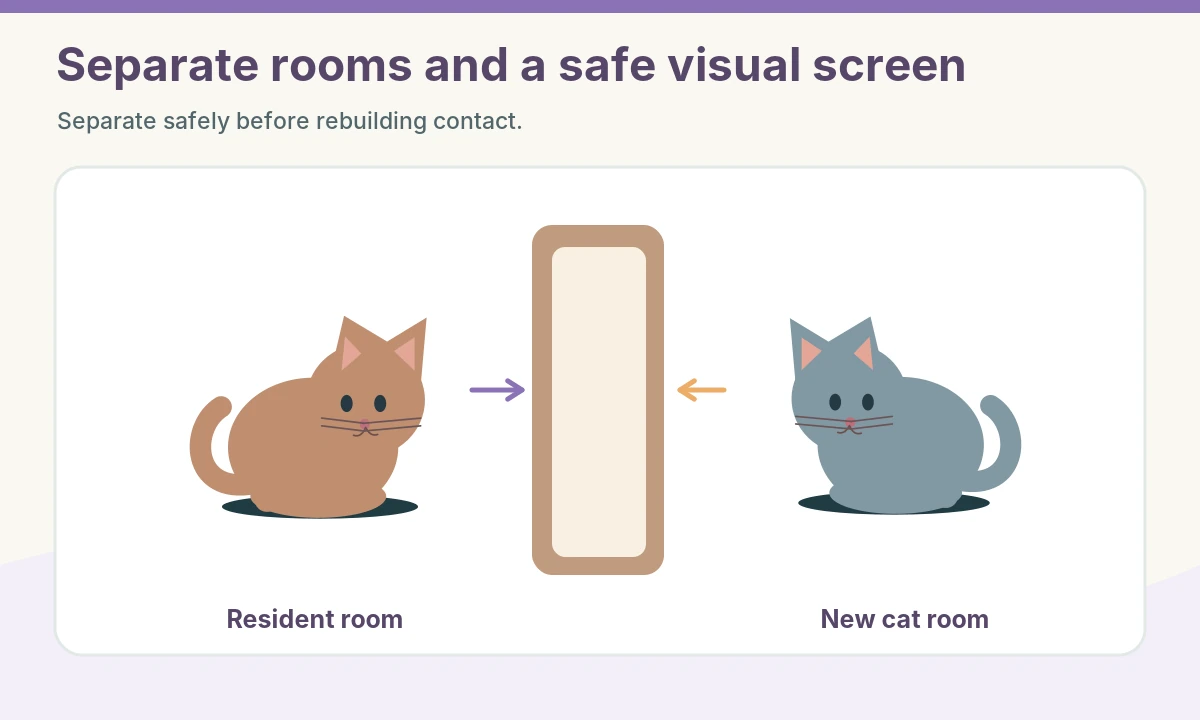
Do not reach between fighting cats or try to lift one while it is striking. Keep children and other pets away. If safe to do so, break the cats’ line of sight with a large solid visual screen and allow each animal to move toward a separate room. Avoid yelling, spraying water, or punishing either cat; these actions can add fear to an already difficult event. Once you have separated them, close the doors and give both animals a chance to settle. If you cannot separate them safely or someone suffers an injury, seek immediate appropriate help rather than improvising physical restraint.
Check for injury and changes in behavior
Cat bites can create small punctures that are easy to miss beneath fur. Contact a veterinarian promptly after a bite, wound, limp, marked pain, or suspected injury. If either cat refuses food, hides continuously, has trouble using the litter box, or acts unusually quiet after the event, ask for medical advice. Do not force a frightened cat into a handling session to examine every patch of skin. Keep the room quiet, supply water and litter, and observe from a distance if touching creates more risk. A physical health problem may also contribute to irritability.
Restore reliable physical separation
Use closed, secure doors rather than relying only on a gate the cats have already challenged. Provide each cat with food, water, a litter box, a bed, a scratching surface, and hiding spots. Place resources away from the separating door so neither cat must listen to the other while meeting basic needs. Family members should know a simple door-opening sequence to avoid accidental meetings. Note whether either cat patrols, stares at, or scratches the door. If this happens, move resting and feeding activities farther from that area and give more quiet time.
Review what happened immediately before the chase
Look for environmental triggers without assuming a single cat was ‘bad.’ Did one animal guard a narrow hallway, approach a sleeping cat, race through a door, or follow the other after it tried to leave? Was a toy or high-value feeding station nearby? Was the meeting too long? Write a brief factual account of distance, direction of travel, body postures, and the available exits. This helps you change the next setup rather than repeating it. Avoid attributing the event to revenge or dominance without evidence. The practical question is what made retreat difficult.
Return to calm, separate routines
Wait until each cat is reliably eating, resting, grooming, and moving through its own area without intense monitoring of the other. That may take more than a day and cannot follow an arbitrary countdown. Continue familiar play and affection only when each cat seeks it. If one cat responds to every sound at the door with a crouch or growl, do not start visual sessions. Ask a veterinarian or qualified feline behavior specialist for a tailored plan when conflict recurs, injuries occur, or either cat’s quality of life remains poor.
Restart with gentle scent information
Begin again with a small cloth carrying the other cat’s cheek scent, set in a place where the cat can ignore it. Do not rub it onto the receiving cat or place it against food. Monitor whether the cat can notice the smell and return to ordinary activities. If scent alone causes tension, remove the item and restore distance. When both cats are comfortable, use brief site exchanges while the other remains securely elsewhere. Secure all doors before allowing exploration. Progress through calm behavior, not the calendar or pressure to reopen the whole home.

Redesign blocked paths and competition points
Walk through the shared areas without the cats and identify choke points: a single hallway to the litter box, one high perch, or a water bowl near the gate. Add resources in separate locations, create two directions around furniture, and provide resting spots without an ambush route. If the cats were fighting over food, return to separate feeding areas. Do not force them to share bowls or a narrow scratching post to prove acceptance. Both animals should be able to leave a room without approaching the other directly. This protects ordinary daily routines as introductions resume.
Use controlled visual contact later
Once scent and room exchanges are consistently uneventful, offer a short view through a secure barrier. Start from a distance where neither cat fixes its stare, lunges, or paws at the barrier. An opaque section can help you reduce how much they see. End the interaction before arousal rises, and separate the cats calmly. Do not use a carrier to hold one animal in front of the other. If either cat refuses treats or cannot disengage, return to a less intense stage. Cats Protection recommends a staged process and freedom to retreat rather than pushing through signs of discomfort.
Plan early shared time as a short choice
A future meeting should take place in a room with several unobstructed exits, not at a doorway where a confident cat can block the newcomer. Open the route only when you have an easy way to end the session and another person can help monitor, if available. Let cats move voluntarily. Avoid tossing treats between them if that creates a contest, and do not encourage wrestling to test whether they are friends. If chasing resumes, separate them and review the plan. Frequent setbacks call for professional assessment, not repeated longer sessions.

Know when separate living may be the kinder option
Not all cats become companions, and some cannot safely share unrestricted space. A household may need rotating access, permanent resource separation, or professional help to protect both animals. Persistent stalking, blocked litter access, injury, loss of appetite, or chronic hiding are signals that the arrangement needs change. Discuss medical contributors and behavior options with a veterinarian, especially when aggression appears suddenly in cats that previously coexisted. Avoid promises that a short reset will make every pair affectionate. The goal is a life in which each cat can eat, rest, eliminate, and move without fear.
How We Research
We compared animal welfare and humane-society guidance on sanctuary rooms, scent exchange, barriers, resource distribution, and cat body language. These stages offer practical ideas, not a fixed timetable. For individual concerns, speak with a veterinarian or qualified feline behavior professional. We did not test or certify any training barrier, product, or treatment. We reviewed the source guidance in October 2026. Individual cats may need a slower approach. Learn more about our methods on the About HubPet page.
Sources
Cats Protection — Introducing Cats & Kittens (reviewed October 2026).
Seattle Humane — Cat to Cat Introductions (reviewed October 2026).
American Humane — Introducing Cats to Cats (reviewed October 2026).
Safety note: If either cat suffers an injury, becomes ill, stops eating, or shows persistent distress or aggression, contact a veterinarian. Do not separate fighting cats with bare hands, use physical punishment, or force contact.
Avoid an immediate reunion. Restore safe separation, check for injury, and restart at a low-intensity scent stage when both cats are back to normal.
Contact a veterinarian promptly. Cat bite wounds can be small and easy to overlook, and ask your veterinarian to assess the injury before restarting training.
No. Punishment can increase fear and tension. Improve barriers, escape routes, and gradual introduction steps instead.
Not necessarily. Context matters, but repeated pursuit, pinning, biting, or inability to retreat means the meeting needs to end and the plan should be reset.
Seek veterinary or qualified feline behavior help after injury, repeated aggression, persistent guarding, appetite changes, or a cat that cannot use resources without fear.