
This article is general information, not veterinary advice. If your pet seems unwell, is in pain or may have eaten something harmful, contact your vet or an animal poison control line right away. Read our vet disclaimer.
How to help a dog with separation anxiety starts with confirming that the dog is distressed when alone. Then the goal is to prevent repeated panic while a veterinary plan is built.
AAHA describes separation anxiety as excessive stress during absence (AAHA, 2026). It recommends gradual desensitization that stays below the pet’s distress threshold. For a closer look at the related behavior pattern, see why Pets May Become Clingy Suddenly.
How to Help a Dog with Separation Anxiety: Confirm the Pattern
First, record what happens after you leave. AVSAB says video is one of the most useful ways to identify separation anxiety (AVSAB, 2021).
Barking, destruction, or house soiling can have other causes. VCA also uses video because confinement, outside triggers, and other problems can mimic separation-related distress (VCA, accessed 2026).
While you collect that information, keep the rest of the day predictable. A calm space, the routines in the daily dog care checklist, and positive reinforcement can support the treatment plan. They are not a substitute for professional help when the dog is panicking.
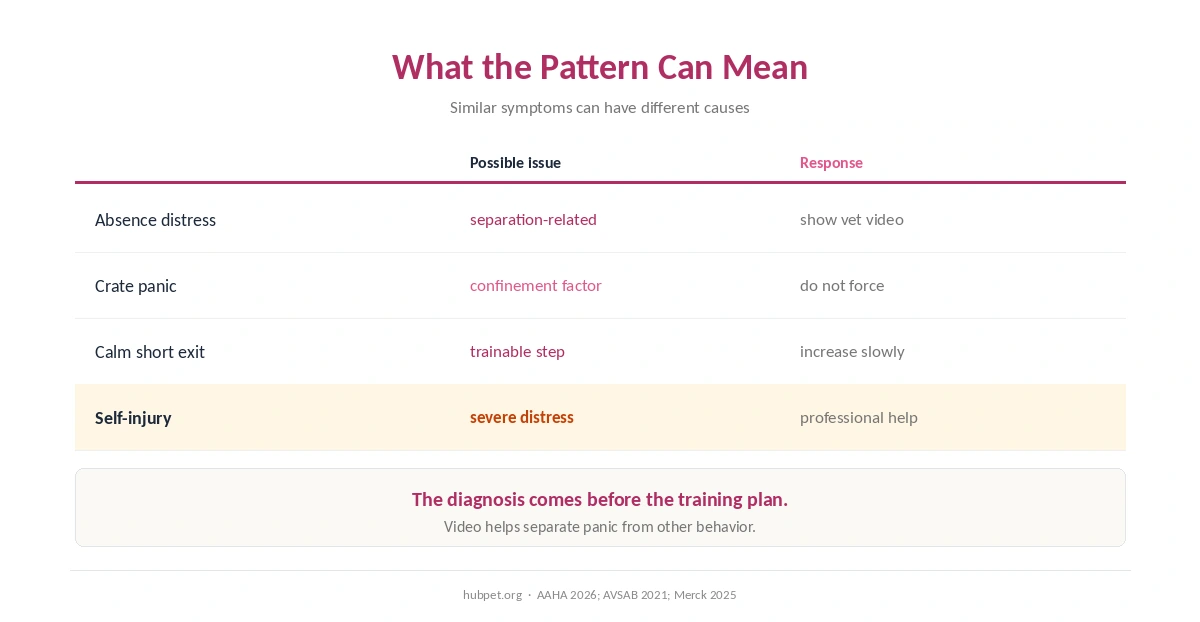
| What you observe | What it may suggest | Next step |
|---|---|---|
| Distress mainly during absence | Separation-related distress is possible | Show video to your veterinarian |
| Panic in a crate but calmer loose | Confinement may be part of the problem | Do not force longer crating |
| Calm during very short practice | Training can progress in tiny steps | Increase only while calm |
| Self-injury or severe panic | High welfare and safety concern | Get veterinary behavior help |
How to Help a Dog with Separation Anxiety Without Triggering Panic
Next, practice absences short enough that the dog remains calm. AAHA says to begin with a duration the pet can tolerate and increase it gradually (AAHA, 2026).
Merck recommends the same below-threshold principle for simulated departures (Merck Veterinary Manual, updated 2025). Video can confirm whether the dog stays comfortable during practice.
- Start with a veterinary discussion, especially when the behavior is severe, sudden, or hard to distinguish from a medical problem (AAHA, 2026).
- Use video to identify the earliest signs of distress instead of guessing from damage found later (AVSAB, 2021).
- Set up a safe resting area only if the dog is already comfortable there; confinement can worsen distress for some dogs (AAHA, 2026).
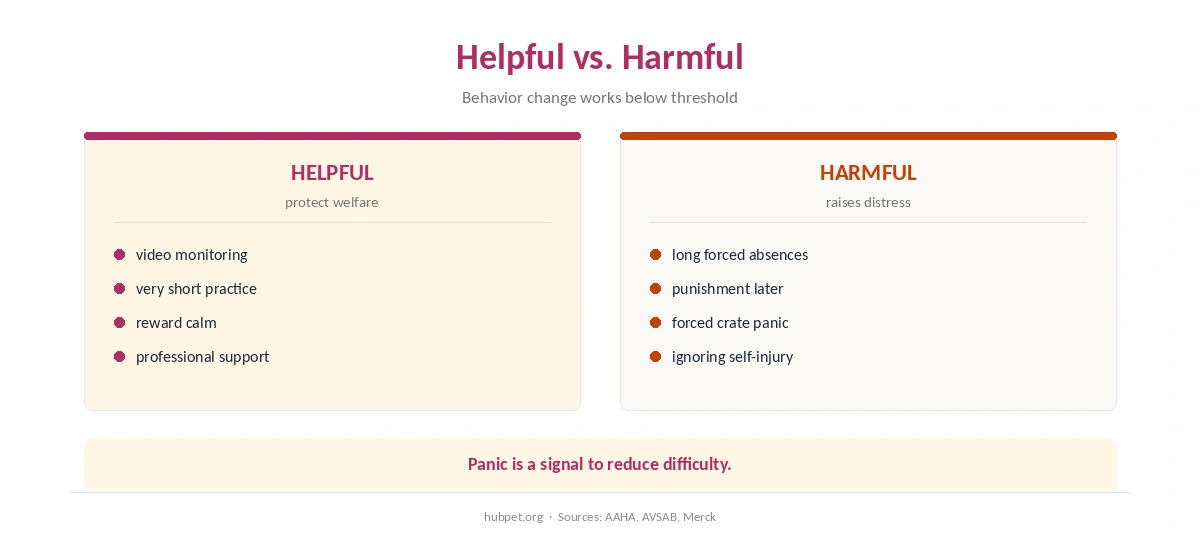
- Practice a very short absence and return before distress starts.
- Increase time gradually only after repeated calm practice (AAHA, 2026; Merck, 2025).
- Do not punish barking, destruction, or house soiling after you return; AVSAB warns that punishment can worsen anxiety (AVSAB, 2021).
- Arrange temporary help when possible so the dog is not repeatedly pushed into panic while treatment is underway (AAHA, 2026; AVSAB, 2021).

How to help a dog with separation anxiety also means separating the symptom from the training target. Excessive barking can occur for many reasons, while destructive chewing can happen outside an anxiety episode. Likewise, basic dog training can build communication but does not by itself treat panic.
How to help a dog with separation anxiety works best when each practice absence stays below panic. If the dog cannot stay calm even for a tiny step, stop and get professional help.
When to Call Your Vet About Separation Anxiety
Contact your veterinarian if the dog injures themself trying to escape or cannot eat or settle when alone (AAHA, 2026). Also call for a sudden behavior change or distress that persists despite gradual training. If you also notice signs of pain, tell the veterinary team. For collapse, severe injury, breathing trouble, or another crisis, use the pet emergency signs guide and seek urgent veterinary care.
A veterinarian or veterinary behaviorist can build a broader treatment plan. When a veterinarian includes medication in that plan, follow the prescription exactly.
For newly adopted dogs, the first-week checklist can help keep routines predictable while you learn the dog’s normal behavior. However, do not assume a dog will simply “get used to” repeated panic. AVSAB warns that untreated separation anxiety can worsen with forced exposure (AVSAB, 2021). A useful companion behavior page is why Dogs Whine When They Want Something.
How We Research
HubPet uses veterinary and behavior sources rather than personal anecdotes. Sources read on October 11, 2026: AAHA 2026 and AVSAB 2021. We also checked Merck 2025 and AVMA 2025. See How We Research for our method.
How to Help a Dog with Separation Anxiety FAQ
That approach can push a distressed dog over threshold. AAHA and Merck recommend gradual practice that remains short enough for the dog to stay calm (2025–2026).
Only if the dog is already comfortable there. AAHA notes that confinement can worsen distress in some dogs (AAHA, 2026).
Use video. AVSAB and VCA both recommend observing the dog during real absences because barking or damage alone does not prove separation anxiety (2021–2026).
No. AVSAB says destruction or soiling during separation can be symptoms of distress, and punishment can worsen anxiety (AVSAB, 2021).
Severe panic, self-injury, failure to improve, or a case that cannot stay below threshold warrants veterinary and behavior-specialist support (AAHA, 2026; AVSAB, 2021).
The Bottom Line
How to help a dog with separation anxiety is a welfare plan, not a test of endurance. Confirm the pattern with video and prevent repeated panic where possible. Then use reward-based, below-threshold practice and involve the veterinary team when distress is severe or persistent (AAHA, 2026; AVSAB, 2021).