
A cat’s nail has a hard outer claw and sensitive living tissue inside. The pink quick is the part you must avoid during trimming. On a clear nail it can often be seen; on a dark claw the boundary may not be obvious at all. This visual guide explains the difference between the visible sharp tip and the inner quick. It also explains why no clipper light or guessing method makes a deep cut safe. If a claw looks embedded, torn, or painful, contact your veterinarian before clipping. See our veterinary disclaimer for pet health questions.
The quick is living tissue, not leftover nail
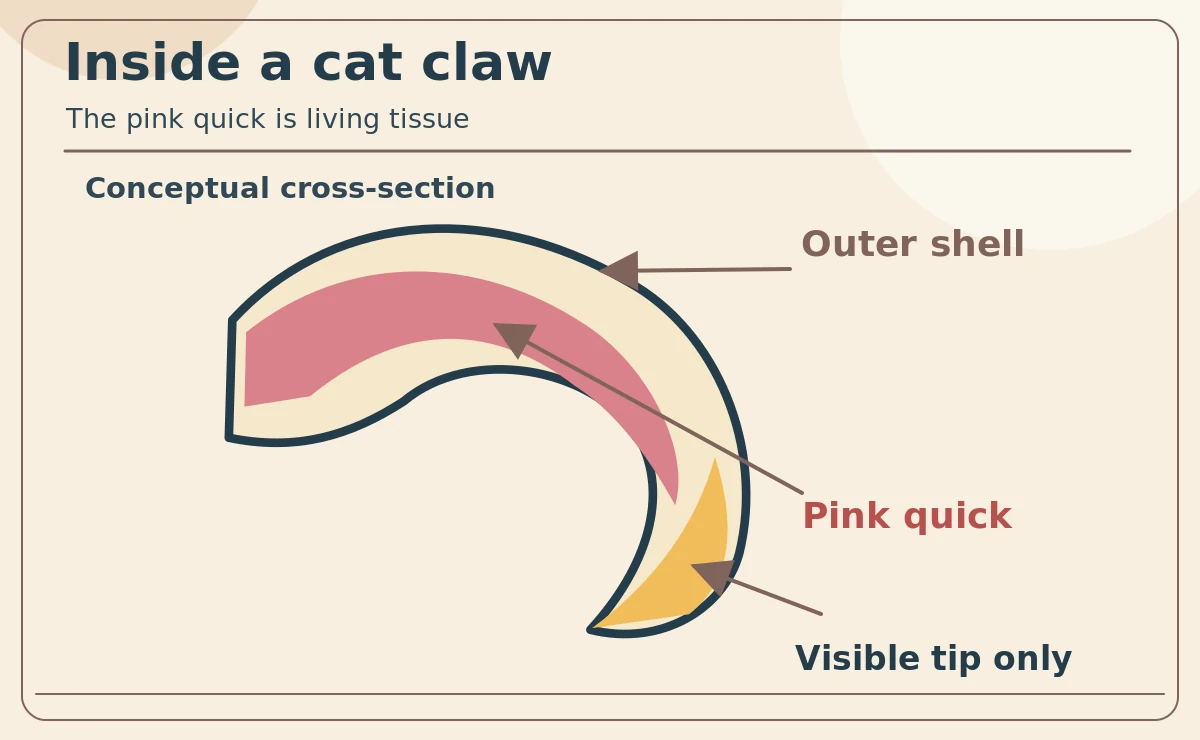
The quick contains blood vessels and nerves protected by the surrounding claw. Cutting it can cause pain and bleeding. The hard curved shell extends beyond this sensitive core, creating the point that may snag fabric. The visible end of a light-colored claw is often more translucent than the pink area nearer the toe. Treat the illustration as a concept, not as an exact map for every cat. Each claw can have a different safe outer tip and some leave almost no obvious margin.
Examine a claw without trapping the cat
Wait for a relaxed moment and let your cat rest on a secure surface. Briefly touch a paw and reward the cat for staying comfortable. A gentle press on a toe pad may extend the claw enough to inspect, but stop if the cat withdraws. Use steady room light rather than gripping the toe harder for a better view. Keep your hands away from the sharp point and avoid forcing extension. If the claw will not show comfortably, you can try later or seek professional guidance.
What a clear claw can and cannot tell you
On some light nails, the pink core is visible and a clear whitish point extends beyond it. That observation helps you avoid the living area, but the boundary may appear different under shadows or from a side angle. Never cut into the pink region. Do not use a memorized number of millimeters as a universal rule for cats. Remove only a tiny visible point if a trim is necessary, your cat remains relaxed, and you know where the quick ends. An uncertain view means stop.
Dark claws require greater caution
Pigment can hide the quick, and extra lighting may not reveal its boundary. A dark nail is not a reason to guess using the shape of another toe. Limit home efforts to inspection and professional technique coaching if you cannot identify a safe outer margin. If a veterinarian has demonstrated an individualized small-tip approach, follow that advice rather than a generic cut-line diagram. You never need to shorten a dark claw dramatically in one session. Pain, resistance, or an unfamiliar nail shape are stop signs.
How curved claws can become a problem
A claw with a long hook can snag on loops of fabric and, in some cats, grow toward the paw pad. An inward-curving tip that presses into or enters skin needs veterinary attention. Do not try to lever it away, cut into the pad, or pull a damaged nail free. The cat may hide discomfort, so watch for limping, licking, or avoiding a usual perch. Older or less mobile cats may need more frequent checks. Treat the surrounding toe and skin as part of every nail inspection.
Claw sheaths are not the sensitive core
Cats often shed thin outer claw layers during scratching. Those curved shells can look like miniature empty claws on carpets or scratching boards. A dry, hollow sheath is different from a torn nail that exposes tissue or causes bleeding. Check the cat’s foot when you find an unusual piece. If you see only a sheath and your cat is behaving normally, continue ordinary maintenance. If the toe is swollen or the cat guards it, call a veterinarian. Avoid removing attached sheath layers manually.

Tool placement matters more than extra features
A small, sharp clipper made for pets lets you see and control the point you intend to trim. Keep blades outside the toe pad and beyond the visible quick. Guards and built-in lights may aid handling, but they cannot guarantee where living tissue ends. Dull clippers can split or crush a claw. Practice the closing motion away from your cat before attempting a cut. If the nail is too thick or awkward to position, do not squeeze harder. Ask your clinic to demonstrate with the actual paw.
A calm routine is part of nail safety
Build acceptance by rewarding brief paw touch, then toe touch, and later the sight of a closed clipper. Do not combine every step at once. If the cat chooses to leave, release the paw and stop. Short sessions may involve only one claw or none. Your goal is a cooperative inspection that stays predictable. Scratching surfaces still matter after a tip trim, because cats use scratching for stretching and communication as well as shedding sheaths. Never punish scratching or use a trim as a way to eliminate it.
If the quick is cut accidentally
Stop clipping and remain calm. A veterinarian can advise how to manage a minor nail-tip bleed, and a pet styptic product may be used according to its label when appropriate. Seek veterinary help for bleeding that persists, a deeply damaged nail, severe pain, or a claw injury near its base. Do not apply strong household disinfectants or continue trimming to make the other nails match. Your cat may be more sensitive to handling afterward. Allow recovery and resume training only when the cat is comfortable.

Compare nails from different paws carefully
Front and back claws may vary in shape, wear, and visibility. A safe-looking margin on one claw does not establish where the quick sits in another. Some nails may need no trimming at all. When checking, compare toes for swelling, cracks, unusual thickness, and how the cat moves. Pay attention to dewclaws on the front legs because they do not contact the ground like weight-bearing nails. Ask a veterinarian to assess an abnormally curved or painful claw rather than trying to standardize all tip lengths.
Recognize when the diagram is not enough
Illustrations simplify anatomy and cannot account for every angle, claw color, or medical issue. Do not trim if you cannot locate a conservative outer tip. Schedule professional help for embedded, split, or bleeding nails, or when your cat becomes aggressive or panicked during handling. If a cat has suddenly stopped scratching or grooming, a veterinary visit may uncover a comfort problem. Use the quick diagram to understand why a cut must be cautious, not as a substitute for individualized assessment.
How We Research
We reviewed independent veterinary guidance and animal-welfare resources on cat nail quick. We separated ordinary preventive care from painful or abnormal nail conditions and checked that each illustration shows a conservative action rather than a precise cut line. The diagrams are conceptual and cannot identify the quick in a real pet. We favor gradual, voluntary handling and referral when the toe, claw, or behavior is abnormal. Learn more about our editorial approach.
Sources
ASPCA — Cat Grooming Tips — https://www.aspca.org/pet-care/cat-care/cat-grooming-tips (accessed October 2026).
VCA Animal Hospitals — How to Trim a Cat’s Nails — https://vcahospitals.com/know-your-pet/how-to-trim-a-cats-nails (accessed October 2026).
HumanePro — How to Clip Your Cat’s Claws Safely (September 2026) — https://humanepro.org/magazine/articles/fact-sheet-how-clip-your-cats-claws-safely (accessed October 2026).
Cats Protection — How to Trim Cat Claws — https://www.cats.org.uk/help-and-advice/caring-for-your-cat/how-to-trim-cat-claws (accessed October 2026).
Safety note: Stop handling if your pet becomes distressed. A claw embedded in skin, significant bleeding, severe pain, or a newly abnormal paw warrants veterinary assessment; an illustration cannot diagnose a problem.
It is the quick, which contains nerves and blood vessels. Keep clippers away from that living tissue.
Often not clearly. Do not guess where it ends; seek a professional demonstration if the safe outer tip is uncertain.
No light or clipper feature guarantees a safe boundary, especially through dark or thick claws.
Usually it is a shed outer sheath. Bleeding, pain, swelling, or a damaged nail base requires a veterinary check.
Do not extract or cut an embedded claw at home. Contact a veterinarian because the surrounding skin may be injured or infected.