
This article is general information, not veterinary advice. If your pet seems unwell, is in pain or may have eaten something harmful, contact your vet or an animal poison control line right away. Read our vet disclaimer.
How to trim a cat’s nails safely starts with seeing the quick before you cut and keeping restraint minimal. VCA recommends several small cuts rather than one large cut and advises stopping if the cat resists restraint (VCA, accessed 2026). Many indoor cats need trims roughly every 2–4 weeks, but the interval depends on the individual cat and how the nails wear. The safer goal is not “finish every claw”; it is a calm session that avoids the quick and does not turn paw handling into a fight.
How to Trim a Cat’s Nails Safely: Set Up First
Choose a quiet place, prepare cat-appropriate clippers, and work when the cat is relaxed. VCA notes that “less is more” with feline restraint and that some cats tolerate a lap, bed, or gentle support better than firm holding (VCA, accessed 2026). FelineVMA’s 2026 respectful-handling statement likewise emphasizes choice, control, and minimizing fear. Practice touching the paw and briefly extending one nail before the first real trim. This is the same low-pressure principle used in brushing a cat without stress.
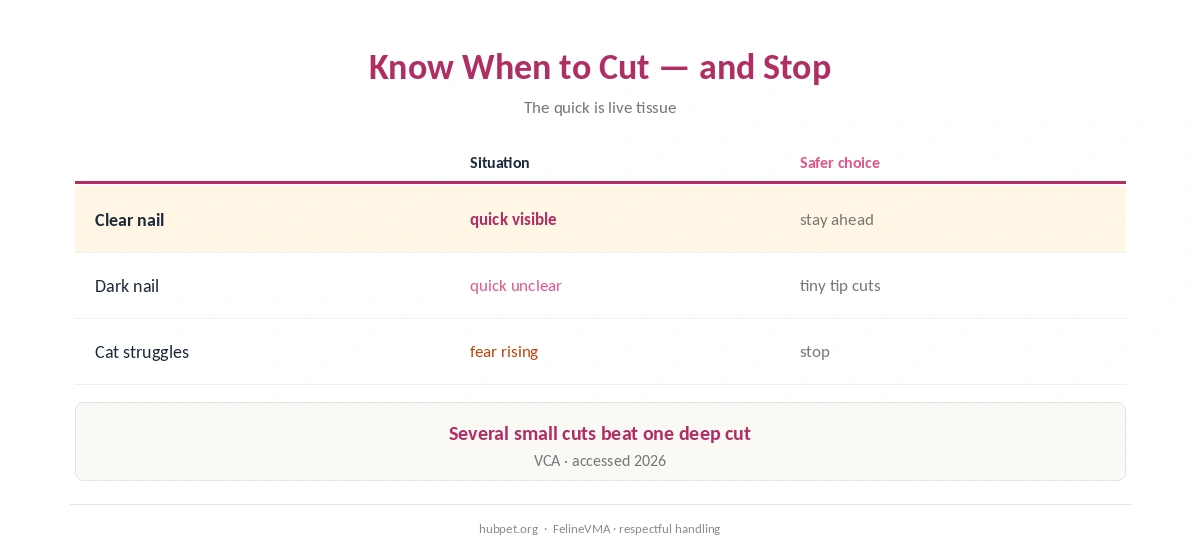
| What you see | What to do | Why |
|---|---|---|
| Clear nail, quick visible | Cut well ahead of the pink quick | Avoid live tissue |
| Dark nail, quick unclear | Take very small tip cuts | Reduce risk of cutting too far |
| Cat pulls away or struggles | Stop and reset later | Prevent fear and injury |
How to Trim a Cat’s Nails Safely: Cut a Little at a Time
Hold the paw gently and press the pad so the claw extends. Position the clipper for a small cut at the tip, away from the quick. VCA specifically recommends gradual shortening because several small cuts are safer than an overzealous first cut (VCA, accessed 2026). Reward cooperation after a nail or a paw. If the cat stays comfortable, continue; if not, stop. The new daily cat care checklist can include brief calm paw handling without making every day a trimming day. That is how to trim a cat’s nails safely without turning one session into a struggle.
- Let the cat investigate the clippers without restraint.
- Touch one paw briefly and reward calm behavior.
- Extend one claw so you can identify the safe tip.
- Trim a small amount and check the nail before taking more.
- Reward the cat and end the session before fear escalates.

Do not use forceful restraint, pin the cat, or chase the cat to finish the job. FelineVMA states that aversive handling can worsen fear and affect welfare (FelineVMA, 2026). If home trimming is unsafe, ask your veterinarian or a qualified groomer to demonstrate a lower-stress setup. Meanwhile, appropriate scratching remains important even for trimmed nails; why cats scratch furniture explains the normal behavior, and sofa scratching redirection shows how to protect furniture without suppressing scratching. Knowing when to stop is part of how to trim a cat’s nails safely.
What If You Cut Too Close?
If you cut the quick, the nail can bleed and hurt. Stop trimming that paw and keep the cat calm. VCA’s broken-nail guidance notes that the quick contains blood vessels and nerves and that damaged nails can be painful (VCA, accessed 2026). If bleeding is heavy, does not stop promptly, the nail is torn, or the cat is very painful, contact your veterinarian. Do not give human pain medication. Use pet emergency signs if there is severe bleeding or another urgent problem.

Nail care also fits into broader home safety. The pet-proofing guide helps remove snag hazards, while the purring guide is a reminder not to use one behavior as proof that a cat is comfortable.
When to Call Your Vet
Call your veterinarian if a nail is torn, grows into the paw pad, bleeds persistently, looks infected, or if your cat suddenly resists paw handling because of pain (VCA, accessed 2026). Ask for help before forcing a trim when the cat cannot be handled safely. Go now for severe uncontrolled bleeding or another emergency sign.
How We Research
HubPet uses published veterinary, welfare, behavior, and research sources rather than personal anecdotes. We read these sources on October 11, 2026: VCA How to Trim a Cat’s Nails, FelineVMA 2026 Respectful Handling statement. See How We Research for our method.
How to Trim a Cat’s Nails Safely FAQ
VCA says many indoor cats need nail trims about every 2–4 weeks, but the right interval depends on the individual cat and nail wear.
Take only a small amount at a time and stay well away from the quick. If the quick is hard to see, make very small tip cuts.
No. VCA specifically advises going at the cat’s pace. One nail or one paw can be enough for a successful session.
No. VCA and FelineVMA favor minimal, respectful handling. Stop if restraint becomes a struggle.
Stop the session. Contact your veterinarian if bleeding is heavy or persistent, the nail is torn, or the cat appears very painful.
The Bottom Line
How to trim a cat’s nails safely is mostly about small cuts and low-pressure handling. See the quick, trim gradually, reward cooperation, and stop before the cat panics. If the nail is damaged or home handling is unsafe, let a veterinarian or experienced professional take over.