
This article is general information, not veterinary advice. If your pet seems unwell, is in pain or may have eaten something harmful, contact your vet or an animal poison control line right away. Read our vet disclaimer.
Is dominance theory still useful in dog training? Not as a general training framework for pet dogs. The AVSAB dominance position statement says dominance describes a relationship involving priority access to resources, not a personality trait that explains most unwanted behavior. AVSAB’s current 2021 humane-training position recommends reward-based methods for all dog training and behavior modification.
That does not mean the word “dominance” has no scientific use. Researchers can study stable status relationships between animals. However, using an “alpha” story to explain barking, jumping, recall problems, fear, or household conflict often skips learning history, context, motivation, and medical factors. Those are the variables a practical training plan actually needs.
Is Dominance Theory Still Useful in Dog Training? Separate Two Meanings
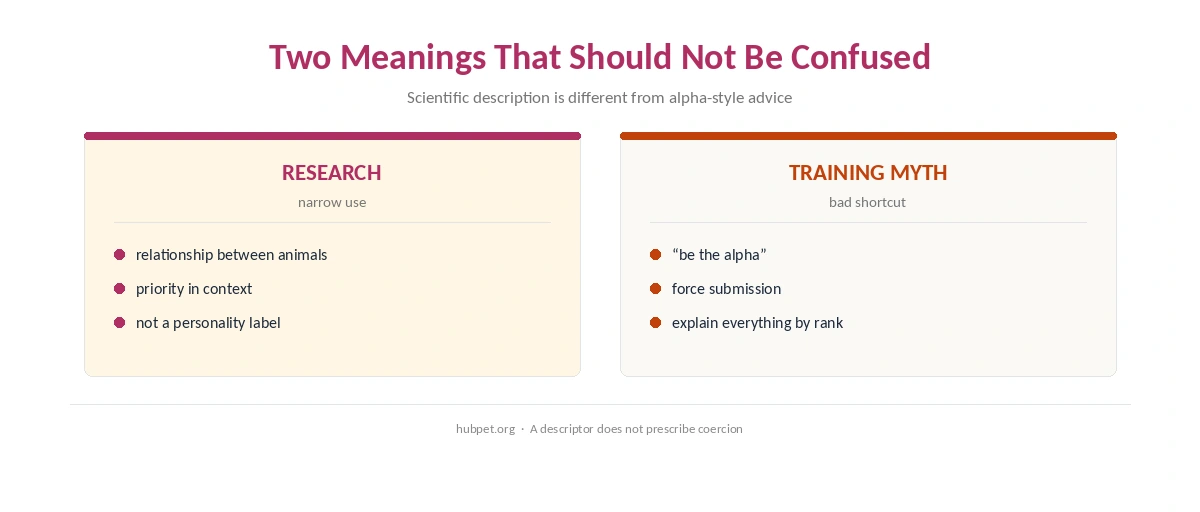
In animal behavior research, dominance can describe a relationship when one individual consistently gains priority access and another consistently defers. Is dominance theory still useful in dog training as a description of some social relationships? Only in that narrow descriptive sense. AVSAB makes this distinction explicitly. A 2009 review by Bradshaw, Blackwell, and Casey also argued that dominance belongs to relationships and is often misused as an individual trait or motive for aggression.
Training advice uses the word differently when it tells a person to become “alpha,” win every doorway, eat first, pin the dog, or use force to establish rank. AVSAB rejects dominance hierarchy theory as a general guide for behavior modification. Instead, it recommends learning theory, reinforcement, desensitization, and counterconditioning. That is the same foundation used in HubPet’s positive-reinforcement guide and basic dog training at home.
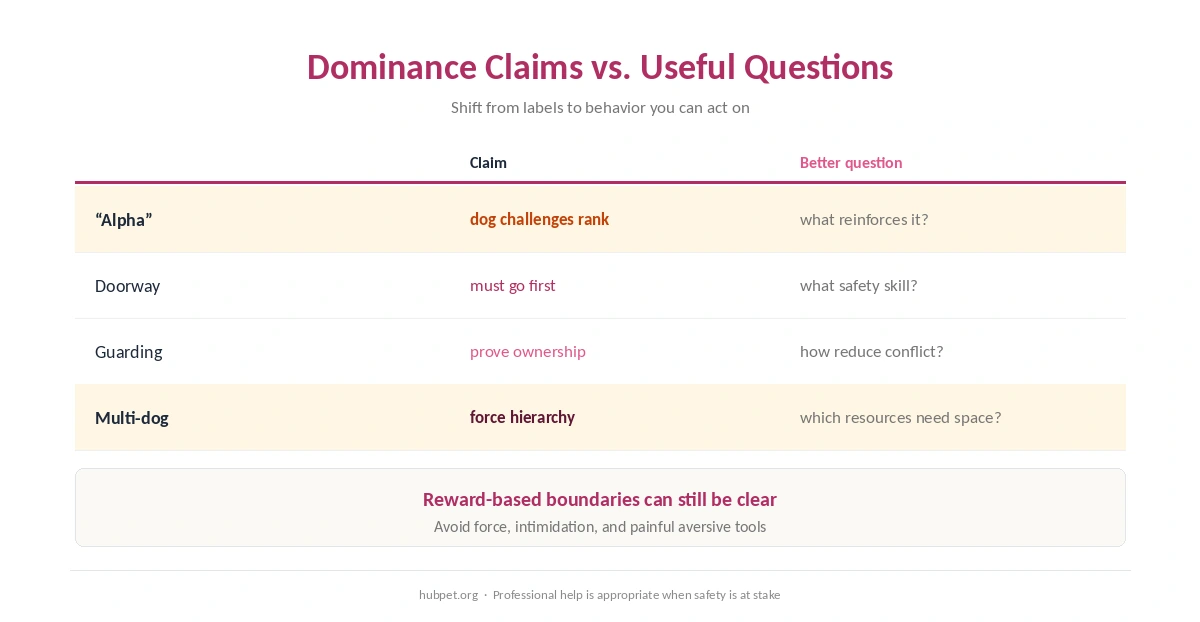
| Claim | What evidence-based guidance says | Better training question |
|---|---|---|
| “The dog is trying to be alpha” | Most everyday training problems do not establish a rank motive | What consequence is reinforcing the behavior? |
| “I must force submission” | AVSAB warns that coercion can increase fear or defensive aggression | How can I teach and reward an alternative? |
| “Dominance never exists in dogs” | Status relationships can be studied between individuals | Does that relationship explain this specific training problem? |
| “Rewarding makes the dog dominant” | AVSAB says food rewards do not confer social rank | Which reward makes the desired behavior repeat? |
Why the Alpha Model Creates Bad Training Decisions
When a trainer labels every unwanted behavior a rank challenge, the response tends to become confrontation. AVSAB’s position warns that punishment can suppress aggression without addressing fear or anxiety, and that threats or force may trigger defensive aggression. A 2009 survey of owners seeking veterinary behavior help also reported aggressive responses to some confrontational techniques. Therefore, a rank-first diagnosis can add risk without identifying the actual trigger.
Consider common problems. Door barking can involve arousal and learned reinforcement, so use the door-barking guide and quiet-cue training. Jumping often persists because greetings reward it. The jumping guide teaches an alternative.
Leash pulling is another skill problem, not proof of a rank challenge. The loose-leash guide uses reinforcement and setup rather than a story about social status.
Resource guarding is another example where confrontation can be dangerous. Do not prove ownership by repeatedly taking valued items. Use management, avoid provoking the dog, and seek qualified reward-based help when guarding includes freezing, growling, snapping, or biting risk. The safety principles in leave-it training and trash-can pet-proofing reduce opportunities for conflict without a power struggle.
Is Dominance Theory Still Useful in Dog Training When Dogs Compete?
Competition over resources can occur between dogs, and researchers may describe status or priority relationships. Is dominance theory still useful in dog training when dogs compete? It may describe a relationship, but “be more dominant” is not a treatment plan. A 2014 review by Schilder, Vinke, and van der Borg argued that formal dominance can describe some dog-dog relationships while warning against enforced human dominance because it can carry risk. A scientific descriptor does not justify coercive training.
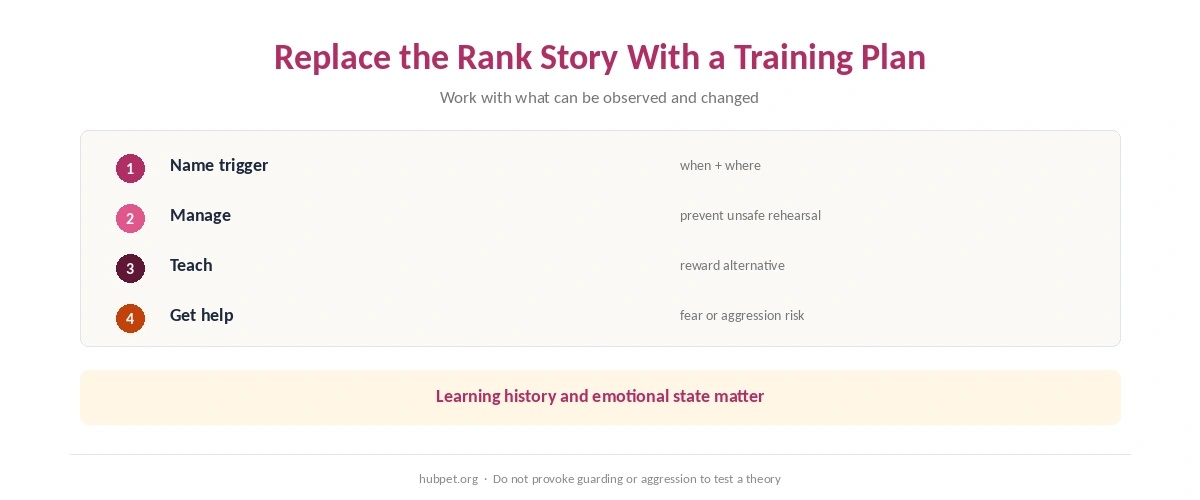
In a multi-dog home, manage the concrete resources and contexts where tension appears. Separate feeding when needed, remove high-conflict items, provide rest areas, and interrupt patterns before escalation. The multi-pet household checklist and the pets-get-along guide focus on access and safety rather than rank labels.
For fear, reactivity, or aggression, the plan should address the dog’s emotional state and learning history. The reactive-dog guide and the separation-anxiety guide explain why distance, management, gradual exposure, and professional support matter. Aversive tools are not a shortcut: AVSAB’s 2021 statement says there is no evidence they are necessary for dog training or behavior modification.
When to Get Professional Help
Get help from a veterinarian, veterinary behaviorist, or qualified reward-based behavior professional when aggression, severe fear, guarding, or reactivity creates a safety risk. Sudden aggression or a major behavior change also deserves veterinary assessment because pain or illness can contribute. Use the common training mistakes guide to screen methods, and avoid trainers who frame force, intimidation, or aversive tools as necessary to establish rank.
Do not use forced pinning, painful or aversive collars, leash corrections, or physical intimidation to test whether a dog “respects” you. AVSAB’s current position recommends reward-based training and tells trainers to avoid aversive methods. Clear boundaries can still exist: manage access, teach the behavior you want, and reinforce it consistently.
How We Research
HubPet reviewed dominance and humane-training sources on October 11, 2026. We used the AVSAB dominance position statement, the AVSAB 2021 Humane Dog Training Position Statement, and the Bradshaw, Blackwell, and Casey 2009 review. We also checked later scholarship that argues formal dominance can describe some dog relationships while cautioning against enforced human dominance. Our research process reports that disagreement rather than pretending the word has only one scientific meaning.
Not as a general framework for teaching pet dogs or explaining most unwanted behavior. Evidence-based training focuses on learning, context, motivation, and welfare.
Some research uses dominance to describe stable status relationships between individual dogs. That is different from claiming a dog has a dominant personality or needs an alpha owner.
No rank ritual is required. Teach door manners because they are useful and safe, using reinforcement for waiting or another desired behavior.
No. AVSAB specifically rejects the idea that food rewards confer social rank. Rewards are tools for increasing behavior you want repeated.
Ask what methods they plan to use. Choose a professional who uses reward-based, evidence-based methods and avoids force, pain, intimidation, and dominance-based confrontation.
The Bottom Line on Whether Dominance Theory Is Still Useful in Dog Training
Is dominance theory still useful in dog training? The term can describe specific social relationships in research, but it is a poor general explanation for household behavior and an unsafe basis for coercive training. Teach observable skills, manage triggers and resources, use reward-based methods, and get qualified help when fear or aggression raises the stakes.