
This article is general information, not veterinary advice. If your pet seems unwell, is in pain or may have eaten something harmful, contact your vet or an animal poison control line right away. Read our vet disclaimer.
How to stop a dog from jumping on people is mainly a question of what gets rewarded during greetings. Blue Cross explains that dogs repeat actions that bring rewards, and it specifically recommends rewarding a puppy for keeping all four paws on the floor during greetings (Blue Cross, 2020; accessed 2026). AVSAB recommends reward-based methods for all dog training and behavior modification (AVSAB, 2021; reaffirmed 2025). Therefore, the plan is to prevent repeated jumping, make calm greetings easy, and reward the behavior you want people to see. A useful companion behavior page is why Dogs Lick People.
How to Stop a Dog from Jumping on People: Manage the Greeting
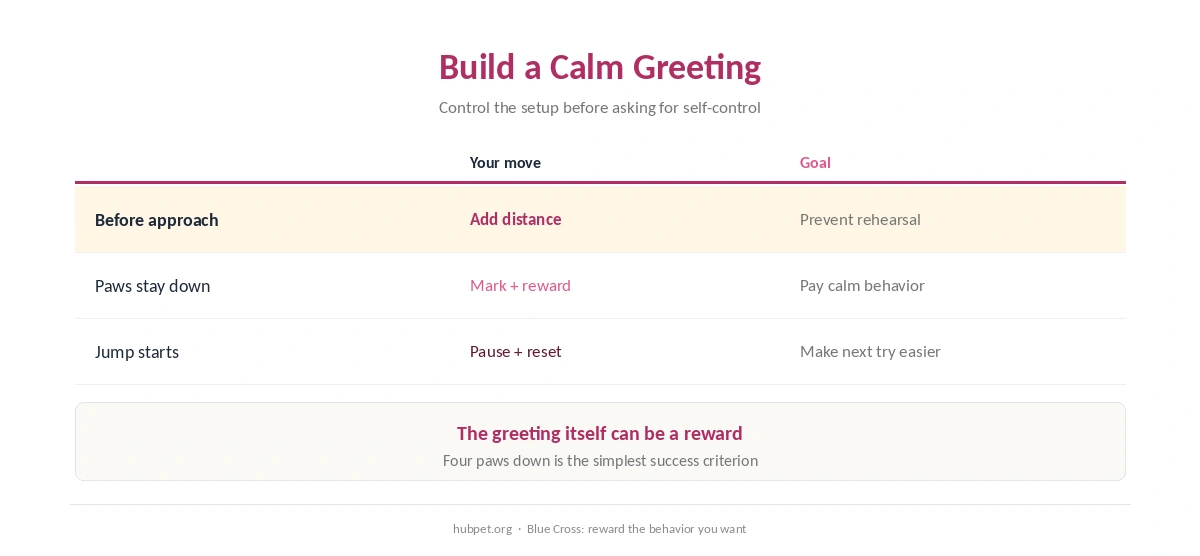
Start by changing the greeting setup. If visitors rush in, bend over the dog, or keep touching the dog while paws are in the air, jumping can keep paying off. Instead, use a leash, gate, or extra distance so the dog can approach only when the greeting is calm. Then ask visitors to wait while you reward four paws on the floor. This makes how to stop a dog from jumping on people a management problem first and a training problem second.
| Greeting moment | What to do | Why it helps |
|---|---|---|
| Before the person approaches | Create distance or use a barrier | Prevents repeated jumping |
| Four paws stay down | Mark and reward immediately | Makes the wanted behavior valuable |
| Dog jumps again | Pause the greeting and reset | Removes the social payoff without punishment |
How to Stop a Dog from Jumping on People: Reward Four Paws Down
Blue Cross advises rewarding the behavior you want and notes that simply ignoring jumping can sometimes make a puppy try harder (Blue Cross, 2020; accessed 2026). So give the dog a clear route to success. A person can crouch or greet at a lower level while the dog keeps four paws on the floor, then deliver attention or a small food reward. If your dog already knows sit, you can use it as an optional greeting behavior. However, four paws down is the essential criterion.
- Practice first with one familiar person and a quiet room.
- Approach only while the dog can keep four paws on the floor.
- Mark the calm moment and reward it right away.
- Let the person greet briefly while the dog stays down.
- If jumping starts, pause the greeting, reset, and make the next attempt easier.
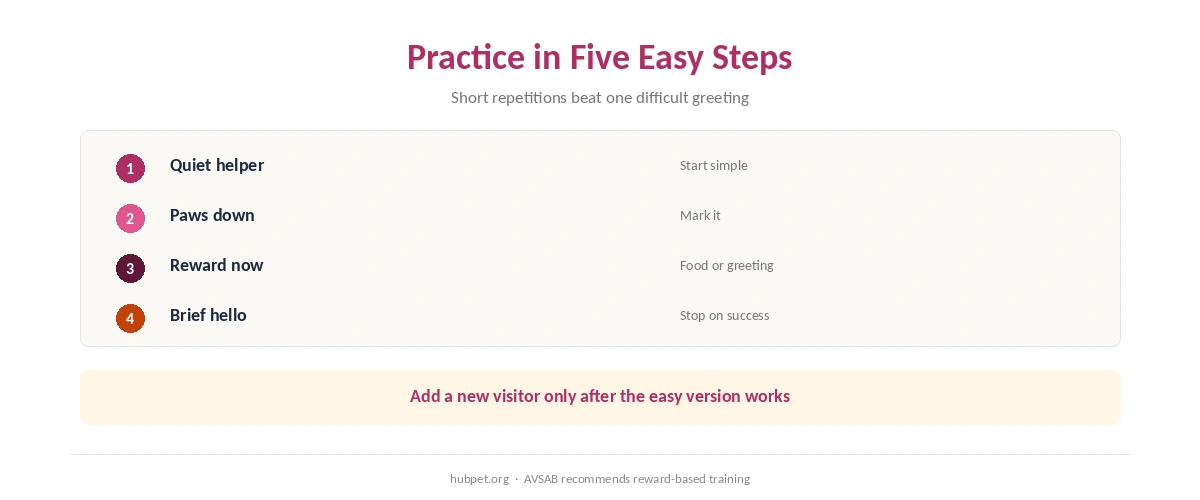
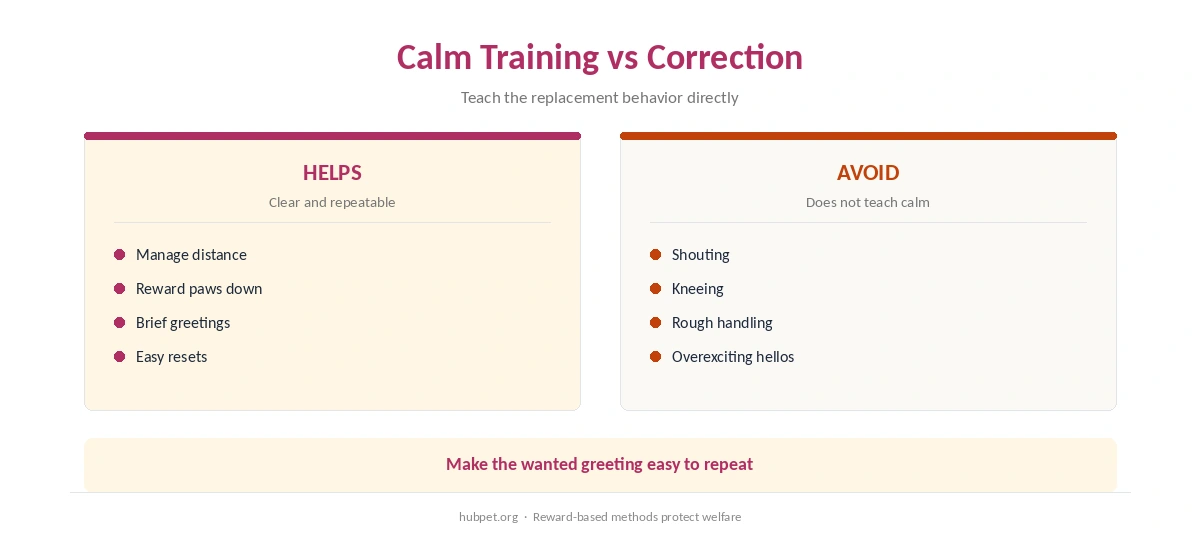
Keep early sessions short and predictable. The same approach appears in positive reinforcement training and basic dog training at home. AVSAB recommends reward-based methods and advises against aversive training (AVSAB, 2021; reaffirmed 2025). Therefore, do not knee the dog, shout, or use physical corrections. Those reactions do not teach the calm greeting you actually want. For a related behavior guide, see how to Respond Calmly to Attention-Seeking Behavior.
Make the Skill Work With Real Visitors
Once one helper can greet successfully, vary one thing at a time. Practice with a different person, a person wearing a coat, or a visitor who enters through the usual door. Meanwhile, keep the dog far enough from the person to succeed. If the dog becomes too excited to take food or keep paws down, increase distance and lower the difficulty. Progress comes from many easy repetitions, not from one long greeting test. If a visitor also triggers barking, use the calmer setup in door-barking training. Watch the whole body rather than the tail alone; tail wagging is not a simple happiness signal.
How to stop a dog from jumping on people also gets easier when household rules stay consistent. The new pet owner checklist can help organize those routines. Meanwhile, simple barriers and controlled access use the same management logic as pet-proofing a home.
How We Research
HubPet uses published veterinary, welfare, behavior, and research sources rather than personal anecdotes. We read these sources on October 11, 2026: Blue Cross reward-based puppy training guidance, AVSAB Humane Dog Training Position Statement. See How We Research for our method.
How to Stop a Dog from Jumping on People FAQ
Jumping can persist because greetings, touch, eye contact, or attention make it rewarding. Blue Cross emphasizes rewarding the greeting behavior you want instead (Blue Cross, 2020; accessed 2026).
Not necessarily. Blue Cross notes that ignoring can make some puppies try harder. A clearer plan is to reward four paws on the floor and manage the greeting so the dog can succeed.
A sit can be useful if it is already easy for your dog. However, four paws on the floor is a simpler core rule and can work even when a full sit is difficult.
Ask visitors to approach calmly, greet only while paws stay down, and pause if jumping starts. Consistency makes the reward pattern easier to learn.
No. AVSAB recommends reward-based training and says aversive methods should not be used for dog training or behavior modification (AVSAB, 2021; reaffirmed 2025).
The Bottom Line
How to stop a dog from jumping on people is to make calm greetings more rewarding than jumping. Prevent rehearsal, reward four paws down, and let social attention arrive only when the dog can stay grounded. Then add new visitors gradually while keeping the same simple rule.