
This article is general information, not veterinary advice. If your pet seems unwell, is in pain or may have eaten something harmful, contact your vet or an animal poison control line right away. Read our vet disclaimer.
Why dogs bark at the door has no single answer. RSPCA says dogs bark for different reasons (RSPCA, accessed 2026). These include excitement, fear, frustration, boredom, or a wish to make something move away. A doorbell or visitor can therefore act as an alarm cue, an exciting predictor, or a stressful event. Why dogs bark at the door therefore depends on the trigger and the dog’s response. The useful question is not “How do I silence the bark?” Instead, ask what happens before it and what the dog can do instead. For a related behavior guide, see why Dogs Bark at People Walking Past.
Why Dogs Bark at the Door: Start With the Trigger
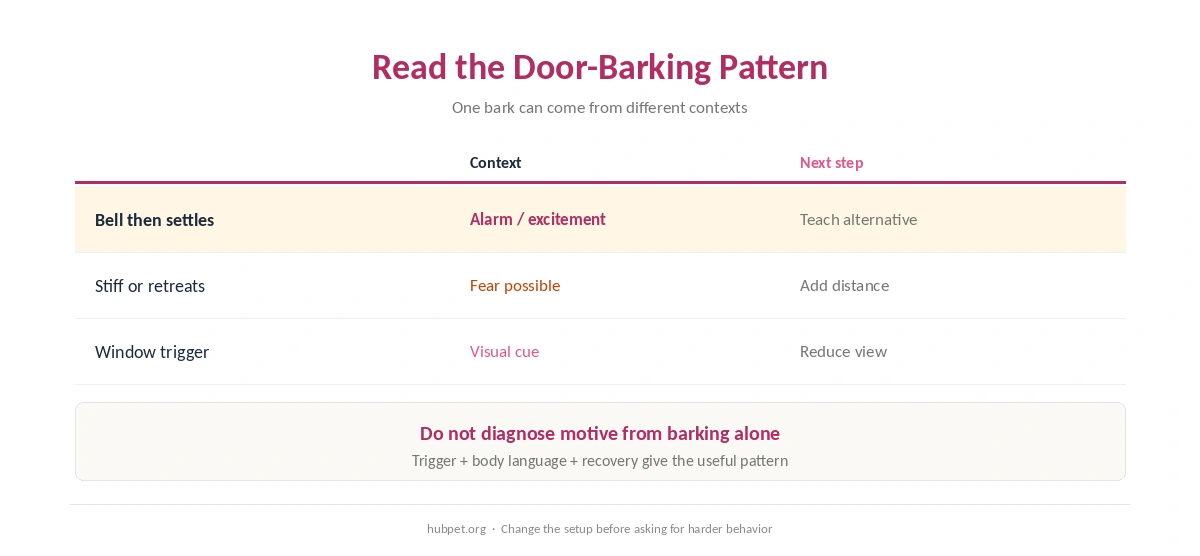
RSPCA describes barking as normal dog communication and advises looking for the cause when barking increases or becomes excessive (RSPCA, accessed 2026). At the door, note whether the trigger is the bell, footsteps, a person appearing, movement outside, or the visitor entering. This context helps explain why dogs bark at the door without assigning one motive. Also watch the rest of the body. A loose body and easy recovery suggest a different emotional state from a stiff posture, staring, retreating, or repeated inability to settle (RSPCA, accessed 2026).
| What you see | Possible context | What to do next |
|---|---|---|
| Bark at bell, then recover | Learned alarm or excitement | Teach a calm alternative before adding visitors |
| Bark plus stiff or worried body | Fear or high arousal may be involved | Increase distance and avoid forcing contact |
| Bark at passers-by | Visual trigger may maintain the pattern | Reduce access to the view while training |
Why Dogs Bark at the Door: Teach an Alternative Response
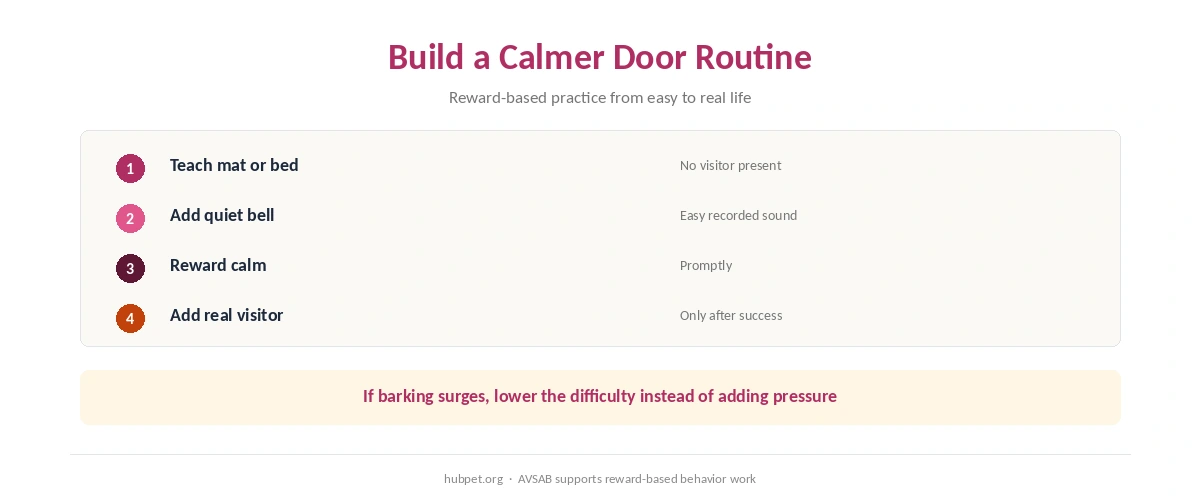
Blue Cross recommends giving a dog another familiar task, such as going to a bed, and rewarding the behavior you want (Blue Cross, accessed 2026). It also describes gradual desensitization to recorded doorbell sounds at a low intensity, paired with food when the dog remains calm (Blue Cross, accessed 2026). AVSAB says behavior work should use reward-based methods rather than aversive tools or physical punishment (AVSAB, 2021; reaffirmed 2025).
- Choose an easy alternative behavior, such as moving to a mat or bed.
- Practice that behavior when nobody is at the door, using rewards.
- Add a very easy version of the trigger, such as a quiet recorded bell.
- Reward calm responses and make the trigger easier if barking escalates.
- Only add real visitors after the dog can succeed in simpler practice.
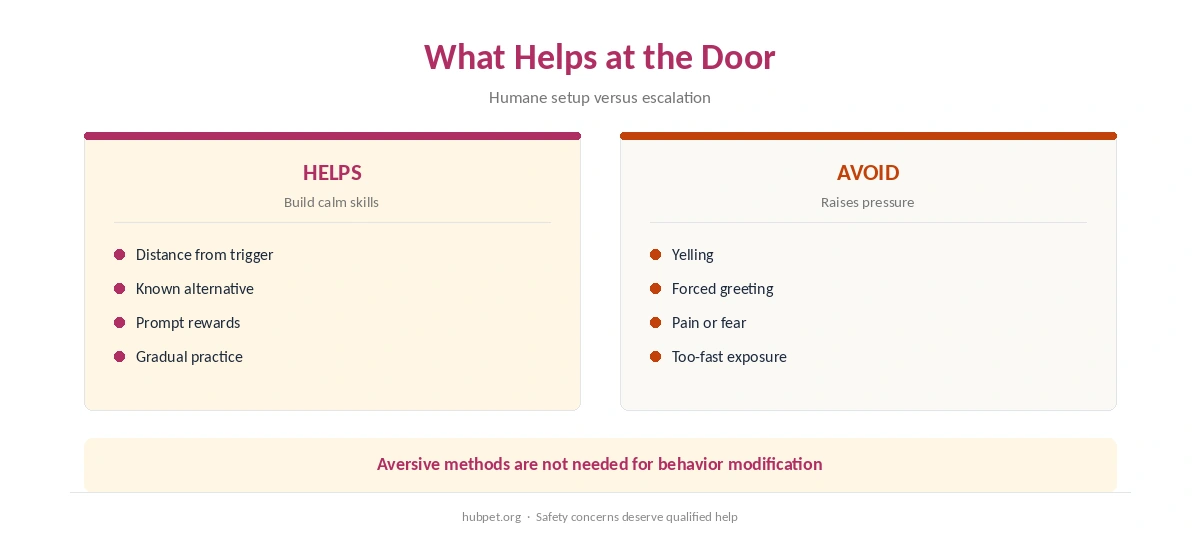
This plan follows the same reward-based principles used in positive reinforcement training. It also works better when the dog already understands simple cues from basic dog training at home. Do not punish barking at the door. AVSAB states that aversive methods are not necessary for behavior modification and can carry welfare risks (AVSAB, 2021; reaffirmed 2025).
When Door Barking May Need More Than Training
A sudden increase in barking deserves a health check. RSPCA notes that hearing problems or other health issues can contribute to changed barking (RSPCA, accessed 2026). Fear, aggression, separation-related distress, or a pattern that creates a safety risk also calls for qualified help. Start with your veterinarian when the change is sudden or health may be involved, then use a credentialed reward-based behavior professional as appropriate.
How We Research
HubPet uses published veterinary, welfare, and behavior guidance rather than personal anecdotes. We read these sources on October 11, 2026: RSPCA dog barking guidance, Blue Cross barking guidance, AVSAB humane training position. See How We Research for our method.
Why Dogs Bark at the Door FAQ
Why dogs bark at the door varies with context. Dogs may bark from alarm, excitement, fear, frustration, or another context. RSPCA advises identifying the cause rather than assuming one motive (RSPCA, accessed 2026).
No. AVSAB recommends reward-based behavior work and advises against aversive methods (AVSAB, 2021; reaffirmed 2025).
Yes. Blue Cross lists a familiar “go to bed” task as one alternative response for door-related barking (Blue Cross, accessed 2026).
Blue Cross describes gradual low-volume exposure paired with rewards as a desensitization and counterconditioning approach (Blue Cross, accessed 2026).
If barking increases suddenly or you suspect hearing or another health problem, RSPCA advises speaking with a veterinarian (RSPCA, accessed 2026).
The Bottom Line
Why dogs bark at the door depends on the trigger and the dog’s emotional state. Identify the pattern, teach a simple alternative, and raise difficulty gradually with rewards. If the behavior changes suddenly or includes fear, aggression, or a safety concern, involve your veterinarian or a qualified humane behavior professional.