
This article is general information, not veterinary advice. If your pet seems unwell, is in pain or may have eaten something harmful, contact your vet or an animal poison control line right away. Read our vet disclaimer.
Why your dog follows you everywhere can have several explanations, and following alone does not diagnose separation anxiety. Merck Veterinary Manual notes that dogs with close attachment behaviors such as following family members are at no greater risk of separation anxiety than dogs that do not show those behaviors (updated 2026). So why your dog follows you everywhere depends on the pattern around rest, departure, and reunion.
Why Your Dog Follows You Everywhere: Normal Attachment vs Distress
Dogs are social animals, and staying near a familiar person can be ordinary. The key question is what happens when the dog cannot follow. AAHA describes separation anxiety as excessive distress during an owner’s absence, with signs such as persistent vocalization, pacing, destructive behavior, or house-soiling (updated 2026). The separation-anxiety guide focuses on those absence-related signs.
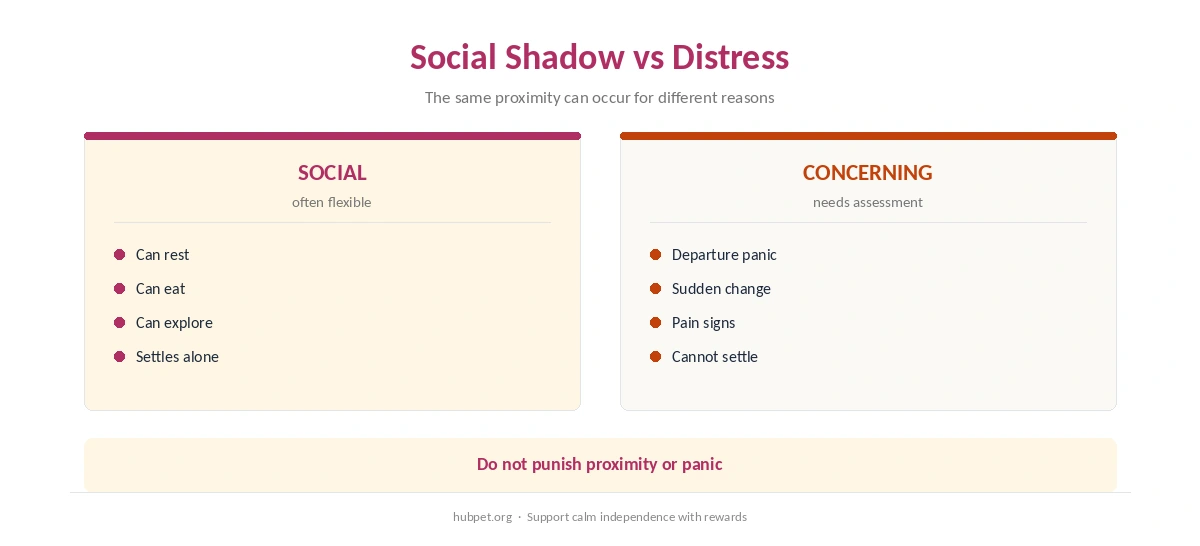
Cornell also notes that dogs with separation anxiety may prefer to stay in the same room while the owner is home and may become stressed during departure cues. However, preference for proximity is not enough by itself. Look at the full pattern rather than labeling a friendly shadow as anxious. A sudden shift in why your dog follows you everywhere deserves more attention than a long-standing habit.
| Pattern | More consistent with | Next step |
|---|---|---|
| Follows, then settles | Social preference | Normal routine |
| Distress starts at departure cues | Possible separation anxiety | Discuss with vet/professional |
| Sudden clinginess plus behavior change | Possible pain or illness | Veterinary exam |
| Cannot settle even with you home | Broader anxiety or discomfort | Assess context |
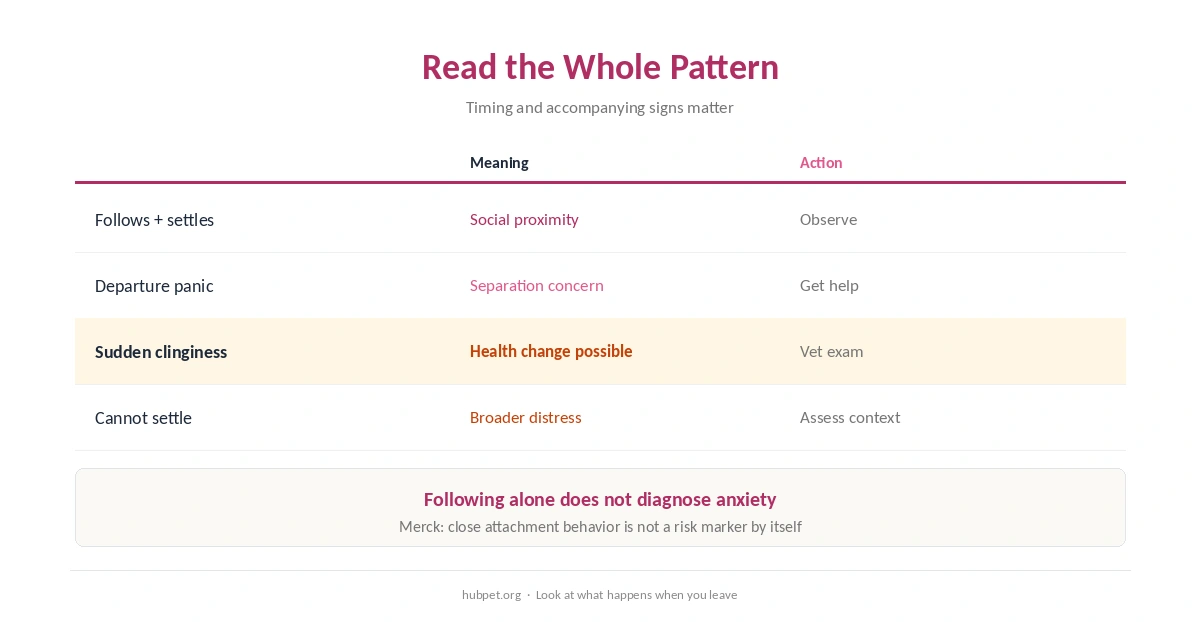
Why Your Dog Follows You Everywhere More Than Before
A sudden change deserves more caution than a lifelong social habit. AAHA says pain can cause personality and behavior changes, including unusual attention-seeking, restlessness, fear, irritability, or withdrawal (2024). Compare the signs of pet pain if the following behavior appears with stiffness, appetite change, trouble getting comfortable, or another new sign. A routine check helps explain why your dog follows you everywhere without assuming one cause. For a closer look at the related behavior pattern, see why Pets May Become Clingy Suddenly.
Routine can also shape proximity. The daily dog care checklist, calm-space guide, and first-week new-dog checklist help build predictable rest, activity, and independent downtime without punishment.
- Notice whether the dog can settle when you are still in the room.
- Watch what happens during departure cues and after you actually leave.
- Keep daily exercise, rest, enrichment, and toileting reasonably predictable.
- Reward calm independent choices such as resting on a bed or mat.
- Do not suddenly shut a distressed dog away as a test of willpower.
- Record short video of absence behavior if your veterinarian or behavior professional requests it.
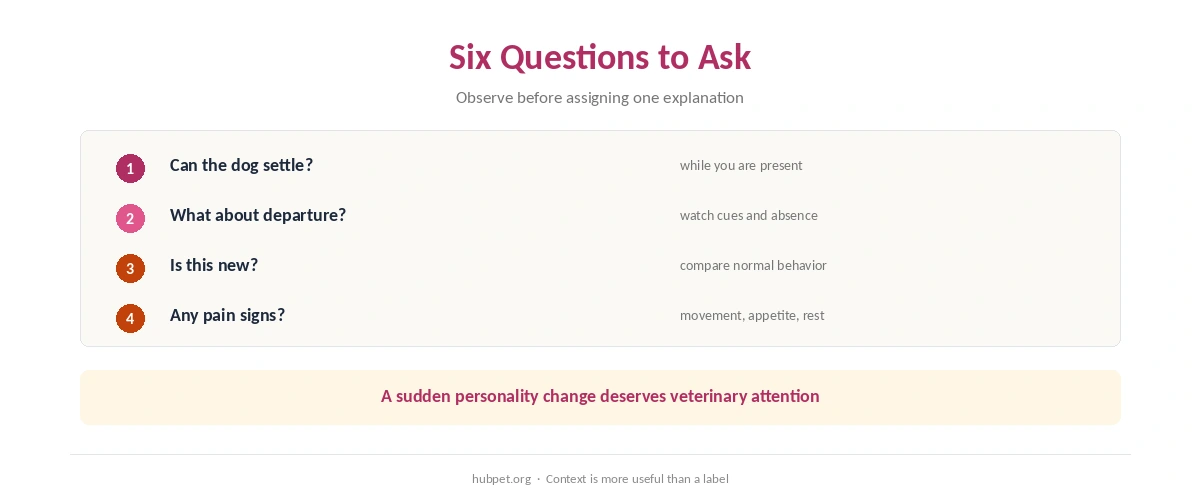
If the dog becomes agitated around doors or outside triggers, compare excessive barking. The reactivity-on-walks guide covers distance and safety around triggers. For calm stationing, practice the stay cue with rewards, but never use it to force a frightened dog through separation distress.
Other isolated behaviors should also be read in context. The head-tilt guide shows why one familiar behavior can be normal in one setting and concerning in another. That same context-first approach is useful here.
When to Call Your Vet About New Clinginess
Call your veterinarian when following or clinginess is a new personality change, especially with pain signs, appetite change, vomiting or diarrhea, altered drinking or urination, weakness, confusion, or reduced mobility. AAHA emphasizes veterinary assessment for sudden behavior changes and possible pain (2024).
If the dog has trouble breathing, collapses, has a seizure, has severe bleeding, or may have eaten something toxic, use pet emergency signs and seek urgent care. If the problem is absence-related panic rather than a medical emergency, use qualified behavior help instead of punishment.
How We Research
HubPet uses veterinary organizations and research rather than personal anecdotes. We read these sources on October 11, 2026: Merck Veterinary Manual behavior problems in dogs, updated 2026, AAHA separation anxiety guidance, updated 2026, AAHA common pet pain signs, 2024, Cornell canine anxiety guidance, accessed 2026. See How We Research for our method.
Why Your Dog Follows You Everywhere FAQ
No. Merck states that close attachment behaviors such as following family members do not by themselves increase the risk of separation anxiety. Distress during absence is the more important pattern.
It can reflect ordinary social proximity, learned routine, anticipation of activity, or another context. Look at whether the dog can also relax independently.
A sudden behavior change can be linked to pain, illness, anxiety, or environmental change. Arrange a veterinary assessment if the shift is new or comes with other signs.
Do not use abrupt social withdrawal as punishment. Reward calm independent resting and address true separation distress with a structured, humane plan.
Following itself is not an emergency. Urgent signs such as breathing difficulty, collapse, seizure, severe bleeding, or suspected poisoning require immediate veterinary care.