
This article is general information, not veterinary advice. If your pet seems unwell, is in pain or may have eaten something harmful, contact your vet or an animal poison control line right away. Read our vet disclaimer.
An XL kennel size label is a starting point, not a promise that a particular dog will fit. One manufacturer may call a 48-inch (122 cm) crate extra-large, while another range includes 42 inches (107 cm), 48 inches (122 cm) or bigger options. More important are the interior usable length, standing height, door opening and your dog’s actual body dimensions. A large dog needs enough space to stand normally, turn around and lie down in a comfortable position. This guide shows where to measure, how to interpret nominal crate labels from 36 inches (91 cm) to 54 inches (137 cm), and what to verify before choosing a folding wire crate, molded kennel or furniture-style enclosure. Kennel size also depends on whether the intended use is home rest or regulated transport.
Measure the dog, then check the *interior* kennel dimensions
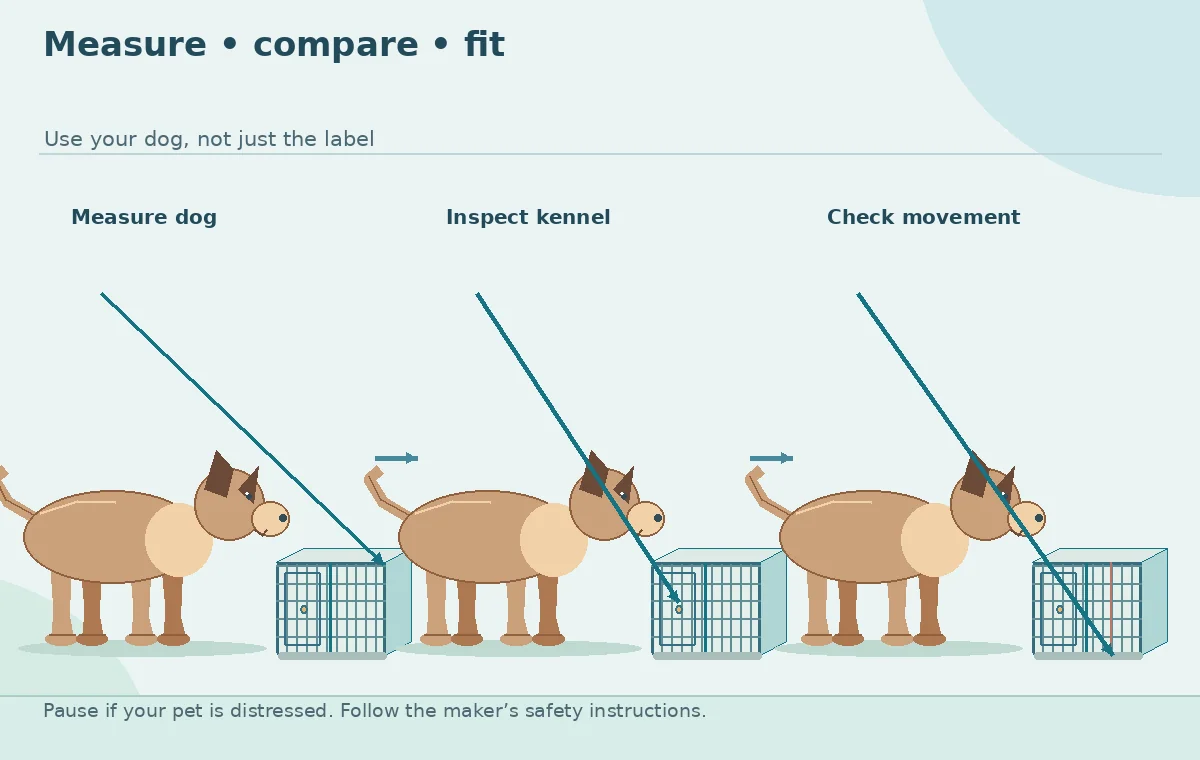
Measure your dog while standing naturally and relaxed, rather than guessing from a breed chart or body weight alone. For length, use the distance from the nose to the base of the tail; for standing height, note the highest point needed for the dog to stand comfortably, including head and ears when upright. Compare these measurements against the manufacturer’s usable internal dimensions, not only the shipping box or stated external footprint. The entrance should not force the dog to crouch or scrape its back. Test whether your dog can turn and lie on its side without curling into a tiny ball. Extra-long or deep-chested individuals may need a different crate profile even when their scale weight is typical. The crate should be a resting space, not a punishment enclosure.
| Seller label | Nominal length example | What to verify instead |
|---|---|---|
| Medium/large | 36 inches (91 cm) | Standing height and turning space |
| Large | 42 inches (107 cm) | Body length plus usable interior |
| XL | 48 inches (122 cm) | Door opening, height and width |
| Giant or XXL | 54 inches (137 cm) | Manufacturer-specific internal dimensions |
| Any size | Exterior number may be rounded | Measure actual dog and usable floor |

A practical fit check for an XL crate or kennel
Ask the seller for internal width, internal height, and the length with the tray, divider and door hardware installed. Some folding wire crates include a divider; it can help reduce a young puppy’s available resting area while the dog grows, provided the remaining space is still comfortable. Manufacturers such as MidWest publish several nominal lengths, including 36 inches (91 cm), 42 inches (107 cm) and 48 inches (122 cm), but size names differ across product lines. For a growing dog, estimate the adult size cautiously and check the divider mechanism rather than purchasing a crate solely from an online breed list. Always check that vents remain clear and there are no sharp, protruding interior parts.
- Record body length from nose to tail base while the dog stands normally; keep measurements in both inches and centimeters.
- Measure standing height to the head or ears in a normal comfortable posture, rather than only shoulder height.
- Compare both dimensions with a seller’s *usable interior* measurements, accounting for the tray and hardware.
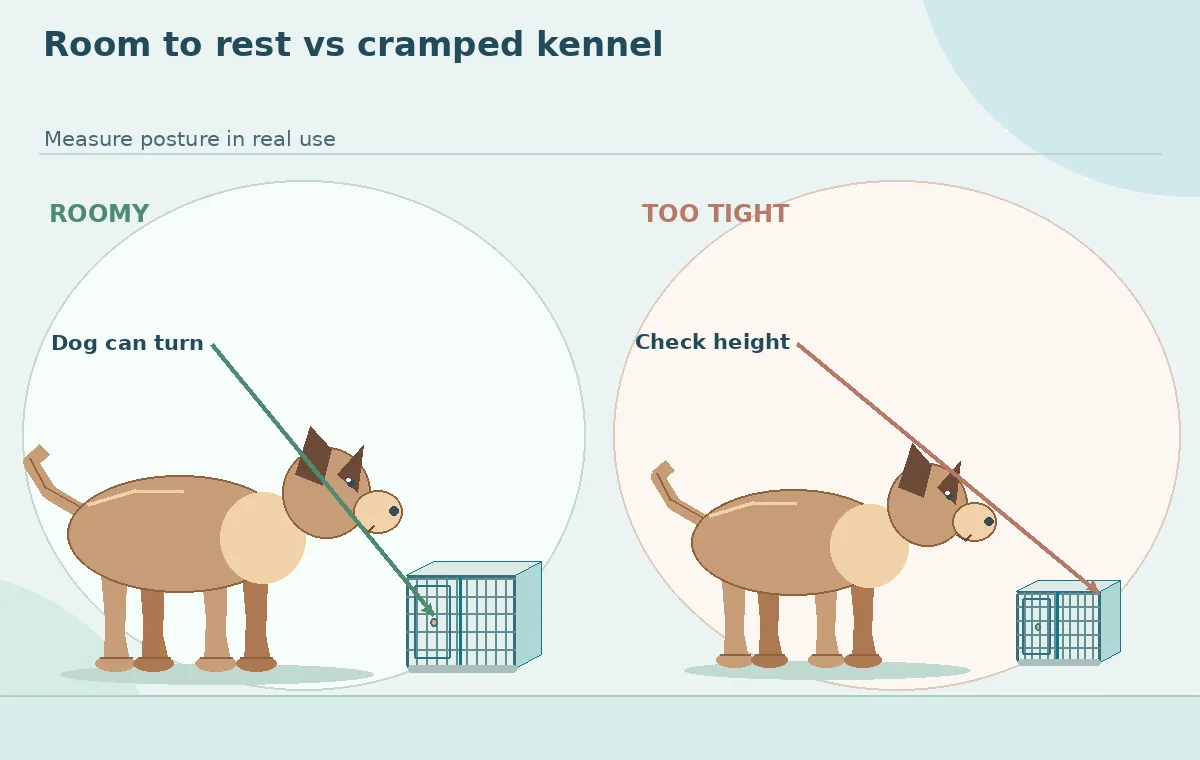
- Confirm the dog can stand naturally, turn around without scraping, and rest stretched out; if possible, fit-test before purchase.
- Check door clearance, latch security, floor tray, ventilation and whether the crate is rated for its intended home or travel use.
When a wire crate, plastic kennel or playpen fits better
Wire crates often offer visibility and fold-flat storage but may rattle or tempt an anxious dog to bite bars. Plastic kennels contain messes more easily and may block some visual stimulation, but internal space and ventilation can differ. A reinforced travel kennel has its own transport requirements; a typical wire home crate is not automatically crash-tested. An exercise pen supplies more floor space for activity and can be more appropriate than extended tight confinement. VCA explains that pens and play yards may include ceiling panels, yet confinement still needs exercise, play, toileting and human contact. A spacious crate does not make long periods of isolation appropriate. For the step-by-step introduction, see positive puppy crate training.
| Setting | Potential fit | Do not assume |
|---|---|---|
| Home naps | Appropriately fitted wire or plastic crate | Larger is always safer |
| Longer awake periods | Secure puppy-proofed exercise pen | Confinement replaces walks |
| Young growing dog | Adult-size crate with properly fitted divider | Divider can make space cramped |
| Car travel | Appropriate restraint or crash-tested system | Every indoor kennel protects in a collision |
| Fearful dog | Gradual training with exit options | More room resolves anxiety |
How to avoid the most common XL sizing mistakes
A dog can have the right crate length but insufficient height, especially with a tall head or high-set ears. Conversely, an extra-tall crate may still be narrow for a broad dog to turn comfortably. Door latches, bedding thickness and divider placement all change usable clearance. Measure the spot in your room as well: a crate sold as 48 inches (122 cm) long can have external hardware that increases its footprint, and a door may need swing room. Avoid placing any crate over a heat vent, in direct summer sun or where children repeatedly disturb a resting dog. A calm setup matters alongside the physical size.
Teach the dog that the space predicts rest and reward. Begin with the door open and pair voluntary entry with food or a familiar chew; build duration slowly rather than suddenly shutting a large dog in a new enclosure. For adults with a difficult history, adult crate acclimation may be more relevant than puppy methods. If your dog struggles, drools heavily or tries to break out, stop extending confinement and seek humane behavior or veterinary support. Helping a pet feel safer in a crate covers the emotional side. No published breed chart substitutes for measuring your individual dog.
When to Call Your Vet
If your dog panics, attempts to chew bars, injures its paws, drools excessively or cannot settle in a crate, discuss the situation with your veterinarian or qualified reward-based behavior professional. Confinement can worsen distress in some pets. If a veterinarian prescribes restricted movement after injury or surgery, follow that individualized advice rather than general size or exercise guidance here.
How We Research
We compared VCA clinical behavior guidance with the AKC’s basic crate-fit advice and a manufacturer’s current published size range. The size table illustrates common nominal commercial length labels, not universal XL definitions or a breed-weight formula. The pass/fail criteria use the dog’s own posture and the actual usable interior; we have not independently measured any specific product. Read our editorial standards on the About page.
Sources
VCA — Crate Training and Confinement for Puppies and Dogs; AKC — A Beginner’s Guide to Crate Training; MidWest Homes for Pets — What Size Crate Should I Get?; MidWest Homes for Pets — Contour Dog Crate (Product Specifications).
Not consistently. Some ranges use 42 inches (107 cm) for large and 48 inches (122 cm) for extra-large. Compare usable interior dimensions and your dog’s standing, turning and lying needs instead of the label.
No. Dogs differ in back length, height, width and posture. Check internal measurements, door opening and comfortable movement before selecting any crate labeled 48 inches (122 cm).
No universal breed rule determines that. A kennel labeled 54 inches (137 cm) may be useful for some individuals, but the safe choice depends on interior fit, intended use and manufacturer dimensions.
An adult-size crate with a suitable divider can work if the puppy’s current space remains comfortable. Recheck measurements as the dog grows and do not use the divider to crowd the puppy.
Do not assume so. Home crates are not automatically tested for vehicle collisions; use a restraint system specifically designed and appropriately tested for travel.