
This guide offers general information, not individualized veterinary advice. For pain, distress, illness, sudden changes, or unsafe behavior, contact your veterinarian. Read HubPet’s veterinary disclaimer.
A pet carrier for 30 pound (13.6 kg) dog searches often begin with weight, but weight alone cannot tell you whether a dog fits. A 30 lb (13.6 kg) dog may be long-legged, broad-chested or compact. Measure the animal’s actual posture, then check the carrier’s interior space and load rating. This guide compares hard-shell crates, structured soft carriers and wearable options without assuming they work equally well. It also explains airline restrictions that require checking the individual carrier and route. For travel, stability, ventilation, secure closures and a calm introduction matter more than an attractive weight badge or a marketing photograph.
Start with the dog’s measurements and the carrier interior
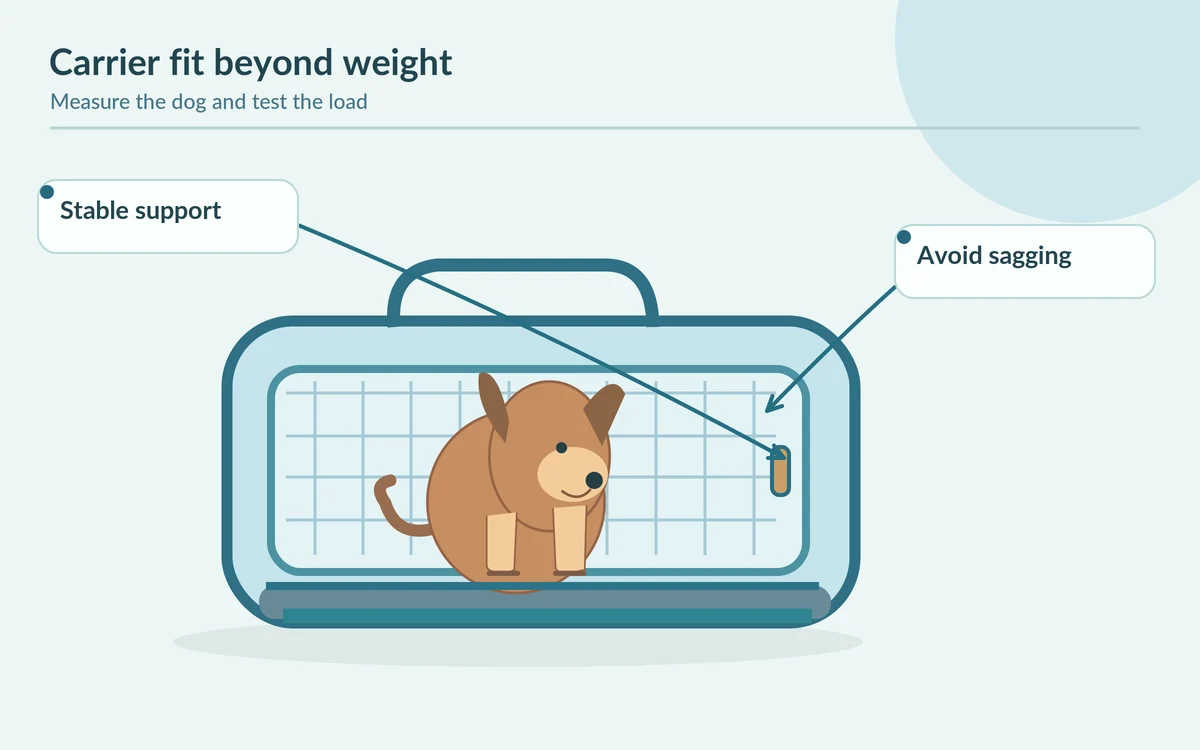
Measure your dog from nose to tail base while standing and from the floor to the highest point when upright. Also observe its shoulder width and relaxed lying position. For a 30 lb (13.6 kg) dog, those dimensions can differ greatly from another animal at the same weight. AVMA advises selecting travel enclosures that allow a pet to stand, turn and lie naturally. Compare those needs with the carrier’s inside length, height and width, not just outside dimensions. Next, verify the bottom supports the entire body without sagging. The animal should not have to crouch throughout a journey.
| Measurement | Record before shopping | Carrier check |
|---|---|---|
| Dog standing height | Floor to top of head or ears as relevant | No forced crouching |
| Body length | Nose to tail base | Can turn and lie naturally |
| Shoulder width | Widest relaxed body point | No wall pressure |
| Body weight | Current weight, including any growth | Within manufacturer load rating |
| Carrier floor | Usable inside length × width | Rigid, level support |

Match the carrier style to your travel method
A rigid crate may suit car travel and offers a structured floor and secure latches. A soft-sided carrier can be easier to store but needs a genuinely supportive base. However, long shoulder straps, flexible sides and weak handles can become a problem with a heavier dog. A backpack requires much more than a claim that it holds 30 pounds (13.6 kg): look for the maker’s structural rating, stable posture and appropriate body support. Do not assume a wearable sling is suitable merely because its weight limit looks high enough. Compare the dog’s length and breathing room with the actual carrier design.
For vehicle trips, keep the carrier stable and follow vehicle and carrier manufacturers’ restraint instructions. Check whether doors, ventilation panels and handles remain accessible after securing it. If flying, confirm the airline’s current route-specific rules before buying. A carrier for a 30 lb (13.6 kg) dog should never be described as universally cabin-approved. Airlines set their own dimensions, animal policies and restrictions; under-seat access varies. The AVMA recommends confirming these details in advance. As another mobility option, the HubPet dog stroller size guide compares cabin measurements and load limits for ground outings.
- Measure the dog in standing, turning and lying positions.
- Confirm the seller lists interior space and a manufacturer load rating.
- Inspect hinges, handles, stitching, floor and ventilation openings.
- Test the empty carrier for stability and smooth latch operation.
- Let the dog explore it voluntarily before any short practice trip.

Inspect the details that weight labels overlook
For a rigid shell, check every latch and the way the door locks into the frame. Interior corners should not have sharp projections. For a soft carrier, inspect load-bearing seams, the support panel and both carrying handles. A strap may feel secure empty but twist under a moving animal. Therefore, examine the actual manufacturer rating and intended carrying method. Ventilation needs unobstructed openings, and the dog must be able to breathe without pressing its nose into the fabric. A removable, absorbent liner makes routine cleaning easier. Never allow a loose cord or handle to hang where the animal could chew or snag it.
| Carrier style | Potential strength | Key limitation |
|---|---|---|
| Hard-shell kennel | Stable walls, defined floor | Bulky; check travel rules |
| Structured soft carrier | Lighter and easier to store | Needs strong seams and floor |
| Backpack-style carrier | Hands-free carrying for approved sizes | Fit and load support are critical |
| Soft sling | Compact for suitable small pets | Often poor posture support at higher weights |
Practice before making a long journey
Place the carrier on the floor with its opening accessible. Add a familiar mat only if it preserves headroom and the floor stays level. Then reward looking toward the carrier, stepping near it and entering voluntarily. Do not push the dog inside. After several calm sessions, briefly close the door while staying close and reopen it before distress rises. Increase duration gradually and add gentle movement only after the dog relaxes. The HubPet introduction guide provides a stepwise approach. Practice should build confidence rather than prove that a dog can tolerate discomfort.
Before departure, check that closures click fully and the floor has no crack or bend. Review your destination’s pet restrictions, weather concerns and any health paperwork. Bring water and plan rest opportunities appropriate to the trip. For air travel, never give sedatives without veterinary direction. AVMA cautions that sedation can create breathing and heart risks. Stop if the dog pants excessively, struggles to breathe or cannot hold a natural posture. A safer travel method may involve a larger crate, a different route or postponing the trip until you have professional guidance.
When to Call Your Vet
Talk to your veterinarian before travel if the dog has breathing problems, mobility limits, heart disease, severe anxiety or a history of travel sickness. Seek urgent care for collapse, severe respiratory distress or overheating. Weight capacity and a travel label do not establish medical fitness. Never administer calming drugs or sedatives without a veterinarian’s specific instructions.
How We Research
We based the fit and travel checks on AVMA travel guidance, Cornell’s enclosure-sizing approach and VCA’s gradual crate training information. Individual airline policies and manufacturer load ratings can change, so readers must confirm them for their specific journey. HubPet’s editorial policy explains the sourcing process. We do not claim that a given 30-pound dog fits a particular model without measurements.
Sources
AVMA — Traveling With Dogs and Cats — source consulted for the relevant section of this guide.
Cornell — Choosing Crates — source consulted for the relevant section of this guide.
VCA — Positive Carrier Training — source consulted for the relevant section of this guide.
Do not assume so. The airline sets current cabin and under-seat rules. Confirm the exact flight policy and ensure the dog can fit comfortably without forcing a crouched posture.
Measure body length, height and width as well as weight. Compare the measurements with real interior dimensions and the manufacturer’s load rating.
Only if the specific product explicitly supports that load and allows a stable, comfortable posture. For many dogs, a rigid floor carrier may be more practical.
No. Weight labels describe load capacity, not available headroom or turning space. A carrier can meet the number and still be too small.
Keep the opening accessible and reward voluntary approaches, then short calm entries. Increase closed-door time and movement gradually without forcing the dog.