
General education only; this is not individualized veterinary advice. For pain, illness, breathing difficulty, marked distress or other safety concerns, contact your veterinarian. See the HubPet veterinary disclaimer.
Pet carrier size is a question about room to move, not a label such as small or medium. For example, a nominal 18 by 11 by 11 inches (46 by 28 by 28 cm) carrier may look roomy in a photo but have a smaller usable interior when its frame, seams, bedding and curved ends reduce usable room. Measure the actual pet first, then read the manufacturer’s inside dimensions and weight rating. This worksheet is useful for cats and small dogs, especially when comparing compact 17 by 11 by 9.5, 18 by 14 by 9 or 19 by 13 by 9 inches (48 by 33 by 23 cm) formats. Those numbers are search examples, not universal sizes or proof of airline approval.
Measure the animal while relaxed and standing naturally
Record your pet’s standing height from the floor to the top of the head, its length from nose to tail base, and its widest comfortable body width. A long-bodied dog and a compact cat may weigh the same but need very different interior footprints. Observe the pet turning and lying down; choose a container that does not force prolonged crouching or prevent a natural turn. AKC recommends checking height and length as well as weight, while VCA specifies room to stand and turn comfortably for air travel. The carrier’s usable internal dimensions matter more than a large outside label. If a thick pad reduces headroom, measure again with the pad in place.
| Pet measurement | How to capture it | Carrier test |
|---|---|---|
| Standing height | Floor to head when standing calmly | No ceiling pressure or forced crouch |
| Body length | Nose to base of tail | Can turn and settle naturally |
| Body width | Widest relaxed shoulder or hip area | No wall compression |
| Actual weight | Current scale reading | Below maker’s stated capacity |
| Usable floor | Inside length by inside width | Level base that supports all paws |
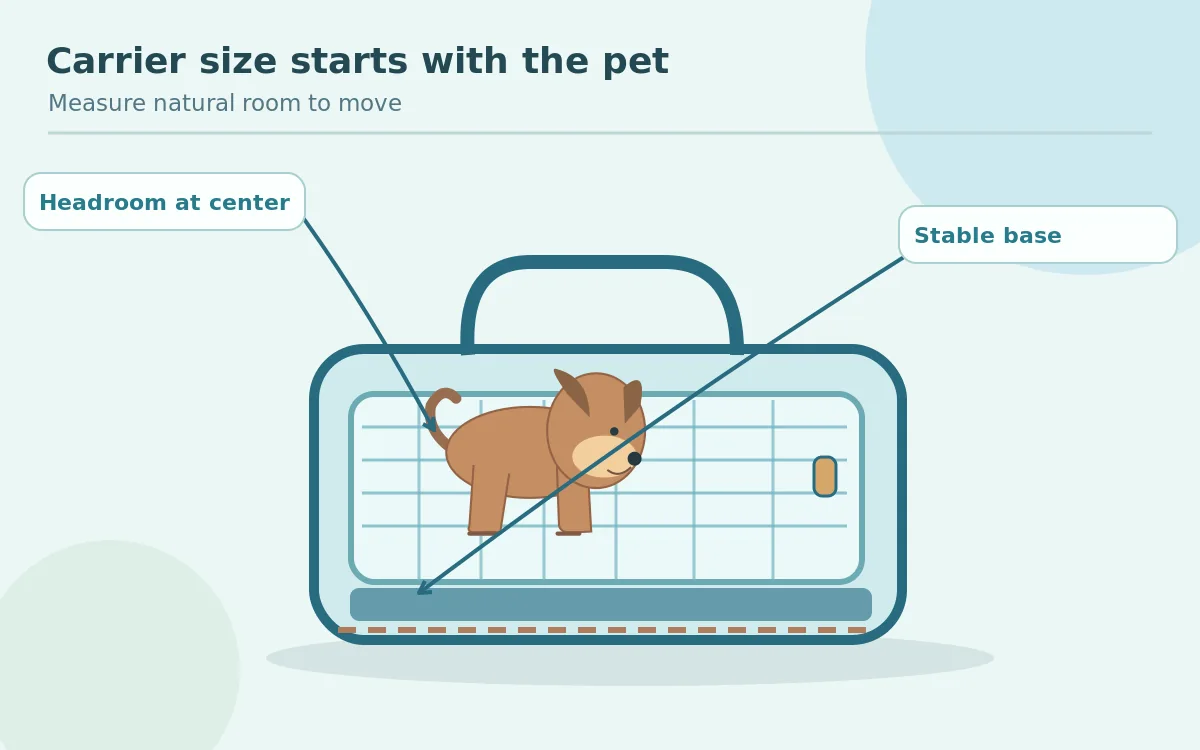
Compare the dimensions shoppers actually see
The same printed three-number size may refer to an external shell, a flat unassembled bag, or the usable space inside. Make a side-by-side note of whether the seller quotes external or internal dimensions. A 17 by 11 by 9.5 inches (43 by 28 by 24 cm) listing can be shorter but taller than an 18 by 14 by 8 inches (46 by 36 by 20 cm) listing. A 19 by 13 by 9 inches (48 by 33 by 23 cm) model could have more horizontal area yet still restrict a tall animal. For example, a carrier listed as 18 by 11 by 11 inches (46 by 28 by 28 cm) does not guarantee those exact interior clearances. Check where its zipper, angled top and reinforcement panels actually sit.
Different activities call for different checks. An indoor vet-trip carrier needs an opening that does not frighten the pet and a floor stable enough for lifting. An airline under-seat bag has a second constraint: the exact aircraft and airline rules. A suitcase-shaped carrier may pass the pet-fit test and fail the airline’s dimension rule, or vice versa. VCA advises contacting the airline and confirming its current requirements. Never compress a pet to meet a cabin limit; choose another transport arrangement. For gradual acclimation, use the HubPet guide to introducing a pet to a carrier.
- Measure the pet while naturally standing, then observe a relaxed turn and lie-down.
- Record inside length, width and height; mark outside-only measurements separately.
- Check the manufacturer’s stated load rating and the strength of the floor and handles.
- Test the closure and each mesh opening with the carrier assembled and bedding inside.
- Recheck airline, train or vehicle rules for the actual trip rather than trusting a label.

Which styles preserve usable room?
Rigid carriers tend to retain their wall shape and can be easier to wipe clean, but its thick plastic sides reduce inner dimensions relative to the outside. Structured soft bags are lighter, yet its roof may bow inward when carried. Collapsible totes can be suitable for a calm, compact pet if the base remains flat and ventilation stays open. Backpack and sling styles are different categories because the handler’s walking changes the pet’s posture and body support. An ordinary floor-crate chart cannot size them alone. If dimensions conflict with load limits, check both measurements and load ratings.
| Advertised format | What to double-check | Reason |
|---|---|---|
| 17 by 11 by 9.5 inches (43 by 28 by 24 cm) | Interior ceiling at center | Soft roof can curve downward |
| 18 by 11 by 11 inches (46 by 28 by 28 cm) | Inside length and shoulder room | External walls take space |
| 18 by 14 by 9 inches (46 by 36 by 23 cm) | Door opening and low headroom | Wide does not mean tall |
| 19 by 13 by 9 inches (48 by 33 by 23 cm) | Measured width plus turning space | Long pets may still feel cramped |
Do a dry run before you leave
Place the empty carrier on the floor, prop the door open safely and reward your pet for looking, sniffing and entering voluntarily. Once your pet rests inside, check whether its nose touches mesh, paws slide off a sagging base or the ceiling bends toward its head. Lift the empty carrier by its handles before attempting a short supported lift with a comfortable pet. Stop if stitching pulls, straps shift or the animal panics. Avoid treating a quiet, frozen posture as consent; the animal should look and move comfortably. A trip to the clinic should not be the pet’s very first exposure to the carrier.
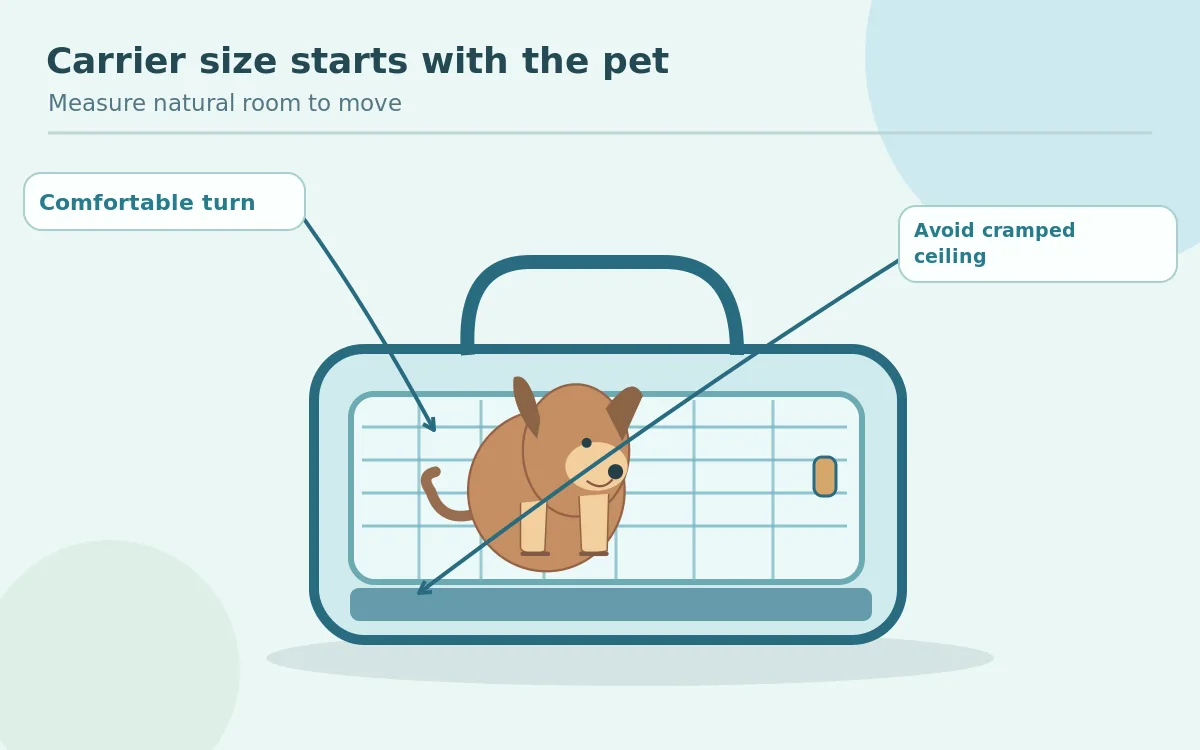
If the pet cannot sit comfortably and the permitted travel space is too small, do not solve the problem by squeezing the bag. Instead, consider a different vehicle, a larger crate or an alternate travel plan. Keep air panels unobstructed and never leave a pet unattended in a parked vehicle. For ground mobility alternatives, the dog stroller sizing guide compares cabin space and actual weight limits. Size charts are only a starting worksheet, not proof of comfort or certification for a particular pet. When body proportions are unusual, test fit matters far more than a generic breed recommendation.
When to Call Your Vet
Ask for veterinary guidance before travel if your pet has respiratory disease, severe motion sickness, anxiety, a painful back or poor mobility. Difficulty breathing, collapse or clear overheating are urgent. An airline-approved label, if present, is not a medical fitness assessment.
How We Research
We used AKC measurement guidance, VCA’s air-travel and cabin advice, and AVMA travel precautions. The sample dimension formats illustrate comparison rather than certified product recommendations. Product interior dimensions, airline requirements and ratings need direct verification for each trip. Read HubPet’s editorial approach for additional details.
Sources
AKC — How to Choose a Dog Carrier — source consulted for this guide.
VCA — Airplane Travel With Your Dog — source consulted for this guide.
AVMA — Traveling With Your Dog or Cat — source consulted for this guide.
Match your pet’s standing height, length, width and normal turn to the usable interior dimensions; then verify the manufacturer weight rating.
No. Manufacturers do not standardize size names, and the outside dimensions may be substantially larger than the pet’s usable space inside.
Yes. Cabin restrictions and humane pet fit are separate requirements; the traveler must satisfy both, or the itinerary needs another approach.
Record both. Weight limits address structural load, while measurements address posture, headroom and turning space. Neither replaces the other.
Not necessarily. Soft roofs may bow when carried and solid walls can be thick, so check the real assembled interior rather than a nominal label.