
This article is general information, not veterinary advice. If your pet seems unwell, is in pain or may have eaten something harmful, contact your vet or an animal poison control line right away. Read our vet disclaimer.
An indoor dog pen with top is a specific type of exercise pen. A fitted ceiling can discourage climbing. However, a roof adds fit and safety questions. The roof must fit the pen shape. Check its attachments and airflow. Do not leave loose loops. A cover cannot guarantee against escape. It also cannot solve panic or separation anxiety. This guide compares mesh, rigid and partial tops. It explains access and ventilation checks and outlines a safe indoor setup. It focuses on compatible covers rather than brand rankings or prices.
What makes a roof suitable for an indoor dog pen?
Begin with the base pen. Count panels and confirm their widths. Then identify the hinges and measure the *assembled* footprint. An eight-panel pen can form more than one shape. A square four-panel roof will not automatically fit an octagonal pen. Marketing terms such as ‘small’ cannot determine compatibility. Manufacturer IRIS, for example, explicitly identifies its mesh roof as fitting a particular four-panel pen, with attached hook-and-loop tabs. That applies to a matched system, not every design. Check whether the roof is removable for cleaning and whether it allows you to reach the dog without leaving an unsecured panel open. Never improvise with loose plastic film, weighted blankets or dangling ties that a dog may chew.
| Top construction | Potential benefit | Check before use |
|---|---|---|
| Breathable mesh | Visibility and air movement | Compatible pen and secure fasteners |
| Rigid fitted panel | Defined shape when approved | Safe edges, openings and lift-off access |
| Fabric partial shade | May reduce visual stimulation | Does not cover ventilation or sag |
| Universal aftermarket cover | May fit some matching footprints | No gaps or stretched attachment points |
| Improvised blanket | Not a tested enclosure roof | Avoid if it traps heat or creates hazards |

Ten-minute inspection before each enclosed session
A safe pen begins with level flooring, stable panels and a door that closes predictably. Next inspect the cover attachment all the way around, looking for snag points, loose straps, projecting wires or sections that sag into the dog’s reachable space. Ensure sufficient airflow and that the pen is far from direct heat, cords and objects a dog can pull through the bars. Set down a comfortable resting area and stable water access when appropriate. Remove collars, dangling tags or harnesses if they could catch on the pen, following your supervision plan and the dog’s behavior. Start with short, supervised, reward-based practice. Watch how the dog uses the covered space before considering even brief absences.
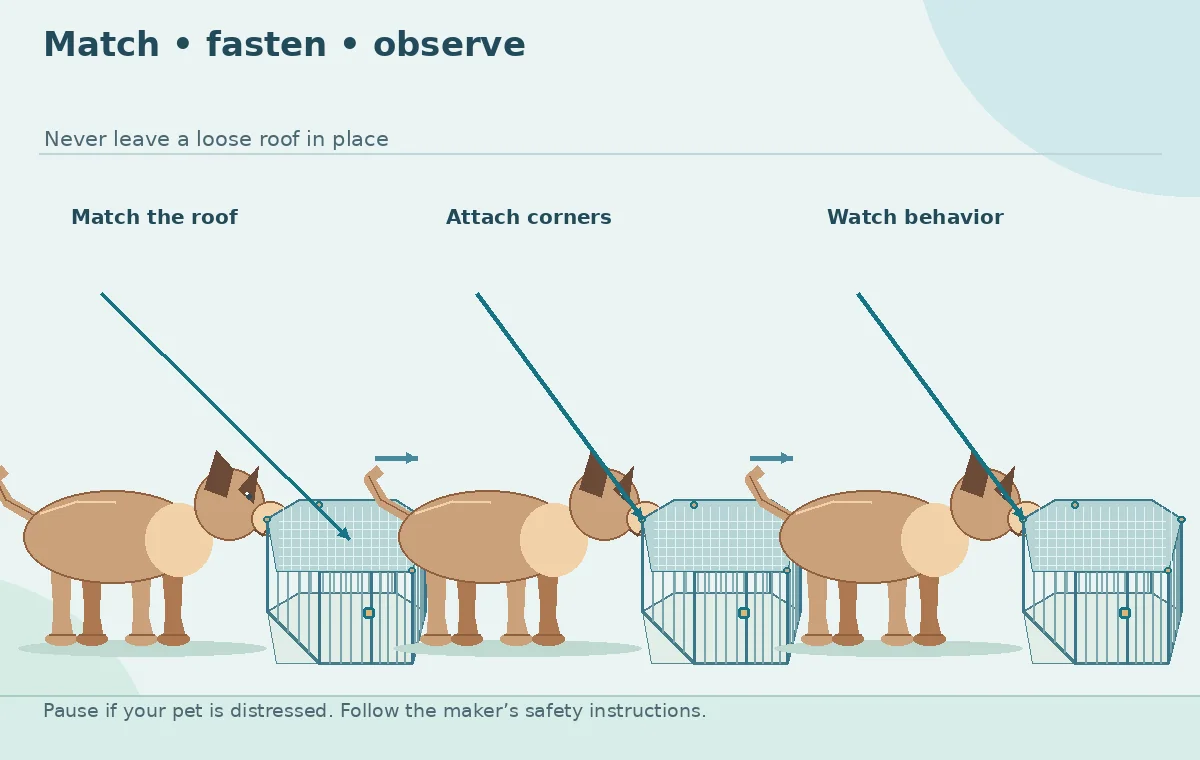
- Match roof and pen according to the manufacturer; inspect each side, corner and attachment rather than trusting the packaging photo.
- Check that the pen is stable on the actual floor and cannot tip or slide when the dog leans on it.
- Check open mesh area for airflow and ensure nothing hangs into the dog’s face or blocks access to the door.
- Inspect for chewing, climbing, distress, fastener gaps and entrapment hazards with the dog present.
- Introduce the space with food and play; increase separation gradually only if the dog stays relaxed and safe.
Pick the configuration by dog behavior and household space
A roof can help with a dog that casually steps or hops over a low pen, but it does not transform flimsy walls into a secure kennel. If the dog lunges against panels, twists at fasteners or chews fabric, you may need an entirely different arrangement and qualified advice. Small puppies need a setup that fits their play, rest and toileting opportunities; tall adult dogs can require higher sturdier sides regardless of whether a mesh lid is present. Put the pen where the family spends time rather than isolating the dog in a hot or noisy corner. VCA notes that exercise pens offer space for bedding and toys, but they still require regular interaction and activity. Use the comparison below as a selection checklist, not a fixed ranking.
| Dog or environment | More suitable direction | Warning sign |
|---|---|---|
| Small calm puppy | Matched secure mesh roof and stable walls | Puppy chews roof ties |
| Jumping or climbing dog | Reassess enclosure type and supervision | Tries to push through roof |
| Warm or sunny room | Open airflow, cooler location | Panting and trapped heat |
| Busy family room | Stable accessible door and escape-free hinges | Children disturbing dog’s rest |
| High anxiety during isolation | Behavior professional; avoid forced confinement | Panic, drooling or escape injuries |

Roofed pen versus crate: different jobs
A covered exercise pen generally offers more floor area for a small dog to stretch, move between toys and settle, whereas a properly sized crate is built primarily around a quiet rest space. Neither is a punishment tool. The practical question is not ‘which is escape-proof’ but ‘which can this dog use comfortably with a safe plan for exercise, sleep and toileting?’ A loose cover that hides the dog from view can make monitoring harder. Choose a pen with a top only when you can confirm the complete manufacturer’s compatibility and can inspect the assembled roof from all sides.
Help the dog approach the pen voluntarily, reward calm exploring and leave the door open for initial sessions. Our calm-confinement guide gives a related emotional approach, while the house-training guide helps plan bathroom breaks. If a puppy is just learning to settle, our positive crate introduction may be helpful even if the long-term choice is a pen. A roof cannot remove the need for supervising new behavior, and a secure enclosure is not a substitute for social contact.
When to Call Your Vet
If a dog shows persistent panic, tries to escape violently, chews barriers until injured, collapses or overheats, stop using that setup and contact a veterinarian. Ask a qualified reward-based behavior professional about safer alternatives for separation-related distress. For injury recovery, do not use a pen or roof as a substitute for the precise restriction prescribed by a veterinarian.
How We Research
We cross-checked VCA descriptions of play yards and humane confinement, AKC puppy-alone training guidance, and a manufacturer’s roof-fit documentation. The table compares cover types and inspection tasks rather than offering unsupported brand rankings or performance guarantees. Compatibility must be confirmed for the exact current pen and roof combination. Read our editorial standards on the About page.
Sources
VCA — Crate Training and Confinement for Puppies and Dogs; AKC — When Can Puppies Be Left Home Alone?; IRIS USA — Pet Playpen Mesh Roof (Compatibility and Specifications); VCA — To Crate or Not to Crate?.
No. A properly fitted cover may discourage some climbing, but it cannot prevent every jump, chew or forceful escape. A distressed dog needs a different plan, not just a stronger lid.
No. Panel counts do not tell the entire footprint or corner design. Use a cover approved for that model and assembled shape, and check attachment points and gaps.
Not when the puppy can reach and ingest material or fasteners. Remove an unsuitable cover and supervise chewing behavior; choose a better enclosure solution.
No. An exercise pen is a management space, not a replacement for movement, enrichment, human interaction or regular toileting access.
Stop increasing confinement, offer calm exit and consult your veterinarian or a qualified reward-based behavior professional. Forcing the dog to stay can worsen distress.