
This article is general information, not veterinary advice. If your pet seems unwell, is in pain or may have eaten something harmful, contact your vet or an animal poison control line right away. Read our vet disclaimer.
A senior pet home support checklist should make everyday movement, rest, toileting, and observation easier. The 2023 AAHA Senior Care Guidelines emphasize environmental modification alongside medical and behavioral care. Therefore, the goal is not to label every older pet as fragile. Instead, adapt the home to the individual animal and keep watching for changes. A useful companion page is how to Avoid Burnout as a Pet Owner.
Senior Pet Home Support Checklist: Start With Footing and Access
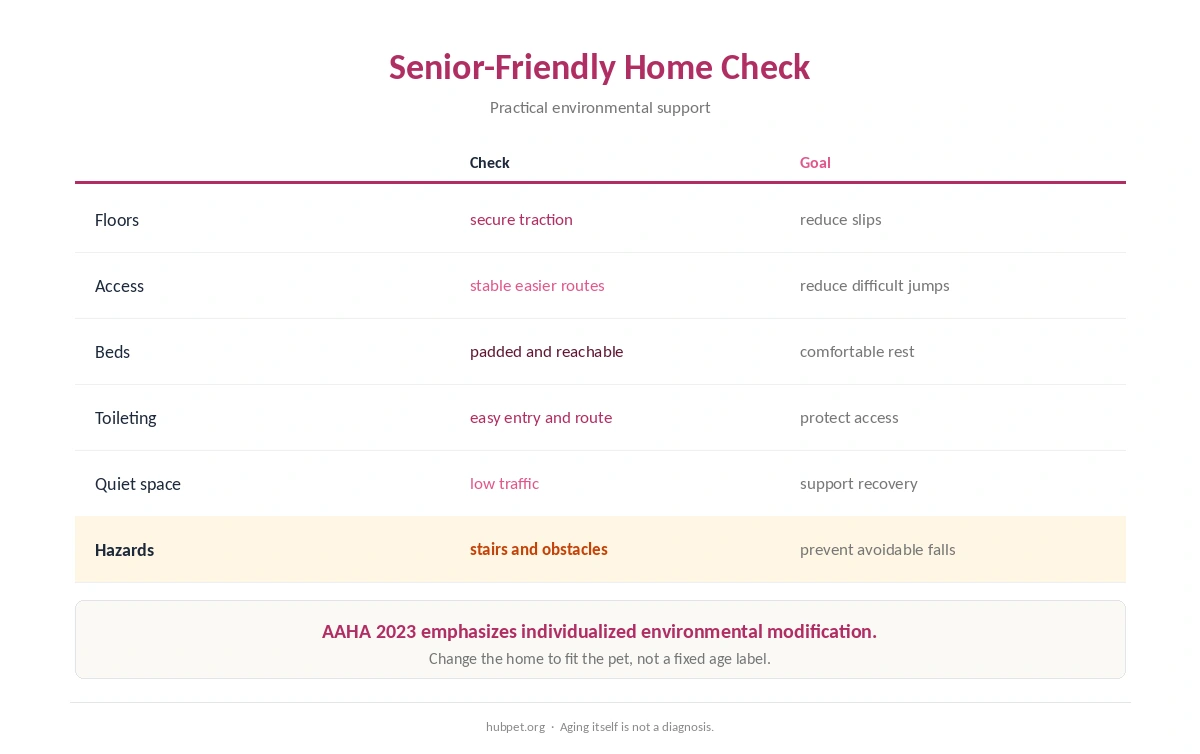
First, walk through the routes your pet uses most. AAHA’s 2023 senior-care guidance highlights traction, ramps, padding, and easier access as practical environmental changes. Secure rugs or runners can help on slippery floors. In addition, keep favorite resting areas easy to reach rather than requiring repeated jumps or steep stairs.
For a broader room-by-room review, use our guide to making the home easier for senior pets. Dog caregivers can also use senior dog comfort ideas. Meanwhile, the pet-proofing guide helps identify stairs, cords, doors, and other household hazards.
- Cover slick travel paths with secure, non-slip surfaces.
- Keep padded beds in places the pet already chooses to rest.
- Use stable ramps or lower access points only when the pet can use them safely.
- For cats, consider easier litter-box entry if mobility has changed.
- Keep food, water, and toileting resources reachable without unnecessary obstacles.
- Protect quiet sleep from constant household traffic.
Next, avoid changing everything at once. Older pets can benefit from a predictable layout, especially when vision, hearing, or mobility changes. Our predictable-routines guide explains how familiar cues can reduce confusion. Likewise, a calm resting space gives the animal a place to disengage. In practice, the senior pet home support checklist should preserve familiar routes while making difficult ones safer.
Senior Pet Home Support Checklist: Watch the Pet, Not Just the Room
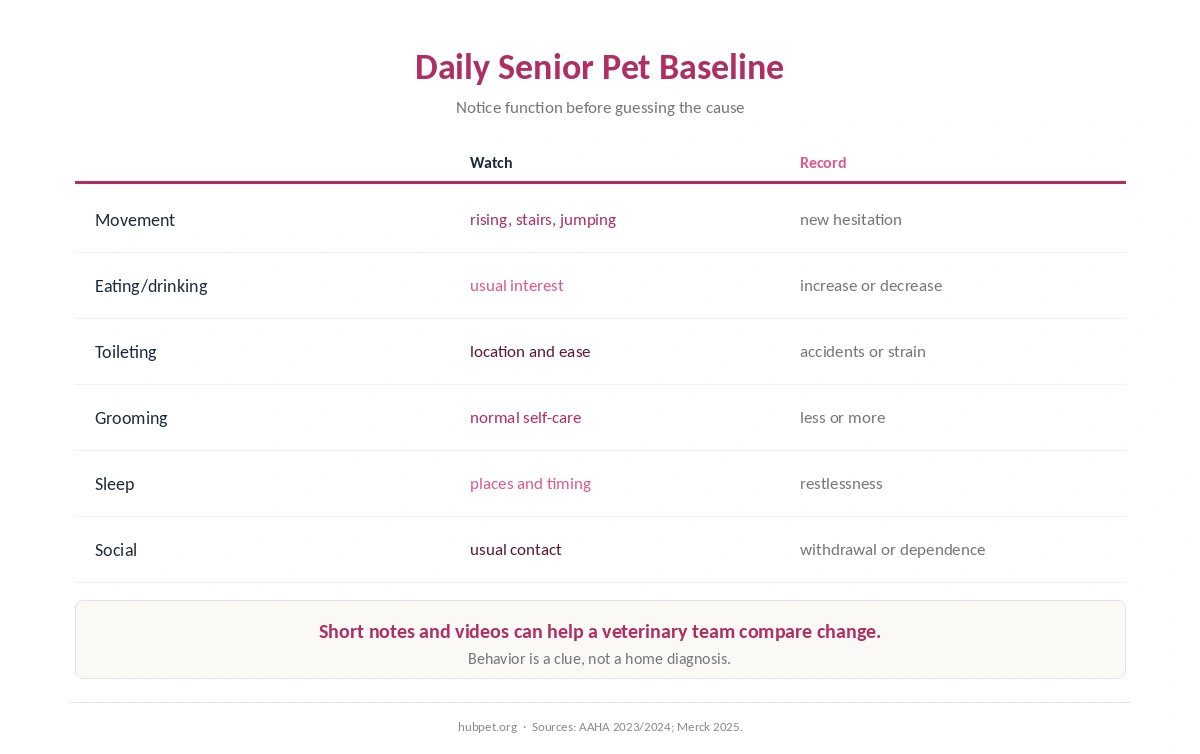
A senior pet home support checklist also needs a monitoring routine. AAHA’s 2023 guidelines recommend a thorough history that covers eating, drinking, movement, play, elimination, attitude, grooming, vision, and hearing. Small videos can also help a veterinary team compare movement over time. Therefore, note what is normal for your pet before deciding that a change is simply “old age.”
Behavior can be part of pain assessment. AAHA’s 2024 pain guidance and Merck Veterinary Manual guidance reviewed in 2025 both describe behavior changes as useful clues. For example, reduced activity, altered grooming, reluctance to move, or a new social pattern can accompany discomfort. Our pet pain-signs guide explains why a new pattern deserves attention rather than punishment.
| Check daily | Compare with baseline | What to record |
|---|---|---|
| Movement | getting up, stairs, jumping | new hesitation or route change |
| Eating and drinking | usual interest and access | noticeable increase or decrease |
| Toileting | usual frequency and location | accidents, straining, access problems |
| Grooming | normal self-care | less grooming or overgrooming |
| Sleep and rest | usual places and timing | restlessness or changed sleep pattern |
| Social behavior | usual contact choices | new withdrawal or unusual dependence |
For grooming and handling, keep sessions comfortable and brief. The handling-practice guide focuses on voluntary, low-pressure steps. The play-and-rest guide can help you keep activity appropriate without turning every quiet day into a fitness problem.
Plan Vet Visits Before a Problem Becomes Hard to Describe
Because gradual changes are easy to miss, bring notes, photos, or short videos to appointments. The vet visit checklist can organize questions, while less-stressful vet visit preparation can make transport and handling easier. If your pet spends time alone, the home-alone safety checklist helps you review access and hazards.
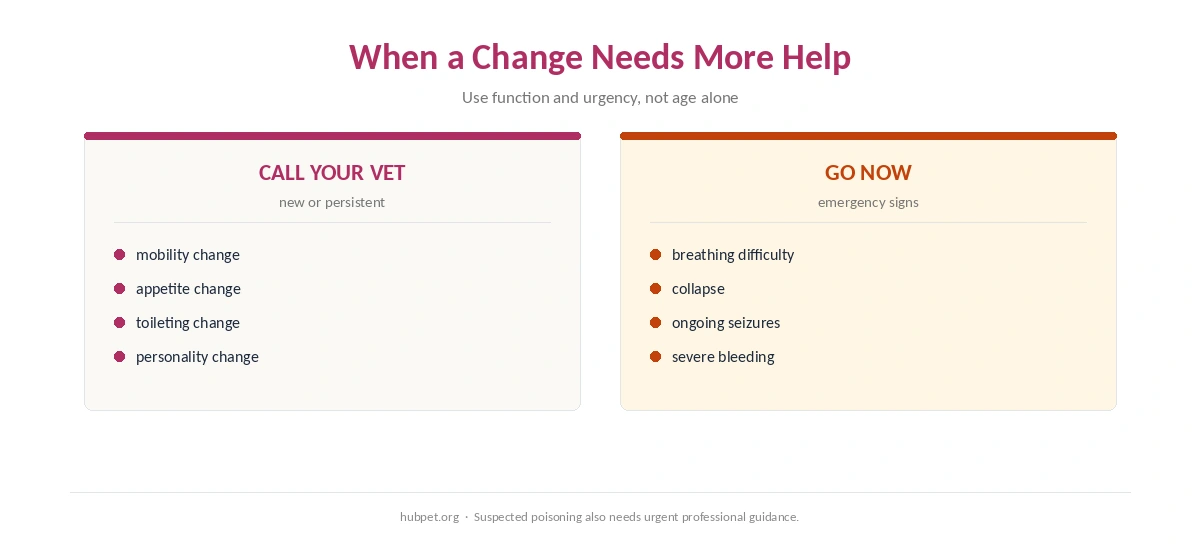
Call your veterinarian when a new change persists, worsens, or affects normal function. AAHA’s 2024 pain guidance advises veterinary assessment for concerning personality or behavior changes. In addition, do not assume reduced mobility, appetite change, house-soiling, or unusual vocalization is an inevitable part of aging.
Go now: breathing difficulty, collapse or loss of consciousness, ongoing seizures, severe bleeding, suspected poisoning, or other emergency signs need urgent care. Use the pet emergency signs guide as a site-wide reference.
How We Research
HubPet reviewed these sources on October 11, 2026: the 2023 AAHA Senior Care Guidelines for Dogs and Cats, AAHA’s 2024 guidance on common pet pain signs, and Merck Veterinary Manual pain guidance reviewed in 2025. AAHA emphasizes individualized senior plans, environmental modification, and tracking changes in daily function. Read our editorial method at How We Research.
No. AAHA’s 2023 guidance stresses individual plans. Add a ramp only when it improves safe access for that specific pet.
No. Reduced mobility can have several causes, including pain. Record the change and discuss it with your veterinarian.
Useful categories include movement, eating, drinking, toileting, grooming, sleep, play, and social behavior.
Yes. AAHA’s 2023 senior-care guidance notes that videos can help assess movement and changes over time.
Urgency depends on the whole picture. Emergency signs such as breathing difficulty, collapse, seizures, severe bleeding, or suspected poisoning need immediate care.
Senior Pet Home Support Checklist: Bottom Line
A senior pet home support checklist works best when it protects traction, access, rest, and observation. Make the home easier without assuming that every older animal needs the same setup. Then, compare daily behavior with the pet’s own baseline and share meaningful changes with your veterinarian. For a related practical guide, see how to Notice Small Changes in Pet Behavior.