
A rolled leather collar has a round profile rather than a wide flat strap. Some owners choose it because a narrower contact line may sit differently in a long or dense coat. That shape does not make it automatically softer, safer, or free from matting. The seam, core, buckle, and fit all determine whether it is a useful ID collar. This guide shows how to inspect a real rolled collar and what to watch on your dog’s skin. It also explains why a comfortable harness is usually the better walking attachment for a dog that pulls. See our veterinary disclaimer for pet-health questions.
How a rolled collar is constructed
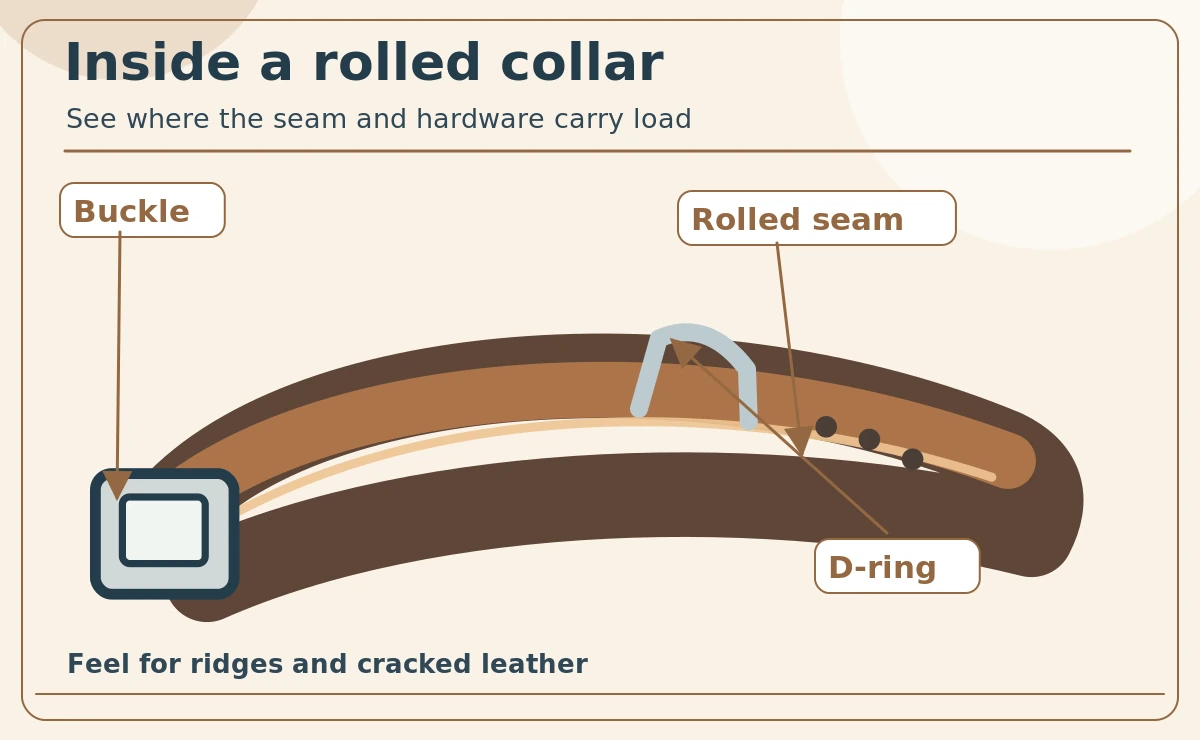
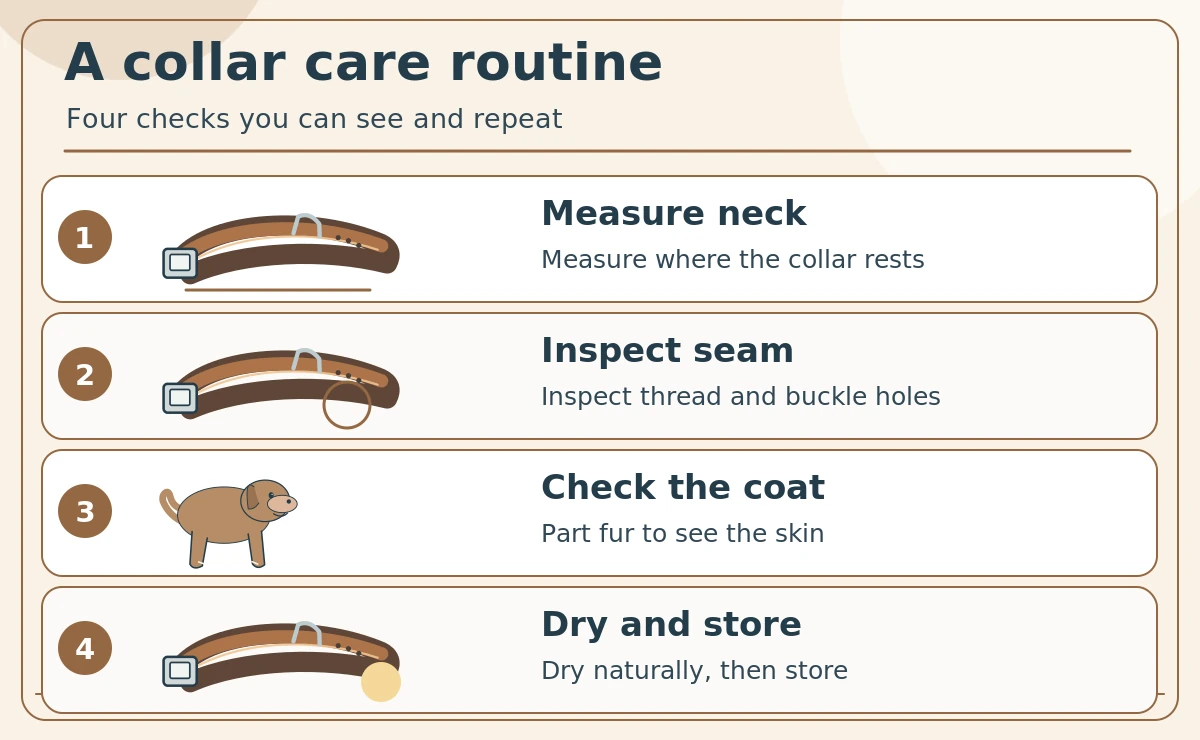
Look closely at the cross-section: leather is folded around a core or rolled into a tube, then joined along a seam. The seam should be even, without hard ridges or exposed thread that could scratch the neck. A round collar is not simply a flat belt turned sideways. The material may change shape with moisture, tension, and age. Inspect the transition into the buckle and D-ring because those joints carry significant load. Descriptions such as handmade or premium do not replace a physical inspection of the stitching and hardware.
Round contact does not guarantee comfort
A smaller contact area can concentrate pressure if a dog pulls into the collar. Some long-coated dogs may have less visible coat flattening, but the effect depends on hair length, collar movement, and skin sensitivity. Lift the collar during routine grooming and check for redness, broken fur, or a groove in the coat. Never use coat appearance as the only fit test. A dog that scratches at the neck, avoids the collar, or has persistent irritation needs the collar removed and the issue assessed. A wide flat ID collar may suit another dog better.
Measure the neck, not the hair volume
Use a flexible tape around the neck where the collar will naturally rest. Part dense fur gently so the measurement reflects the dog’s body rather than a cloud of coat. Follow the product maker’s sizing directions and check fit with the dog standing. The collar should not restrict breathing, swallowing, or normal movement. You should be able to slide fingers comfortably underneath, but the collar must not slip over the head. Recheck after grooming or a change in body condition. Never use a length number as a universal fit for all breeds.
Examine the buckle and D-ring arrangement
A rolled collar may use a traditional tongue buckle, a clasp, or a special connector. The buckle holes should remain round and intact rather than stretched into tears. Check that the tongue seats correctly, the keeper holds excess length, and the D-ring cannot pull through weak leather. Metal edges should be smooth where they touch the coat. A decorative ring is not necessarily an appropriate leash attachment. Read the maker’s directions before loading the hardware. Replace equipment if the buckle deforms or the leather tears near a punched hole.
Separate ID function from walking control
A properly fitted flat or rolled collar can carry ID information. For many dogs, a well-fitted walking harness reduces concentrated pressure on the neck. This distinction matters when a dog rushes forward, coughs on leash, or has a sensitive airway. Do not add leash corrections to test collar strength. Use the harness connection intended for walking and keep the ID collar comfortable. If you use the collar for a quiet walk, ensure your dog does not pull and can never slip out. Ask a veterinarian about neck concerns.
Check the long-coat contact zone
Part the hair at the back and sides of the neck after a walk. Feel for mats that formed below the collar, damp undercoat, or areas where hair appears abraded. Do not drag a comb aggressively under the rounded leather. Gently remove the collar for grooming when the dog is indoors and safely supervised. A rounded surface can still hold grit against the coat. If you find tender skin or a tight mat close to the neck, stop combing that spot and seek grooming or veterinary help as appropriate.

Water and leather require care
Rain or swimming can soak natural leather and affect its shape or surface. Follow the maker’s cleaning and conditioning instructions, and avoid household solvents or strong fragrances. Wipe away grit with a soft cloth and let the collar dry naturally away from direct high heat. Do not put a wet collar back against irritated skin. If the material becomes brittle, cracked, permanently stretched, or sour-smelling despite proper cleaning, replacement may be safer than another treatment. Water-resistant claims need careful reading; they are not a promise of waterproof performance.
Compare a round collar with a flat one
A rounded collar may sit neatly in a dense coat and may be visually unobtrusive. A flat collar distributes contact over a broader strip and is often easier to inspect along its full width. Both need sound hardware and a secure fit. Neither design is suitable as a pain-based training tool. A rolled collar should not be purchased solely to hide its outline in photographs. Choose based on actual neck comfort, ID attachment, care demands, and how reliably it stays adjusted through ordinary movement.
Introduce the collar without pressure
Show the collar on the floor and let your dog investigate it. Reward calm interest, then practice a brief touch near the neck before fastening it. If the dog backs away, stop and try a smaller step. Check that no hair is pinched in the buckle when fastening. Begin with a short supervised wear session and remove the collar to inspect the coat afterward. You should not have to chase or hold the dog down to put on an everyday ID collar. Comfortable handling can be trained gradually.
Avoid snagging during unsupervised play
Collars can catch on crate bars, branches, furniture, or another dog’s jaw during play. Rounded leather is not immune to entanglement. Follow your veterinarian’s and the product maker’s advice for supervised use and removal in risky settings. Never leave a leash attached to the collar while a dog is resting alone. If two dogs wrestle with their mouths around each other’s necks, interrupt calmly and manage their gear to reduce catches. A collar must not be treated as permanent safety equipment without a context check.
Replace worn rolled leather before it splits
Feel the entire collar for uneven hard spots or places where the core seems to bulge. Look closely at the stitching, buckle holes, and D-ring stitching after each wet walk. A deep crack, loose seam, pulled rivet, or exposed sharp edge is a stop-use sign. Do not rely on cosmetic leather conditioner to restore a damaged load-bearing part. Fit the replacement from the beginning rather than copying an old hole position. The dog’s weight and coat may have changed since the last purchase.
How We Research
We checked veterinary and animal-welfare guidance on fit, equipment pressure, and reward-based handling. We separated the features a buyer can inspect from guarantees that a product cannot make. The illustrations explain common construction and use; they are not product certification or individual fitting advice. Every dog has different proportions, movement, and handling needs. Our priority is a comfortable, secure connection and a practical stop rule when gear causes distress. See our editorial approach for more about HubPet.
Sources
VCA Animal Hospitals, Collar and Harness Options for Dogs — https://vcahospitals.com/know-your-pet/collar-and-harness-options-for-dogs (accessed October 2026).
Tufts Cummings School of Veterinary Medicine, Dog Collars and Harnesses — https://vet.tufts.edu/news-events/news/dog-collars-and-harnesses (accessed October 2026).
RSPCA Knowledgebase, Equipment for Walking a Dog or Puppy — https://kb.rspca.org.au/categories/companion-animals/dogs/training/what-equipment-should-i-use-when-teaching-my-dog-or-puppy-to-walk-on-a-leash (accessed October 2026).
Dogs Trust, Teach Your Dog to Wear a Harness — https://www.dogstrust.org.uk/dog-advice/training/outdoors/harness-training (accessed October 2026).
Safety note: Do not use walking equipment to jerk, punish, or restrain a distressed dog. Seek veterinary advice for pain, coughing on leash, abnormal gait, or exercise intolerance. Check the manufacturer’s exact fitting and care directions before use.
They may create a different contact pattern, but they do not eliminate tangles or friction. Check the coat and skin regularly before deciding.
Only when it fits securely and the dog walks without pulling. A well-fitted harness is often a better connection for walking and training.
Follow the maker’s instructions and check comfortable finger clearance while ensuring the collar cannot slip over the head. Recheck after grooming.
Natural leather may change after soaking. Follow the manufacturer’s care directions and remove wet gear from sensitive skin.
Cracked leather, loose seams, stretched buckle holes, or damaged hardware call for replacement. Do not repair structural damage with glue.