
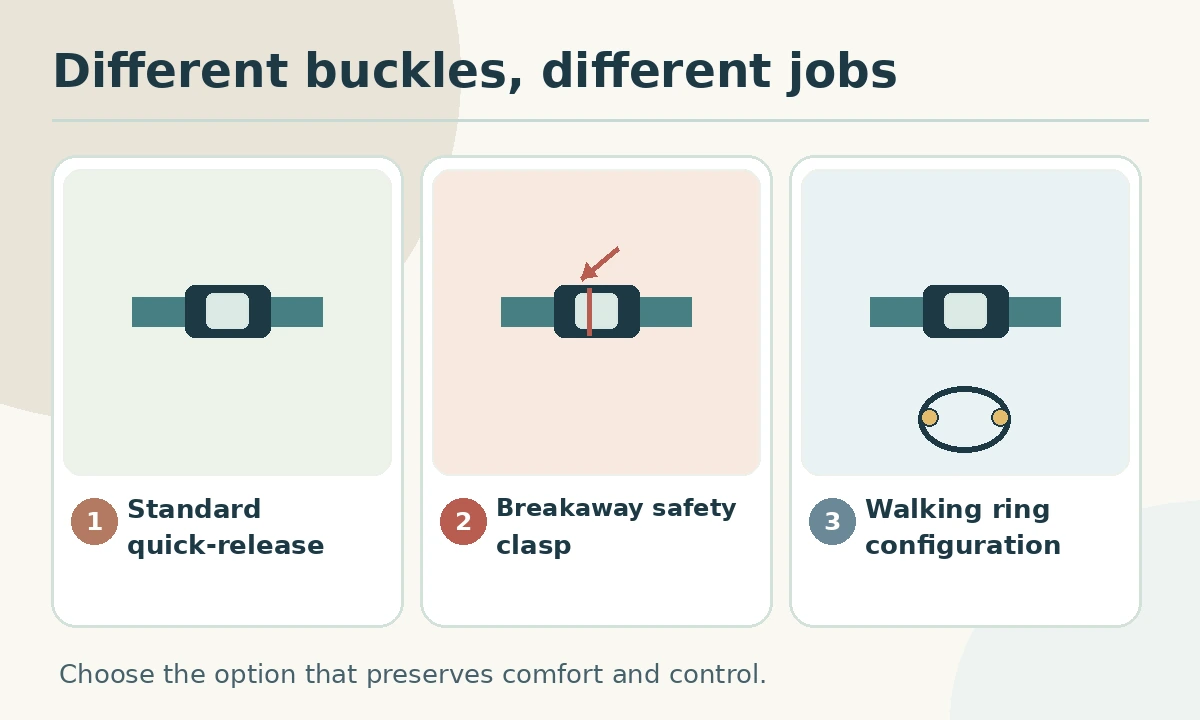
A snap-open buckle is not the same as a breakaway safety clasp. This guide explains the important differences before buying. We focus on fit and practical handling rather than untested brand rankings. The diagrams illustrate general principles; use the actual manufacturer instructions for your specific equipment.
Quick-release and breakaway describe different actions
A standard quick-release collar usually has two squeeze tabs so a person can open it without threading a pin through holes. The mechanism should stay shut under leash tension instead of popping open automatically. A breakaway clasp is different: it may separate when a collar becomes trapped, depending on its design. This distinction matters because shoppers sometimes mistake any plastic snap for an entanglement-release mechanism. Before buying, read the product’s stated use, closure type, and leash attachment instructions. Do not infer safety behavior from photos or a broad “quick release” product title.

Look for a reliable latch, not merely a convenient click
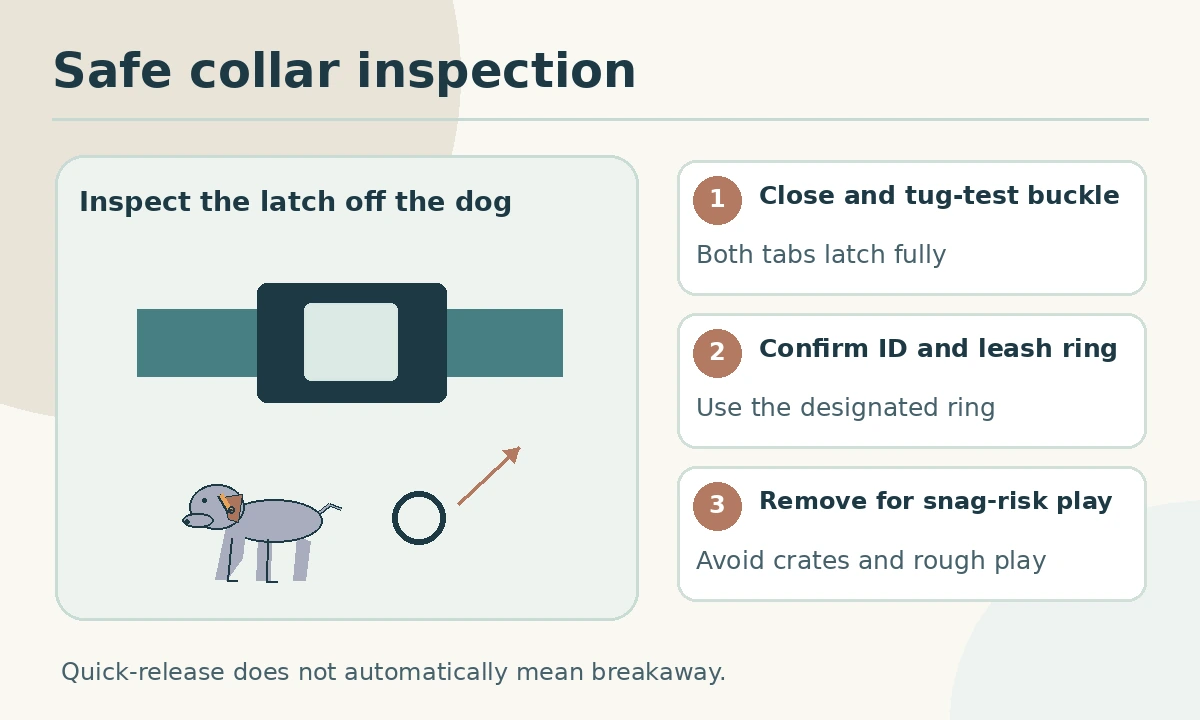
Close and reopen the buckle several times with the collar off the dog. Both halves should seat fully, the tabs should spring back, and a light hand pull should not separate the closure. Sand, grit, fur, and damage can prevent a latch from closing correctly. Inspect the hinges and edges for sharp burrs or cracks. Large buckles on very small dogs may concentrate pressure in one spot; narrow buckles on a heavy, strong dog may lack adequate hardware for that use. A secure closure must match the dog and the manufacturer’s stated purpose, not just feel easy to press.
Do not confuse the breakaway feature with leash security
VCA explains that some breakaway collars have a separate ring system for walking: the leash must connect to the specified pair of rings to prevent accidental release. Never attach a leash to other breakaway designs unless their instructions clearly permit that use. There is no safe universal shortcut. If a manufacturer cannot explain exactly how the collar functions during a walk, use a conventional walking harness and keep breakaway gear only in contexts for which it is designed. Never improvise by clipping through a random decorative loop. A dog should not be able to run into traffic because a safety-release feature opened unexpectedly.
Measure the neck and assess slip risk
Measure around the place where the collar rests with a flexible tape. Give the dog room to breathe and swallow normally while keeping the band from passing over the ears during a gentle check. Collar fit varies with coat thickness, head shape, and whether your dog is still growing. Take the measurement again after a haircut, weight change, or growth spurt. Watch whether the buckle rotates to the front or rests against a sensitive neck area. No “two finger” slogan can replace noticing pressure marks, difficult swallowing, or a collar that is simply too loose for safe identification.
Use the collar for identification, not as a pulling solution
A properly fitted flat collar can carry identification and sometimes serve as a leash point for calm dogs. It cannot correct lunging or pulling by applying neck pressure. If your dog repeatedly strains against the collar, consider a well-fitted harness and a reward-based loose-leash plan. Avoid leash pops, choke mechanisms, and claims that discomfort makes a dog more obedient. Especially when a dog coughs or has known breathing concerns, ask a veterinarian before choosing neck-based control. A buckle’s convenience should never become a reason to use it as punishment.
Plan for play, crates, and places that can catch the collar
Collars can snag on a playmate’s mouth, a wire crate, a gate, or a protruding household object. This standard buckle still may not open by itself in a sudden entanglement. Remove collars when dogs play closely or when confinement creates a realistic snag risk, following your household’s secure containment and ID strategy. Check hanging tags, loose webbing ends, and dangling decorations. If your environment requires a wearable ID, discuss safer tag placement and escape prevention; the aim is to balance identification with everyday entanglement hazards rather than treat one closure as universally safe.
Read the D-ring, stitching, and tag arrangement
A strong-looking strap is only one part of the system. Inspect the ring weld or bend, stitching around the ring, plastic sliders, and any edge binding. Check the name tag attachment so it does not obstruct the buckle or catch in the dog’s coat. Avoid bulky charms and unverified decorative components when they may snag during play. If a collar doubles as a walking attachment, choose hardware that suits the dog’s size and ordinary walking forces. Replace damaged parts rather than trying to fix load-bearing stitches with household thread.
Introduce fastening as a low-stress handling skill
Some dogs tolerate a collar until they hear a snap near their ears. Begin with the collar open, reward a calm approach, and gently touch the neck before attempting fastening. Close it briefly, give a reward, and take it off before the dog becomes frustrated. Keep fingers clear of the buckle to avoid pinching skin or long hair. If your dog freezes or turns away, slow down. For puppies, plan repeat sizing checks rather than starting too tight to avoid growth-related slipping. The best fastening routine is quick because the dog cooperates, not because a person moves abruptly.
Decision checklist before a purchase
Ask whether you want ID storage, a walking attachment, or an entanglement-release feature. Check the manufacturer’s exact mechanism and any dual-ring directions. Measure the neck, assess the latch and hardware, and consider play and crate routines. A standard snap buckle is convenient but does not offer automatic breakaway behavior; a breakaway design may need special precautions on walks. If either purpose is unclear, choose a simpler verified setup. Inspect the collar periodically, and keep ID and microchip information up to date as part of a broader lost-pet safety plan.
How We Research
We compare the physical design of walking equipment with veterinary safety guidance and established humane handling advice. Our framework weighs secure fit, realistic movement, hardware condition, a handler’s control, and the dog’s comfort before convenience or advertising claims. We have not independently crash-tested, strength-tested, or field-tested a specific commercial model. Illustration labels are teaching examples, not manufacturer specifications, guarantees, or certifications. For our editorial approach see About HubPet.
Sources
VCA Animal Hospitals, Collar and Harness Options for Dogs: Read source. Accessed October 27, 2026.
American Kennel Club, Finding and Choosing the Right Dog Collar: Read source. Accessed October 27, 2026.
American Kennel Club, Dog Leashes 101: Read source. Accessed October 27, 2026.
Safety note: Stop using equipment that slips, squeezes the neck, restricts movement, or causes visible discomfort. For coughing, breathing changes, injury, or persistent skin irritation, contact your veterinarian; this general buying guide does not replace individual professional advice. See our veterinary disclaimer.
Not necessarily. Many quick-release buckles simply open faster when the handler squeezes the tabs. A breakaway mechanism instead separates under the tension specified by its manufacturer.
Only if the product explicitly provides a secure walking arrangement and you follow its instructions. Some models need both designated D-rings clipped together.
It should not squeeze the neck or slide over the head. Check the maker’s sizing guidance and evaluate fit on your dog, not by label size alone.
Consider the risk of snagging on bedding, crate wires, furniture, or playmates; remove collars when safely practical and supervised, while maintaining appropriate identification plans.
Replace it when the buckle fails to latch reliably, the webbing frays, the ring deforms, or you cannot achieve a comfortable secure fit.