
A light-up harness can help other people notice a dog at dusk, but its glow does not replace a leash, sidewalk awareness, or a properly fitted harness. LEDs may sit on a chest band, back panel, or attached module. Each position changes what a driver or cyclist can see. You also need to inspect charging covers, wires, and small parts that a dog could chew. This guide separates visibility from physical restraint and shows a practical night-walk check. Prioritize the fit and the attachment ring before choosing a color or flashing pattern. See our veterinary disclaimer for pet-health questions.
Start with the harness, not the lights
Check the shape of the chest and shoulder straps first. The harness should allow a normal stride without a band cutting across the moving shoulder joint. Fit the girth securely and check the body for rubbing, especially behind the elbows. A glowing panel cannot compensate for a loose harness that allows backing out. Follow the product size chart and try it in daylight. Give the dog a short indoor walk and watch whether the harness twists. If the dog struggles, pause and choose a more comfortable shape.
Map the viewing angles
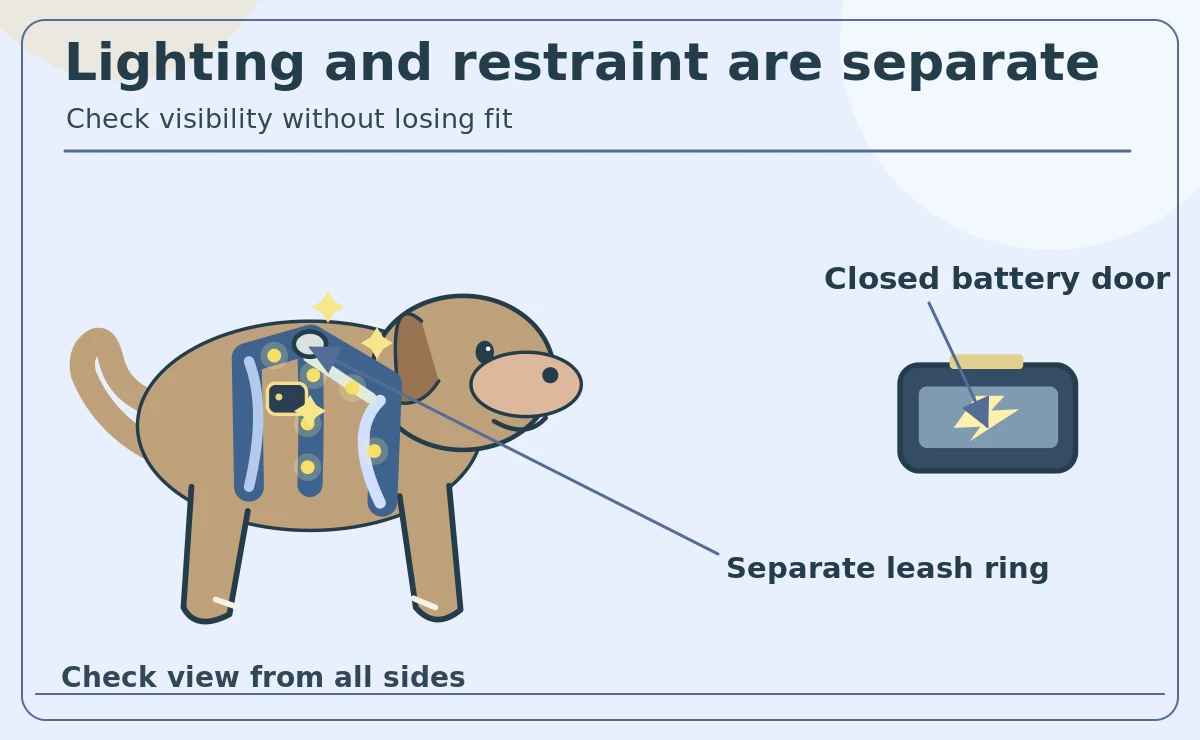
A back-mounted light is easy to see from above but may disappear behind a dog’s body from the front. Side strips can help outline movement, and a chest light may be visible to people approaching head-on. Stand several steps away and look from front, side, and rear with the dog supervised. Do not assume that every direction is equally bright. Thick fur, a coat, or a leash can obscure LEDs. The visibility test should happen outside direct sunlight, on a safe enclosed surface, before a first dark walk.
Understand glow versus reflection
LEDs emit light when powered, while reflective trim returns light from a source such as a headlight. The two features behave differently and can complement each other. Neither makes a moving dog impossible to miss. Keep your own reflective clothing and a handheld light or headlamp when useful. Choose well-lit routes with a sidewalk. Do not let the harness encourage an off-leash road crossing. Drivers may notice a blinking shape without knowing it is a dog, so you must continue controlling the distance to traffic.
Inspect the battery compartment
Look for a closed battery door with no exposed wires or removable cells that the dog can reach. A small battery is an ingestion hazard if a pet chews through the housing. Follow the manufacturer’s instructions for charging and battery replacement. Do not leave a charging harness on a dog. Keep the charger and cable away from pets and moisture. Stop using a module that heats unusually, swells, cracks, leaks, or makes an odd smell. Never improvise a replacement battery or tape a damaged compartment shut.
Check buttons, seams, and removable modules
A raised power button may be pressed against a dog’s body by a strap. Confirm that the module sits on an exterior surface and that hard edges cannot rub the skin. Pull gently on the straps and examine thread near the lighting channel. If the light module detaches, check how it locks and whether it could fall into the dog’s mouth. A decorative lighting clip is not a leash anchor. The leash must connect to a separate, rated ring intended for restraint. Avoid loose loops of wiring near the dog’s legs.
Treat water resistance as a limited claim
Wet grass, rain, puddles, and laundering expose the harness to different conditions. Read the maker’s exact water-resistance and washing instructions; a splash-resistant product is not automatically safe to submerge. Remove electronic modules before washing when directed. Dry all fabric and closures completely before storing or charging. If water enters an electronic compartment, turn it off and follow manufacturer guidance rather than testing it on your dog. A simple reflective harness without electronics may be a better choice for frequent soaking or for a dog that chews gear.

Test fit with the lights switched off
This is a useful control test: ask whether you would still choose the harness if its LEDs never worked. Walk your dog in a safe room with the unit turned off. Check the shoulder swing, elbow clearance, belly strap position, and ability to back out. The top ring should remain stable with gentle slack. Reward your dog for wearing it, and remove it if behavior suggests discomfort. If the fit fails, do not buy a different color of the same shape and expect the problem to disappear.
Choose a sensible light mode
Some products offer steady, slow-flash, or rapid-flash settings. Use a mode that makes the dog visible without startling the dog or distracting you from walking. Avoid assuming that a brighter light is always better in every setting. Test whether the mode can be changed with gloves and whether the button locks against accidental presses. If the dog is frightened by a flashing reflection or sound, switch to a steady setting or use reflective gear instead. Visibility should add comfort, not become a training obstacle.
Keep the night-walk route ordinary
Use familiar sidewalks and check for bicyclists, driveways, and intersections. Hold a fixed leash securely and allow safe slack away from traffic. A glowing harness does not allow crossing without checking vehicles. If light is poor, pause before picking up waste or adjusting equipment so the leash remains in your hand. Bring a separate light for finding hazards underfoot, such as glass or uneven pavement. Ask household members to check the electronic gear after the walk rather than leaving the dog wearing it unattended.

Compare a bright harness with a simple reflective one
A light-up harness may help with visibility from some directions even when no headlights are aimed at it. Its costs include charging, batteries, heavier parts, and more maintenance. A reflective harness has fewer electronic failure points but depends on incoming light. Consider a secure, comfortable fit first, then the visibility conditions on your normal route. For some dogs, a lightweight reflective vest over an ordinary harness may be less intrusive. Confirm that layers do not cover attachment hardware or restrict movement.
Make a before-and-after walk checklist
Before leaving, test the light, inspect the charging cover, and confirm the leash ring is separate from the LED attachment. Turn the dog in place to check front and rear visibility. After returning, remove the gear, wipe away grit, and inspect areas that touched the skin. Recharge only according to the maker’s directions in a pet-free space. If a strap frays, a snap fails, or an electronic piece becomes loose, stop using the harness. Replace the unsafe part or choose non-electronic walking equipment.
How We Research
We checked veterinary and animal-welfare guidance on fit, equipment pressure, and reward-based handling. We separated the features a buyer can inspect from guarantees that a product cannot make. The illustrations explain common construction and use; they are not product certification or individual fitting advice. Every dog has different proportions, movement, and handling needs. Our priority is a comfortable, secure connection and a practical stop rule when gear causes distress. See our editorial approach for more about HubPet.
Sources
PetMD, Staying Safe While Walking with Your Dog at Night — https://www.petmd.com/dog/wellness/evr_dg_staying_safe_while_walking_your_dog_at_night (accessed October 2026).
VCA Animal Hospitals, Collar and Harness Options for Dogs — https://vcahospitals.com/know-your-pet/collar-and-harness-options-for-dogs (accessed October 2026).
Dogs Trust, Teach Your Dog to Wear a Harness — https://www.dogstrust.org.uk/dog-advice/training/outdoors/harness-training (accessed October 2026).
Tufts Cummings School of Veterinary Medicine, Dog Collars and Harnesses — https://vet.tufts.edu/news-events/news/dog-collars-and-harnesses (accessed October 2026).
Safety note: Do not use walking equipment to jerk, punish, or restrain a distressed dog. Seek veterinary advice for pain, coughing on leash, abnormal gait, or exercise intolerance. Check the manufacturer’s exact fitting and care directions before use.
Each helps visibility in a different way. Neither replaces careful route choice, a fixed leash, and a properly fitted restraint.
No. Remove the harness before charging and keep cords and batteries away from the dog.
Not necessarily. Check the specific product’s instructions for rain, washing, and water exposure.
Check visibility from the front, side, and rear. No single light position guarantees that people can see the dog from every angle.
No. Remove walking harnesses when not directly supervising your dog to reduce rubbing, chewing, and entanglement risks.