
How to reward calm behavior effectively starts with noticing the quiet moments you usually ignore. Reward-based training works best when the animal can clearly connect a behavior with a good outcome. Reinforce calmness while it is happening, not only after excitement has ended.
How to Reward Calm Behavior Effectively: Catch It Early
AVSAB’s 2021 humane dog training position recommends reward-based methods for all dog training and behavior modification. Dogs Trust guidance reviewed in 2026 gives a practical example: begin by rewarding simple low-arousal behavior, such as standing quietly, disengaging from people, sniffing a blanket, or lying down, then gradually reinforce more relaxed behavior.
Start in an easy environment. Our positive reinforcement guide explains the basic learning principle, while short-session practice helps you stop before the learner becomes tired or frustrated. If you want a specific station, use settle-on-a-mat training.
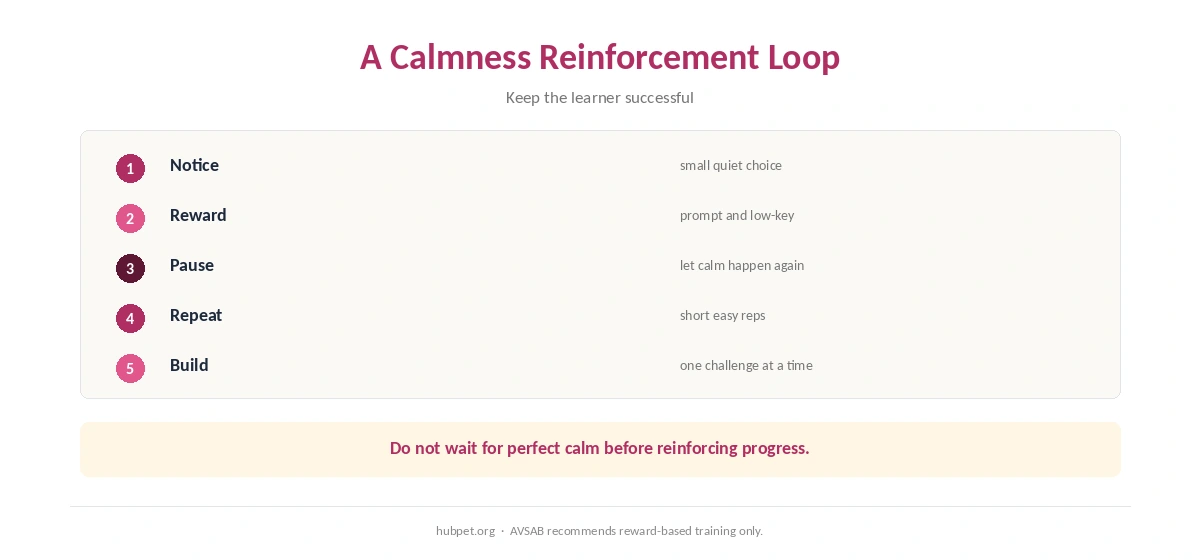
- Notice a calm choice. Look for quiet standing, looking away from a distraction, lying down, or resting the head.
- Deliver the reward promptly. The consequence should follow closely enough to make the connection clear.
- Keep the reward compatible with calmness. Use something the learner values without turning the moment into frantic play.
- Pause again. Give the animal a chance to make another calm choice instead of cueing constantly.
- Repeat in short sessions. End while the behavior is still easy and successful.
The basic dog training guide can help you organize these sessions. The training-mistakes guide is useful if your timing is late or the criteria change from repetition to repetition.
What Counts as Calm Enough to Reward?
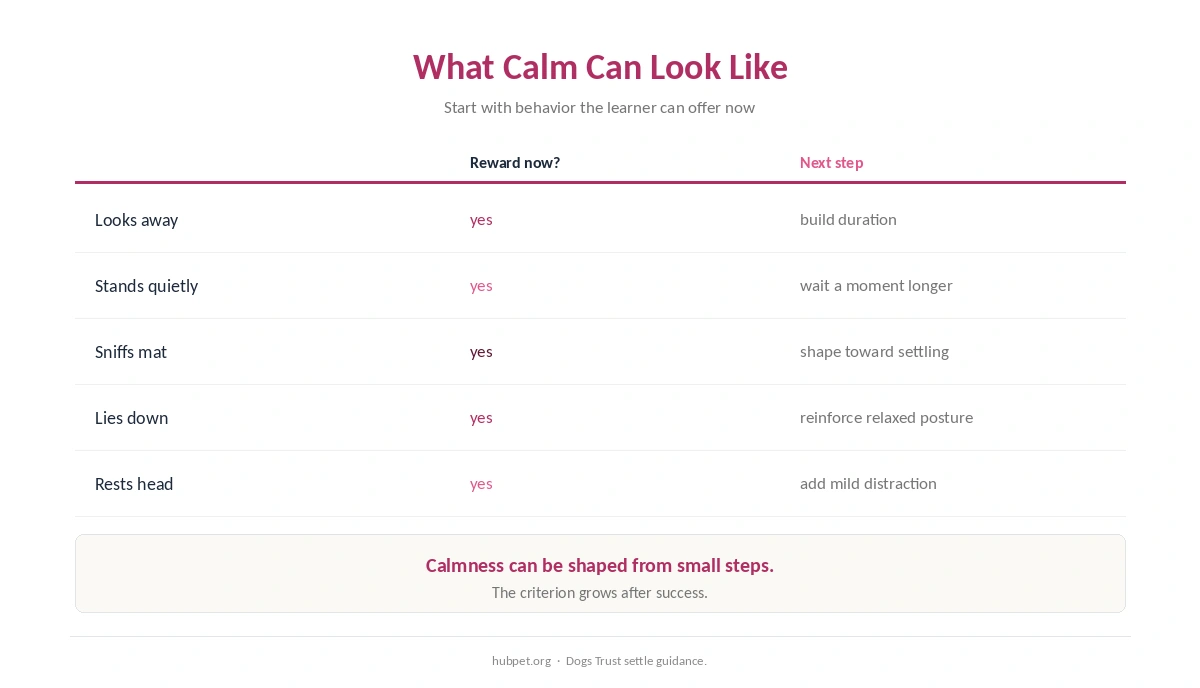
Do not wait for a perfect down-stay. Dogs Trust guidance reviewed in 2026 suggests starting with any behavior that is quieter than the current level of excitement, then shaping toward signs such as lying down, shifting weight comfortably, sighing, or resting the head. This approach gives the learner many chances to succeed.
| Early calm behavior | What you do | What you avoid |
|---|---|---|
| Looks away from excitement | Reward the disengagement | Calling the pet back into arousal |
| Stands quietly | Reward before jumping starts | Waiting until the pet fails |
| Sniffs the mat or floor | Reward low-key investigation | Repeated verbal prompting |
| Lies down | Reward while the body is settled | Exciting play as the immediate reward |
| Rests head or softens posture | Reinforce the relaxed state | Increasing difficulty too fast |
This is especially useful around predictable triggers. For doorways, combine it with waiting at the door. For visitors, use the doorbell calmness guide. If jumping is the problem, reward an alternative to jumping instead of adding punishment.
Food is not the only possible reward. Dogs Trust guidance reviewed in 2026 notes that dogs value different outcomes, including food, toys, play, attention, and access to activities. How to reward calm behavior effectively also depends on reward choice. Pick an outcome that does not immediately push arousal back up. Quiet praise, gentle contact if the animal enjoys it, or a small food reward may fit better than an energetic game.
How to Reward Calm Behavior Effectively as Difficulty Grows
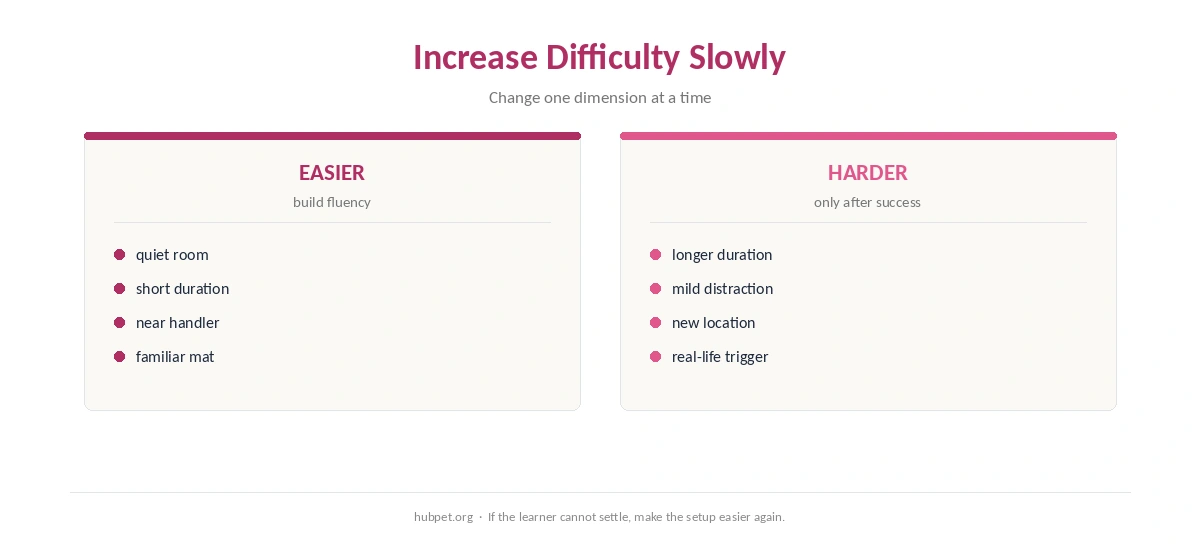
How to reward calm behavior effectively changes once distractions appear: keep the same behavior goal, but make only one part harder at a time. Dogs Trust settle guidance reviewed in 2026 recommends gradually increasing duration and then adding distractions. If the animal cannot relax, reduce the distraction or increase distance.
For outdoor practice, the distraction-training guide shows how to lower difficulty. The weekly training checklist can help you spread practice across settings instead of attempting one long session.
If food or attention drives the excitement, teach the replacement behavior directly. The begging guide and wait-for-food guide use reinforcement rather than confrontation. For noisy behavior, quiet-cue training works best when the dog also learns what to do instead.
Do not add scolding, leash corrections, shock, prong, or choke tools to make calmness happen. AVSAB’s 2021 position rejects aversive methods for dog training and behavior modification. Our scolding myth guide and dominance-theory guide explain why force is not the foundation for reliable calm behavior. For the related reward-based training guide, see how to Practice Calm Behavior Before Walks.
When to Get Professional Help
If the animal cannot settle because of intense fear, reactivity, guarding, or repeated panic, stop raising the difficulty and seek a qualified reward-based behavior professional. The fearful-dog confidence guide can help you manage distance in the meantime, and redirection guidance can help you reinforce safer alternatives without punishment.
How We Research
HubPet reviewed these sources on October 11, 2026: the AVSAB position statements page, including the 2021 humane dog training position, Dogs Trust settle training guidance, and Dogs Trust positive reinforcement guidance. Read our editorial method at How We Research.
At the start of a new skill, frequent reinforcement makes the connection clearer. As the behavior becomes reliable, you can gradually vary the rewards while still reinforcing calm choices.
Yes. Dogs Trust settle training deliberately rewards relaxed behavior the dog offers, so calmness can become useful even when you have not asked for a formal cue.
Use a calmer delivery or a different valued reward. The goal is to reinforce the quiet behavior without immediately creating a bigger burst of arousal.
No universal rule fits every situation. Manage safety first, prevent rehearsal when needed, and make the calm alternative easy enough to reward.
AVSAB’s 2021 position recommends reward-based methods and rejects aversive methods for dog training or behavior modification.
How to Reward Calm Behavior Effectively: Bottom Line
How to reward calm behavior effectively is mostly a timing and difficulty problem. Notice small quiet choices, reinforce them promptly, keep rewards compatible with the state you want, and increase duration or distractions gradually. Reward-based repetition teaches calm behavior without forcing or frightening the learner.