
Martingale dog collars have a large loop around the dog’s neck and a smaller control loop where the leash connects. When the leash becomes taut, the smaller loop draws the large one closer, helping prevent certain narrow-headed dogs from slipping free. The crucial safety feature is a real limit to tightening, not a promise that any martingale is gentle by default. Edmonton Humane Society and Calgary Humane Society both emphasize correct adjustment and removing these collars when the dog is not supervised. This guide explains how to examine the loop layout, assess fit at rest and under light tension, and recognize when a harness would be a better walking choice.
Identify both loops and the actual stopping point
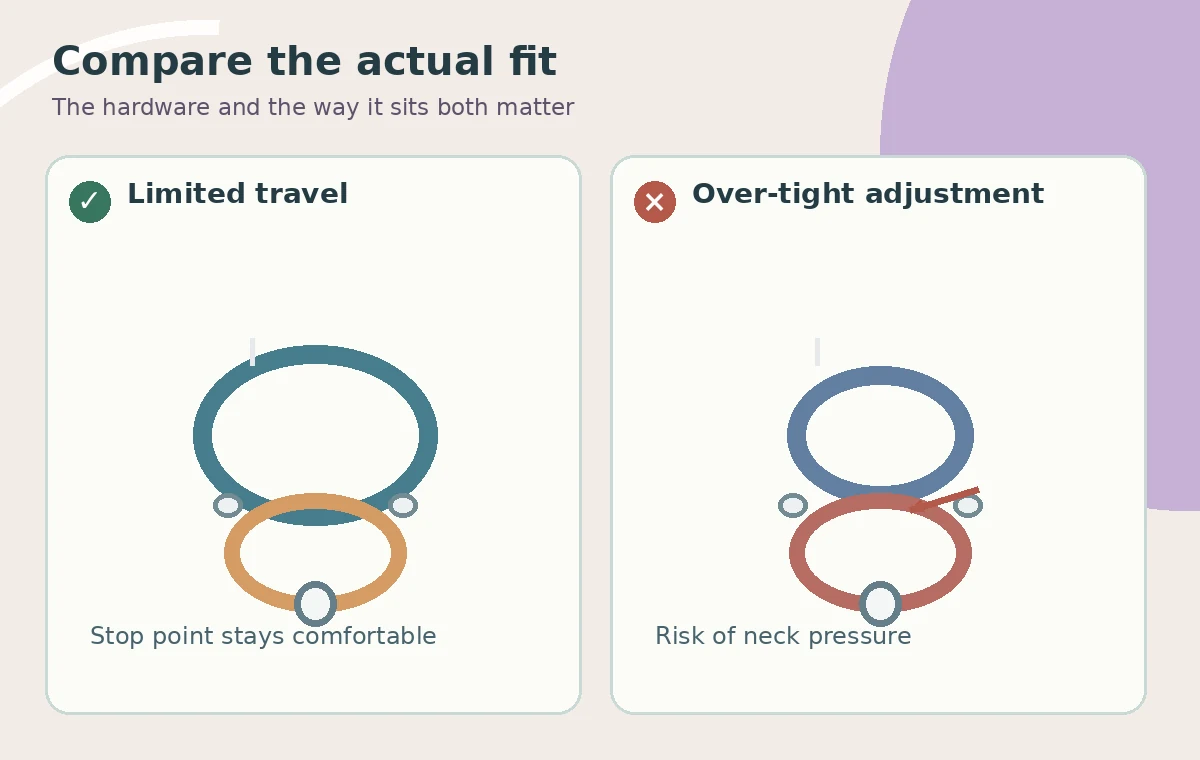
Place the collar on a table before first use. The larger band lies around the neck. A second, shorter fabric or chain segment connects points on that band, and the leash fastens to its ring. Under pressure, the control segment should take up slack only until a predetermined stop. Some products use sliding rings; others rely on a chain or fabric section. Examine the hardware path, adjustment buckle, and whether the leash ring can travel freely without snagging. If the construction is confusing or you cannot see what prevents unlimited tightening, do not test it on the dog. Ask the manufacturer for a fitting diagram.
Choose a size for the dog’s actual head and neck
Measure as the manufacturer directs, including the neck circumference and sometimes the widest point of the head. Head shape matters: sight hounds and some other dogs can have heads little wider than their necks, making escape from a flat collar easier. A martingale must pass on or buckle comfortably and then adjust to stay secure without squeezing. Do not select by breed alone, since individual dogs vary. A wider, smooth band may distribute contact differently from a narrow stiff one, but width cannot compensate for improper adjustment. Start with a collar that offers adequate adjustment range without long loose webbing tails.

Test light tension without compressing the throat
Fit the collar when the dog is relaxed. Attach a leash and apply only a small steady pressure while checking where the loops stop. The collar should not tighten indefinitely or press forcefully into the throat. Watch for coughing, gagging, flinching, or the dog bracing away. These are reasons to stop, not signs that training is working. The Canadian and Edmonton humane guides caution that incorrect fit can injure the neck; never use the smaller loop to administer leash corrections. If the dog pulls hard, a properly fitted body harness often avoids concentrating all the force at the neck.
Understand the buckle and chain alternatives
An all-fabric control loop avoids metal chain sound and may suit a noise-sensitive dog. Chain designs move differently through rings and should be checked for damaged links and sharp or rough spots. With a buckle style, you can open the collar without passing it over the head, but the buckle must fully close and resist normal handling. Non-buckle designs need enough room for safe removal while still meeting the stop-point requirement. Compare the actual maximum tightened circumference rather than assuming every model with the word ‘martingale’ functions identically. Hardware quality and documented adjustment instructions are essential.
Use this collar only when supervised
A loosely hanging control loop can catch on furniture, fencing, play equipment, or another animal’s mouth. Tightening may follow even when no person is holding the leash. Humane societies therefore recommend removing martingales when walks end and avoiding them for unsupervised play or crating. Keep a separate safe identification plan that suits the dog’s household and legal requirements. Do not tether a dog by a martingale or attach one to a fixed object. If other dogs are wrestling, take the martingale off beforehand. Escape prevention on a supervised walk does not override entanglement prevention at home.
Pair secure equipment with gentle walking skills
Equipment alone cannot teach a dog to handle distractions. If the dog rushes toward squirrels or lunges at other dogs, increase distance, reward attention and calm choices, and practice with a reward-based trainer where necessary. Avoid deliberate jerks, popping the leash, or using discomfort to stop pulling. VCA notes that painful leash pressure can worsen fear or reactive behavior. Consider a Y-shaped harness with good shoulder movement and a backup connection as part of an appropriate walking plan. Use the martingale for containment only where it fits safely, not as an automatic anti-pulling device.
Check the collar after washing and growth
Repeated washing may stretch, dirty, or stiffen fabric. Inspect every loop for fraying, loose stitches, rough ring edges, or a buckle that catches rather than clicking. Refit after coat changes, weight gain or loss, and growth. Some dogs need a different collar width or a different design once their neck size changes. Repeat the light-tension stop test whenever you adjust the band. Clean and dry it before storing. Never repair a compromised load-bearing stitch with ordinary household thread and then rely on it for restraint.

Make a clear pass-or-return decision
A suitable martingale comes off easily, releases completely when the leash slackens, stays on during ordinary walking, and never creates choking pressure. The hardware should move smoothly, without an uncontrolled tightening path. If the dog coughs, balks, or repeatedly pulls, address the fit and underlying walking problem instead of tightening further. A regular flat ID collar or a different harness may better meet daily needs. A product called ‘humane’ is not evidence of comfort; what matters is the actual stopping geometry and responsible supervised use.
How We Research
Our editorial review uses first-party animal welfare and veterinary guidance to check equipment fit, movement, attachment, and handling risks. We evaluated product construction and observable use criteria, not untested brand rankings or invented laboratory results. Illustrations explain principles; they do not represent product certifications or veterinary examination. Sources reviewed October 27, 2026. Learn more at About HubPet.
Sources
Edmonton Humane Society — Martingale Collars. Read source. Accessed October 27, 2026.
Edmonton Humane Society — Selecting Walking Gear. Read source. Accessed October 27, 2026.
Calgary Humane Society — Dog Walking Equipment. Read source. Accessed October 27, 2026.
VCA Animal Hospitals — Collar and Harness Options for Dogs. Read source. Accessed October 27, 2026.
Safety note: This guide provides general equipment information, not a diagnosis or an individualized behavior or medical plan. Stop using gear if your dog shows pain, coughing, breathing difficulty, or persistent distress. Contact a veterinarian for health concerns and consult a qualified reward-based trainer for difficult walking behavior. See our veterinary disclaimer.
A correctly designed and adjusted martingale has a limited tightening range, although a poor adjustment can still make it dangerous.
Remove it when you cannot supervise the dog, particularly during play, sleeping, or crating, because the loop can snag.
They can help some narrow-headed dogs stay contained on supervised walks, but correct sizing and a comfortable limit stop are essential.
Neither is universally better. Compare noise, smooth movement, condition of hardware, adjustment range, and the individual dog’s comfort.
No collar replaces reward-based loose-leash training. A strong puller may need a well-fitted harness to limit neck pressure.