
Dog leash clips connect the lead to a collar or harness, yet this small piece of hardware receives less attention than leash length and handle padding. A snap hook depends on a gate, spring, and correctly sized attachment ring; a swiveling model adds a moving joint that can bind or wear. Locking gates introduce another step the handler must use consistently. No clasp type is infallible, and an unfamiliar closure can slow an owner when a dog is moving. Veterinary guidance emphasizes comfortable well-fitted walking equipment and avoiding harsh leash tension. This article offers an inspection-first framework for choosing a clip that fits the intended harness or collar ring and remains reliable in ordinary walking conditions.
Understand what actually holds the ring
A common bolt snap has a sliding spring-loaded bolt; a trigger snap usually opens a hinged gate through a thumb lever. A carabiner-style clip uses a gate that may have an optional screw or twist lock. Identify the fixed part and the moving part. Then locate the narrowest gap through which a ring might escape. The gate must close completely on its own after you release it. Check that there is no catch on the hinge, hook tip, or spring housing. Do not assume a large clip is strong enough for your dog because it feels heavy; construction and suitable load rating matter more than appearance.
Match the clip to the harness attachment ring
Try the clip on the actual D-ring or O-ring while the dog is not wearing the gear. The ring should sit freely inside the clip without forcing its gate partly open. Very thick welded rings may not fit a narrow hook throat; very small rings can wedge into a gap around a hinge. Rotate the clip and ring through ordinary angles to see whether they bind. Follow the harness maker’s requirements for single or paired rings. Never clip onto a decorative handle, fabric tab, or identification-tag split ring unless the manufacturer specifically designs that component for leash force. The intended load path should be clear before a walk.
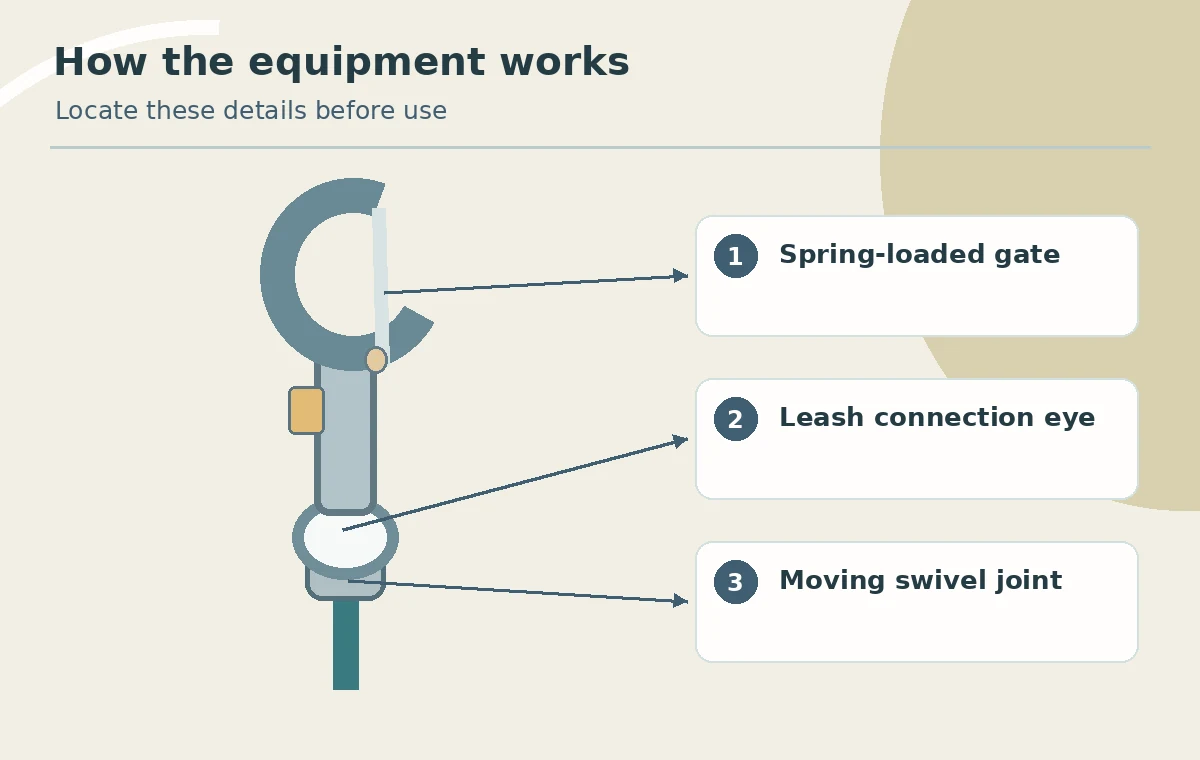
Look carefully at swivel joints
A swivel lets the leash rotate when the dog circles, potentially reducing twists. It does not prevent all tangles and can add a bearing or rivet that deserves inspection. Hold one end stationary and turn the other through a full rotation. It should move smoothly without grinding, wobbling, or exposing a widening gap. Check for bent retaining pins and sharp edges around the pivot. Dirt or corrosion can make a swivel freeze, causing the leash to twist into a stiff coil. If movement feels rough or the connection has visible play, retire the questionable hardware rather than oiling it and hoping it holds.
Evaluate a locking gate without trusting the label
A locking carabiner can reduce accidental gate movement when the handler closes and locks it properly, but it adds a manual sequence. Practice opening, attaching, locking, unlocking, and removing it with the actual walking gloves you use. Ask whether grit or wet hands make the mechanism hard to operate. Examine the lock position visually rather than assuming a partial turn is secure. Do not confuse climbing carabiner ratings with pet-walking suitability, or assume all decorative ‘locking’ clips have verified standards. A handler who uses a simple reliable snap correctly may manage better than someone who frequently forgets an elaborate lock.

Test closure before every outing
With the leash detached, press the gate open and release it several times. The spring should push the gate firmly against its mating surface each time. Attach it to the correct ring, then look directly at the closed gap and use gentle hand pressure to confirm that it sits fully inside the hook. Give the leash a normal directional turn; the clip should not twist sideways into a position that lifts the gate. Keep fingers out of pinch points and perform checks away from traffic. This is a routine functional check, not a destructive strength test. Change a clip that fails to close before leaving home.
Inspect material wear and corrosion
Salt, mud, sand, and repeated wetting can affect metal springs and surfaces. Rinse and dry walking equipment as the manufacturer directs, then examine the hook tip, spring action, swivel, and leash stitching around the eye. Surface discoloration alone does not establish structural damage, but pitting, cracks, deformation, and rough operation are warning signs. Beware of sharp burrs that could cut webbing or skin. Replace damaged or unknown load-bearing hardware. Never attempt makeshift repairs with wire, a household key ring, or tape. Confirm that a qualified repairer installs any replacement clip with appropriate load-bearing stitching.
Consider handling and dog behavior together
An oversized hook may feel secure but bump the dog’s shoulder or snag long fur. A very small gate can frustrate a person working quickly in cold weather. Choose a mechanism you can operate consistently while keeping the dog at a comfortable distance. If a dog pulls hard or lunges, do not compensate by choosing a punitive collar or jerking the leash; practice calm reward-based walking and appropriate distance from triggers. VCA advises avoiding painful equipment and emphasizes the role of good harness fit. The clip can maintain the connection, but it cannot solve a stressful walking context.
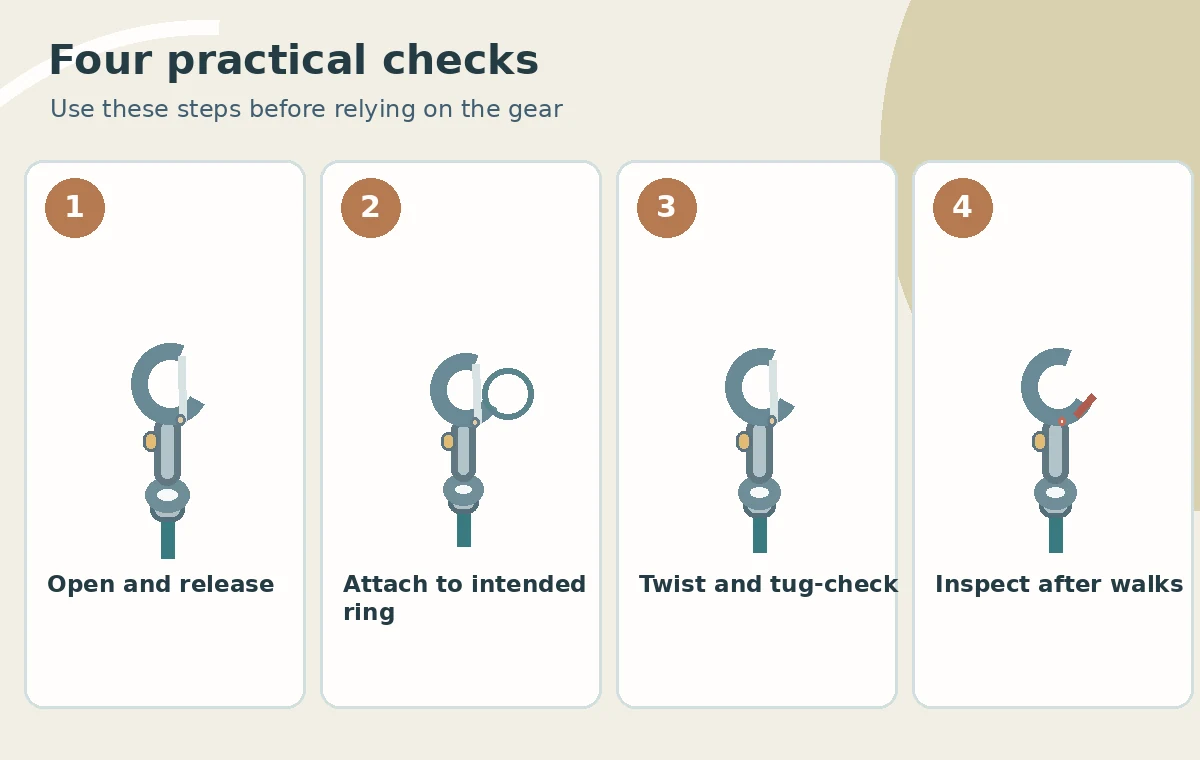
Make a simple replacement rule
Keep a spare complete leash rather than improvising an emergency clip in the field. Replace the lead if the gate sticks open, the swivel separates, the metal bends, or stitching at the terminal loop frays. Confirm that hardware suits the real attachment ring after any harness or collar change. For larger or very active dogs, ask the product maker for a documented load specification and avoid claims based solely on the metal’s shiny finish. Your final choice should open predictably, close positively, turn without binding, and connect to intended restraint hardware every time.
How We Research
Our editorial review uses first-party animal welfare and veterinary guidance to check equipment fit, movement, attachment, and handling risks. We evaluated product construction and observable use criteria, not untested brand rankings or invented laboratory results. Illustrations explain principles; they do not represent product certifications or veterinary examination. Sources reviewed October 27, 2026. Learn more at About HubPet.
Sources
VCA Animal Hospitals — Collar and Harness Options for Dogs. Read source. Accessed October 27, 2026.
VCA Animal Hospitals — Controlling Pulling on Walks. Read source. Accessed October 27, 2026.
RSPCA South Australia — How to Fit Your Dog’s Walking Harness. Read source. Accessed October 27, 2026.
Edmonton Humane Society — Selecting Walking Gear. Read source. Accessed October 27, 2026.
Safety note: This guide provides general equipment information, not a diagnosis or an individualized behavior or medical plan. Stop using gear if your dog shows pain, coughing, breathing difficulty, or persistent distress. Contact a veterinarian for health concerns and consult a qualified reward-based trainer for difficult walking behavior. See our veterinary disclaimer.
A correctly operated lock can reduce accidental opening, but the mechanism must suit the ring and the handler must reliably close it each time.
They use different moving gates to capture a ring; test complete closure, smooth operation, ring clearance, and condition rather than choosing by name alone.
They may reduce twisting when a dog turns, but they do not eliminate tangles and the moving joint must be inspected for wear.
No. Small split rings intended to hold identification tags should not replace a load-bearing harness or collar D-ring.
Replace damaged, bent, cracked, gritty, or unreliable hardware, including gates that fail to close or swivels that have developed looseness.