
This article is general information, not veterinary advice. If your pet seems unwell, is in pain or may have eaten something harmful, contact your vet or an animal poison control line right away. Read our vet disclaimer.
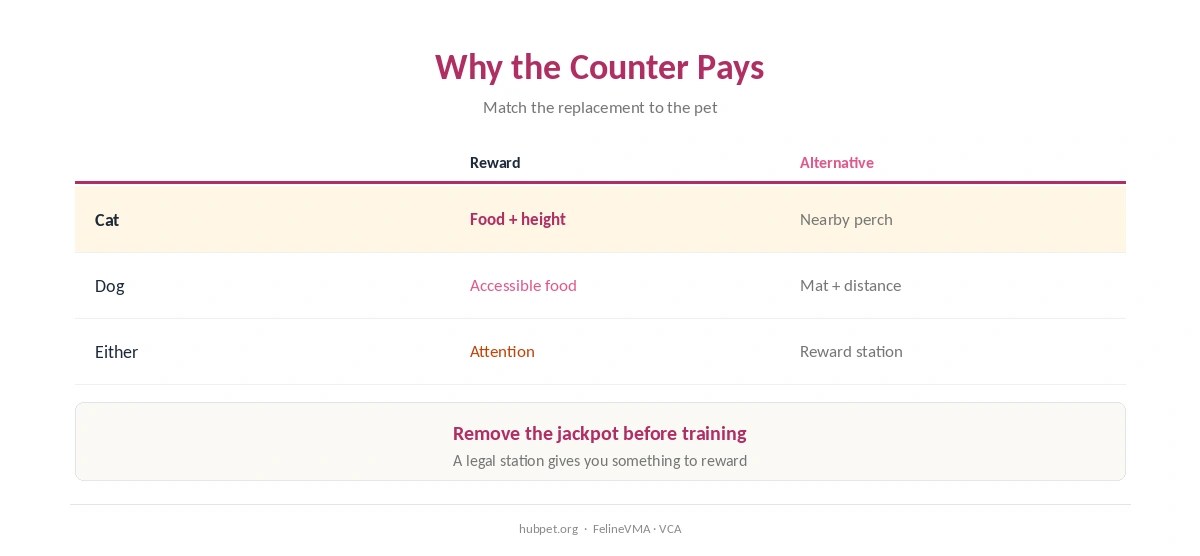
How to keep pets off kitchen counters works best when the counter stops paying and an alternative place becomes worthwhile. FelineVMA notes that cats may climb onto counters because they find food there or want a high place near people, and it recommends clearing food and rewarding a nearby perch (FelineVMA, accessed 2026). For dogs, VCA likewise emphasizes prevention around accessible food and teaching an alternative behavior (VCA, accessed 2026).
How to Keep Pets Off Kitchen Counters: Remove the Payoff
Start with management. Clear food, dishes, crumbs, and other interesting items before the pet can practice finding rewards. For cats, even an occasional food discovery can keep the counter valuable. For dogs, access to food can reinforce counter-surfing without any human attention at all (VCA, accessed 2026). This part of how to keep pets off kitchen counters follows the same prevention logic as pet-proofing your home and preventing furniture chewing.
| Pet | Likely payoff | Better setup |
|---|---|---|
| Cat | Food or high view near people | Clear counter + nearby perch |
| Dog | Accessible food or attention | Clear counter + managed kitchen access |
| Either | Inconsistent house rule | Reward an alternative place |
How to Keep Pets Off Kitchen Counters: Teach an Alternative Place
For cats, FelineVMA recommends a desirable high perch where the cat can watch the person without using the counter, then rewarding the cat for choosing it (FelineVMA, accessed 2026). For dogs, a mat or bed outside the food-preparation zone can serve the same function. Reward the alternative before the pet reaches the counter. If your dog already knows sit, teaching a reliable sit can become part of that kitchen routine.
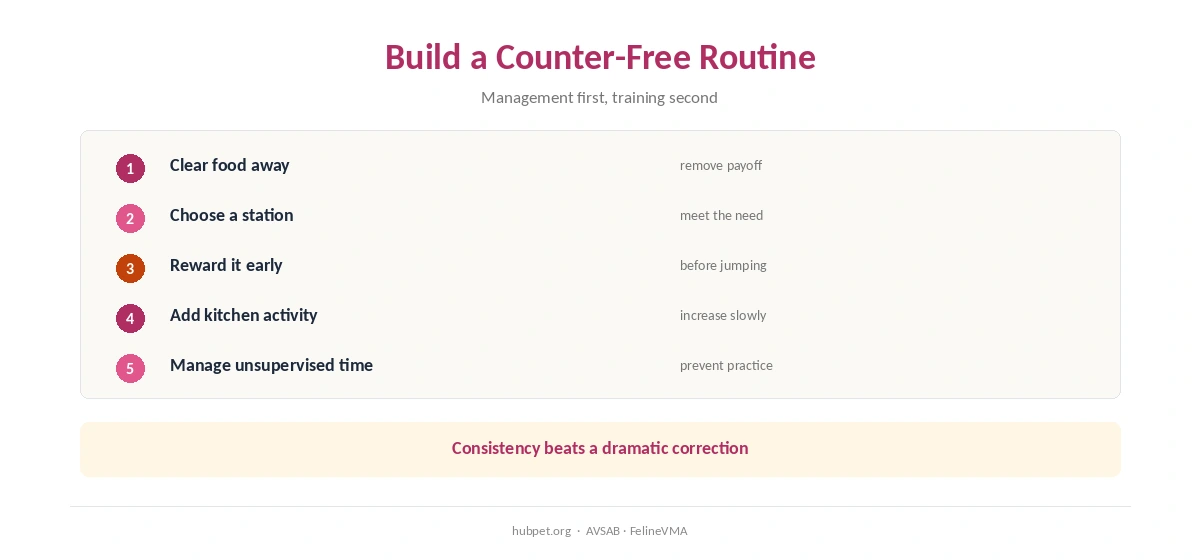
- Clear the counter before training starts.
- Choose a legal station that meets the pet’s reason for approaching.
- Reward the pet for choosing that station while the kitchen is quiet.
- Add normal food preparation only after the station is easy.
- Use doors, gates, or distance when you cannot supervise the setup.
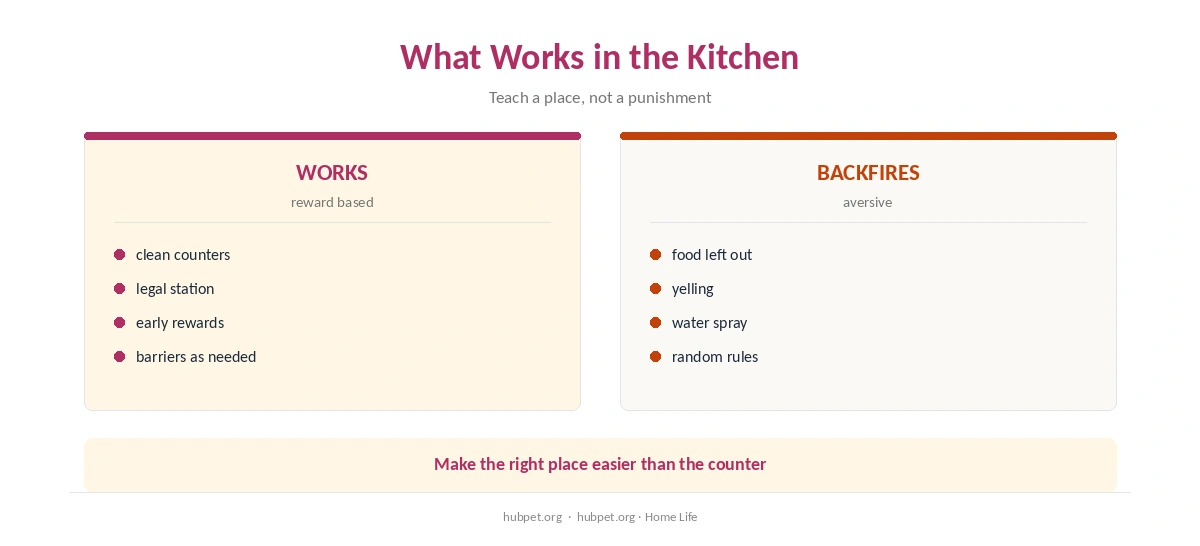
Avoid punishment-based shortcuts. FelineVMA specifically warns that yelling, water spraying, or aversive mats can create fear and still fail when food remains more rewarding (FelineVMA, accessed 2026). AVSAB recommends reward-based methods for dog training and behavior modification (AVSAB, 2021; reaffirmed 2025). So teach where you want the pet to be. The same principle underlies positive reinforcement.
Make the Kitchen Rule Easy to Maintain
Consistency matters more than a dramatic correction. Everyone in the household should keep food inaccessible and reward the same legal station. For cats, that may be a perch outside jumping range of the work surface. For dogs, it may be a mat beyond the preparation area. If your cat also scratches nearby furniture, use the redirection plan in stopping sofa scratching rather than removing normal outlets. In practice, how to keep pets off kitchen counters depends on making the legal station consistently worthwhile.
Home safety also depends on what is accessible. The existing guides to foods toxic to dogs and foods toxic to cats cover hazards separately. Meanwhile, the toxic houseplants guide can help you decide what should never sit on an accessible surface.
How We Research
HubPet uses published veterinary, welfare, behavior, and research sources rather than personal anecdotes. We read these sources on October 11, 2026: FelineVMA counter-training guidance, VCA dog stealing and food-access guidance, AVSAB Humane Dog Training position. See How We Research for our method.
How to Keep Pets Off Kitchen Counters FAQ
FelineVMA notes that food, height, and proximity to people can make counters rewarding. Remove food and offer a useful nearby perch.
Food can reward the behavior by itself. Prevention matters because a successful food find reinforces another search (VCA, accessed 2026).
No. FelineVMA warns that aversive responses can cause fear and may not solve a behavior that still earns food.
A mat, bed, or simple stationary behavior outside the preparation area gives you something specific to reward.
It is an important first step, but many pets also need an attractive legal place and repeated rewards for choosing it.
The Bottom Line
How to keep pets off kitchen counters is a two-part plan: remove the rewards on the counter and reinforce a legal place nearby. Keep the rule consistent, manage access when supervision is impossible, and skip punishment that adds fear without teaching the replacement behavior.