
This article is general information, not veterinary advice. If your pet seems unwell, is in pain or may have eaten something harmful, contact your vet or an animal poison control line right away. Read our vet disclaimer.
How to trim a dog’s nails at home safely is less about finishing every paw. The priorities are avoiding the quick and keeping the dog comfortable. VCA advises checking nail length regularly and notes that many dogs need trimming about monthly, with individual variation based on wear and activity (VCA, 2025; accessed 2026). If your dog is frightened, painful, or impossible to hold comfortably, stop and use veterinary or professional grooming help instead of forcing the trim.
How to Trim a Dog’s Nails at Home: Prepare Before You Clip
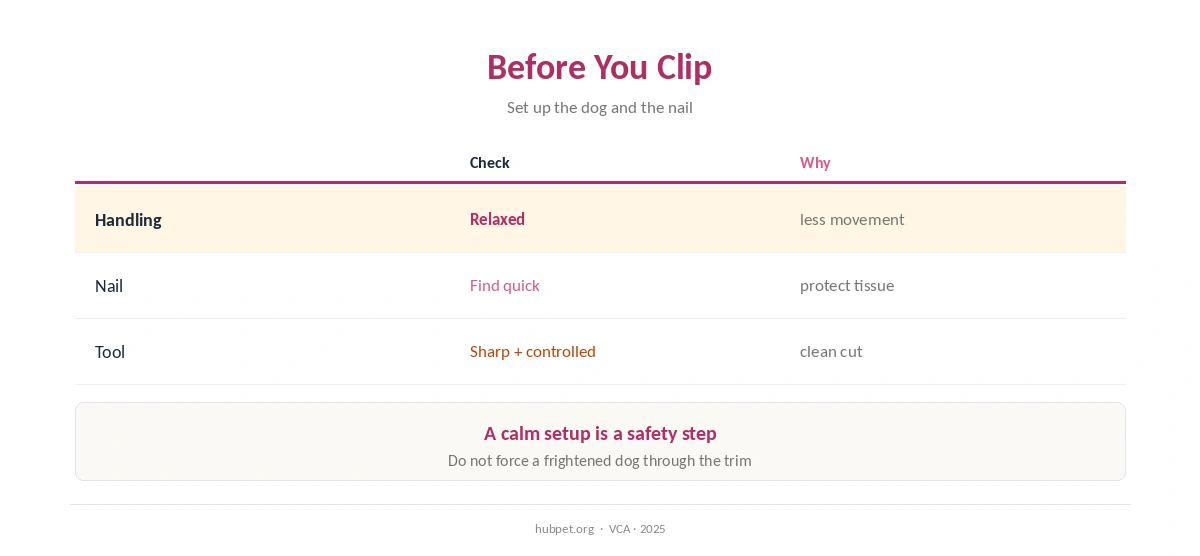
Before cutting, identify the nail anatomy and practice calm paw handling. VCA’s behavior guidance recommends short sessions that pair foot handling with rewards before equipment is introduced (VCA, accessed 2026). This makes how to trim a dog’s nails at home a handling skill first. The same approach fits the broader routine in grooming a dog at home and the reward timing in positive reinforcement training.
| Before clipping | What to check | Reason |
|---|---|---|
| Paw handling | Dog stays loose and accepts touch | Reduces sudden movement |
| Nail view | Locate the quick when visible | Avoids live tissue |
| Equipment | Sharp suitable clipper or file | Cleaner controlled trim |
How to Trim a Dog’s Nails at Home: Take Small Controlled Cuts
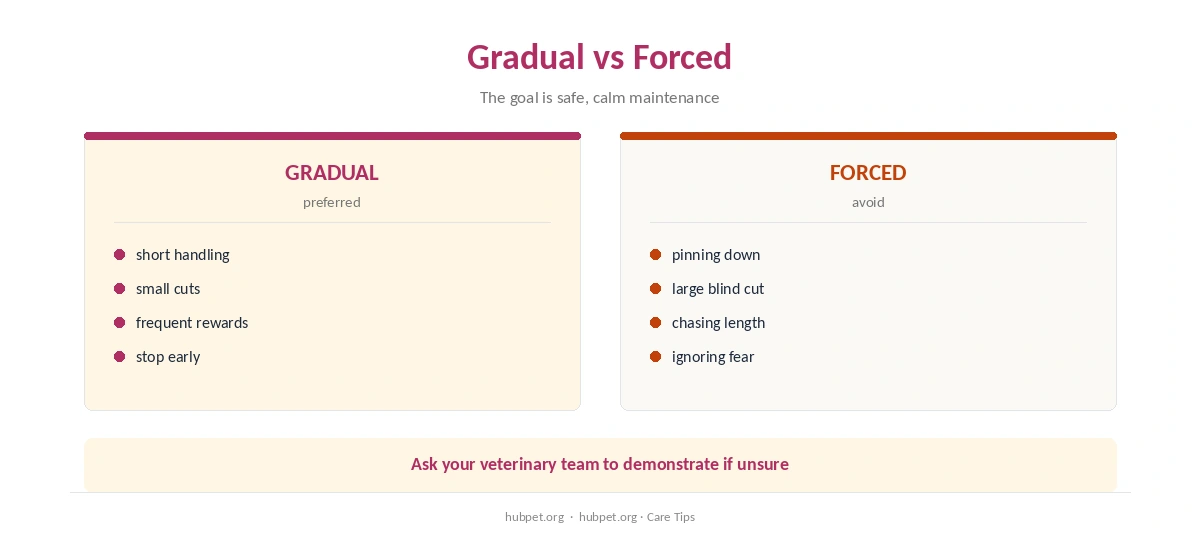
For clear nails, the pink quick may be visible. For dark nails, VCA recommends progressing gradually rather than taking one large cut (VCA, 2025; accessed 2026). Therefore, remove only a small amount at a time and inspect the cut surface before continuing. Remember the dewclaws, because they may not contact the ground and can overgrow. If you are unsure where to stop, ask your veterinary team to demonstrate before you try again.
- Choose a quiet location and a position your dog can hold comfortably.
- Handle one paw and reward calm behavior before clipping.
- Trim a small amount from one nail, then pause and inspect it.
- Stop before the quick and do not chase a cosmetic target length.
- End the session early if your dog becomes fearful or struggles.
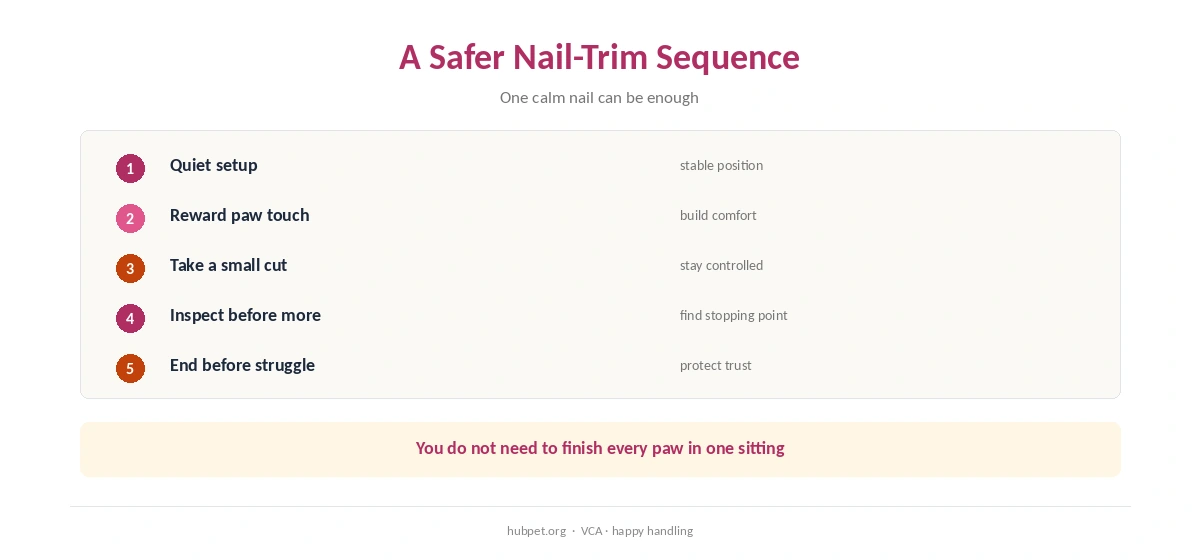
You do not need to complete every nail in one sitting. VCA specifically recommends going at the dog’s pace and building from handling to one nail, then several nails as comfort improves (VCA, 2025; accessed 2026). Short practice also matches basic dog training at home. For a broader routine, use the daily dog care checklist to notice paws and movement between grooming sessions.
How Often Should Dog Nails Be Trimmed?
VCA says many dogs need a nail trim about once a month, while dogs with more natural wear may go longer and others may need attention sooner (VCA, 2025; accessed 2026). Clicking on hard floors or nails contacting the ground can indicate they are too long. However, frequency is individual. Check the feet routinely rather than treating a calendar date as a medical rule. In practice, how to trim a dog’s nails at home depends on comfort as much as the calendar.
Nail care sits beside other routine tasks such as cleaning dog ears safely. If your dog suddenly resists paw handling, compare that change with signs your pet is in pain instead of assuming it is stubbornness.
When to Call Your Vet
Contact your veterinarian if a nail is torn, growing into the paw pad, repeatedly bleeding, or clearly painful. Also ask for help when your dog suddenly becomes sensitive about a foot or cannot walk normally. VCA notes that broken or overgrown nails can be painful and that fearful dogs may need a veterinary plan for low-stress nail care (VCA, 2025; accessed 2026).
How We Research
HubPet uses published veterinary, welfare, behavior, and research sources rather than personal anecdotes. We read these sources on October 11, 2026: VCA dog nail-trimming guidance, updated 2025, VCA happy-handling guidance. See How We Research for our method.
How to Trim a Dog’s Nails at Home FAQ
VCA says many dogs need trimming about monthly, but wear, activity, and individual growth change the interval (VCA, 2025; accessed 2026).
Work gradually and remove only a small amount at a time. If you cannot judge where to stop, ask a veterinary professional to demonstrate.
No. VCA recommends building tolerance gradually. One calm nail can be a better training session than a forced full paw.
No. Dewclaws may not touch the ground, so they can overgrow even when other nails wear naturally.
Stop and check for pain or injury. Sudden sensitivity deserves veterinary attention rather than more restraint.
The Bottom Line
How to trim a dog’s nails at home safely is a gradual process: teach calm paw handling, identify the quick, take small controlled cuts, and stop before fear or pain turns the session into a struggle. When the anatomy or the dog’s comfort level is unclear, let your veterinary team show you the next step.