
Large dog toys have a sizing challenge that small models cannot solve by simply scaling the colors. A broad jaw may crush a hollow object, split a seam or swallow a toy intended for a smaller dog. Yet very dense, rock-hard toys introduce dental risks. The best choice balances a generously sized shape with a manageable grip and material that survives the dog’s real play style. This guide explains which dimensions and seams deserve attention, how to evaluate a large toy without destructive testing, and when to stop a session.
Separate large size from heavy-duty marketing
A product can look enormous in a photo yet have a thin narrow section that breaks off. Read the actual length, width, thickness and opening dimensions. Consider whether your dog could fit the entire object deep into the mouth or pinch a small projecting end off with the back teeth. Avoid treating a breed photo as a fit chart. A young, lanky retriever, a broad-headed mastiff and an energetic shepherd may need different handle shapes. If possible, compare the toy with an item the dog carries comfortably, then supervise a short initial session.
Look for a grip that does not force the jaw
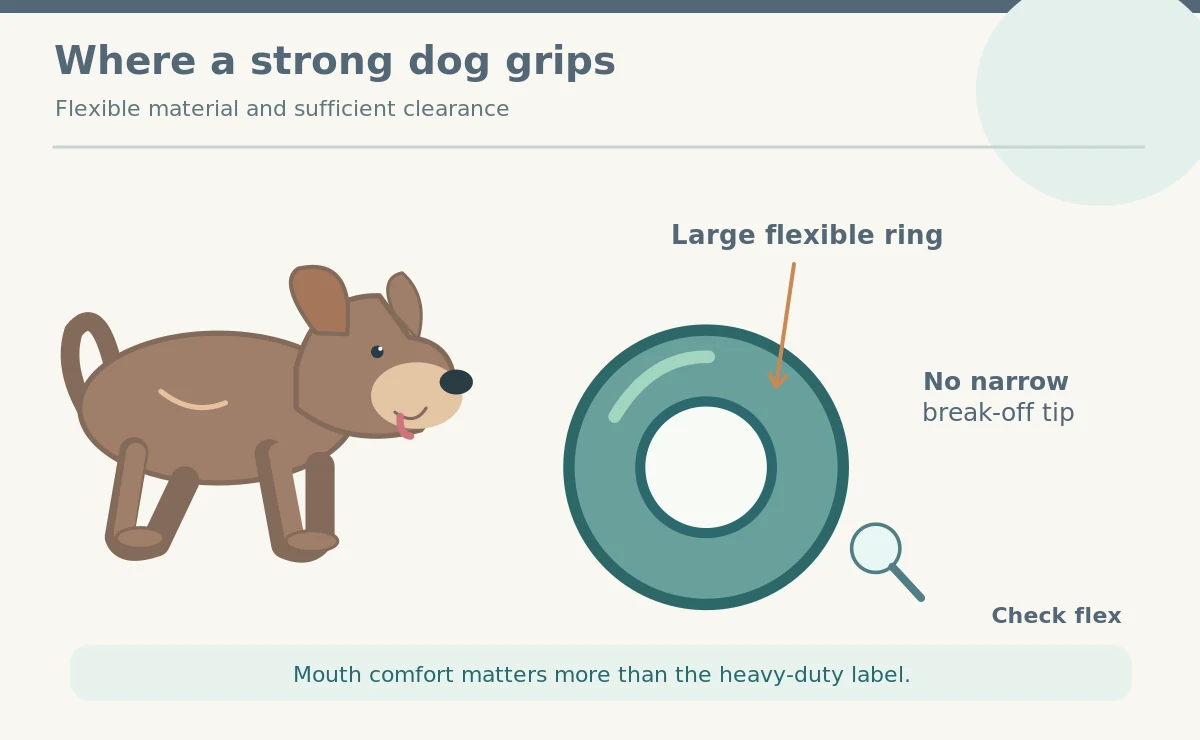
Thick solid balls can be difficult to pick up, while narrow necks may concentrate bite pressure at one weak point. Some large dogs prefer an elongated flexible body with an obvious grasp zone. Others carry a wide ring comfortably. Watch for jaw stretching, repeated dropping or frantic biting at a hard protrusion. A toy should not have an opening that traps the lower jaw. Avoid rigid handles that encourage the dog to lever against its teeth. The safest practical dimensions reflect how your individual dog holds the object, not only the maximum size printed on the label.
Understand soft, flexible and hard materials
A flexible rubber toy may compress under a strong bite, which can protect teeth, but it must also resist splitting into swallowable pieces. Thin latex-like skins may suit gentle play and fail during power chewing. Extremely hard nylon, antlers and other rigid materials can pose tooth-fracture risks. Texas A&M veterinary guidance recommends checking whether a material yields to a thumbnail rather than assuming harder means safer. Examine the actual toy and follow the maker’s use restrictions. No material is indestructible, and no simple home test can guarantee that a powerful chewer will not break it.
Treat seams as engineering details
Plush toys designed for larger dogs often include stitched panels or internal reinforcement. A long decorative ear, fabric tail or loosely attached patch can still tear away. Pull gently on each seam before play and check it again afterward. A toy that shows exposed filling or a protruding squeaker should leave the rotation immediately. Durable fabric can slow damage but does not make stuffing edible. Use plush as a supervised carry or interaction item for dogs who respect it. Heavy shredders need a different activity, not a stronger-looking fabric toy left alone.
Match fetch and tug to the setting
For fetch, choose a toy that remains large enough to avoid accidental swallowing while still easy to pick up from grass or a hard floor. For tug, keep the human hand away from the teeth and play with relaxed, voluntary grips. Avoid sudden vertical lifting, jerking the neck or holding the dog off the ground. A large dog can accelerate quickly and collide with furniture; clear space before the game. If your dog becomes overaroused, pause or switch to sniffing. A toy that excels for calm carrying may be unsuitable for high-speed outdoor throws.
Check the whole object after one session
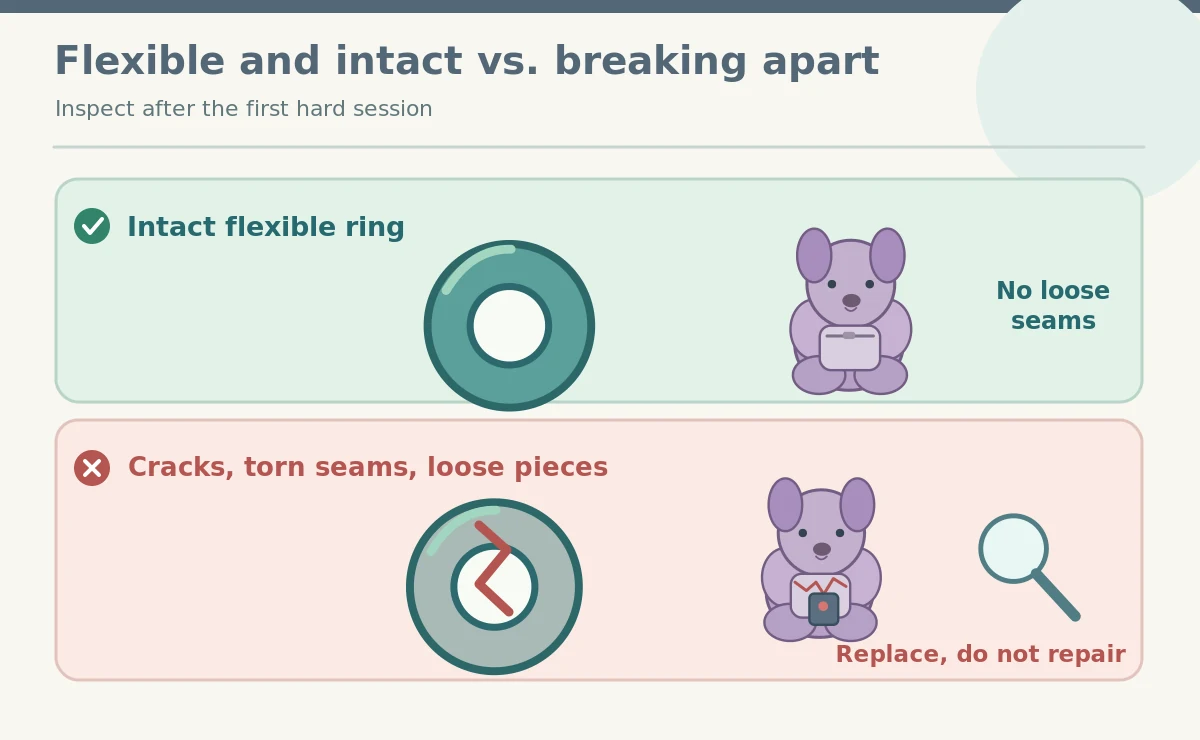
Run your eyes and fingertips over seams, edges and rubber folds without putting the object in the dog’s mouth. Look for white stress lines in plastic, a lifted edge on bonded layers, missing nubs or small teeth-shaped splits. Compare the toy with a pre-play photo if you are unsure whether a piece has vanished. Discard compromised toys rather than trimming off damaged portions and continuing to use them. A ripped edge may start a chain of tearing. A manufacturer’s heavy-duty claim should never override visible damage or your dog’s habit of swallowing fragments.
Plan a supervised heavy-chewer rotation
Offer short sessions with one suitable toy at a time. Put the toy away while you check it and let the dog rest. Alternate carrying, scent-search and low-impact interaction to avoid endlessly challenging the dog to destroy the same object. Food toys can add variety, but count their contents toward meals and choose openings that can be cleaned. Reward a voluntary drop, then return the toy when safe. Preventing access to a failing product is more useful than trying to correct chewing after a piece breaks away. Observation is part of every purchase decision.
Clean a large toy all the way through
Large hollow toys may trap food residue in a cavity that looks clean from the outside. Follow the product label; a brush sized for the opening can reach interior walls. Use suitable soap and water, rinse thoroughly and dry fully. A broad fabric toy may require more drying time than its machine-wash setting suggests. The CDC recommends regular cleaning of pet supplies and following manufacturer instructions. Do not soak an electronic component or a toy with an inaccessible cavity. If you cannot clean and dry a food-contact channel, choose a simpler washable design.

Compare true replacement costs
An expensive object that survives only one session may cost more per safe play hour than a modest, well-designed toy. Keep a basic note of purchase date, play style and the reason each toy was retired. Avoid false precision such as promising a specific number of months. Strong chewers differ, and even two toys from one line may fail differently. Pay for suitable dimensions, cleanable surfaces and a return policy rather than a vague unbreakable label. If your dog reliably destroys all toys, discuss safer enrichment approaches with a veterinary professional or qualified trainer.
Respond promptly to damaged or swallowed parts
Stop play immediately if a large dog cracks a toy or exposes inner components. Check the floor for fragments and account for missing pieces. Contact your veterinarian quickly after suspected swallowing, even when your dog seems comfortable. Repeated vomiting, abdominal pain, gagging and refusal to eat demand urgent assessment. Do not induce vomiting or pull a visible string without veterinary advice. Consider a simpler supervised activity while you reassess toy selection. Responsible toy ownership means retiring a popular object as soon as it stops being structurally appropriate.
How We Research
We compared current animal-welfare guidance, veterinary safety information and the practical characteristics readers can inspect before buying. We did not conduct laboratory strength tests or claim that any toy is universally safe. Manufacturer instructions inform the product-specific electronics guidance. We reviewed sources on October 28, 2026. You can read more about HubPet and our editorial method.
Sources
Texas A&M Veterinary Medicine, How to Chews the Best Dog Chew Toys. Read source.
ASPCA, Position Statement on Dog Chews and Treats. Read source.
Seattle Humane, Dog Toys and How to Use Them. Read source.
CDC, About Cleaning and Disinfecting Pet Supplies. Read source.
Safety note: This is general product selection guidance, not a veterinary diagnosis. If you think your dog swallowed a toy fragment, strand, battery or heat-pack material, seek veterinary advice promptly. Do not induce vomiting or pull visible string without veterinary instruction. Review our veterinary disclaimer.
No. Observe the actual dog and retire toys that split, shed pieces or expose stuffing.
Choose a ball that cannot be swallowed but remains comfortable to grasp; size alone is not enough.
Not necessarily. Excessively hard toys can damage teeth. Ask your veterinarian if you are unsure about material hardness.
Yes for some gentle carriers under supervision, but not for dogs that tear and ingest the filling.
Replace it when it shows cracks, missing tips, detached sections or any piece the dog could swallow.