
Raised cat feeding stations are often sold as a comfort upgrade, yet a taller rack does not automatically make a meal easier for a cat. The practical questions are whether the bowl remains steady, the cat can reach it without strain, and the frame stays out of the way of paws and household traffic. A low stable holder may work well for one cat while another prefers an ordinary bowl. This guide focuses on measurable height, retention rings, foot grip, easy washing, and calm access. It does not treat elevation as a medical remedy or make digestion promises without evidence. Start with your cat’s familiar posture and watch its voluntary use of a new setup. For painful movement or loss of appetite, review our veterinary disclaimer and seek veterinary advice.
Start with the cat rather than the stand
Raised cat feeding stations range from a small tilt block to a tall two-bowl rack. Elevation is not automatically more comfortable. Observe your cat eating on a familiar level surface first: where are the paws, how is the neck angled, and can it leave freely? Some cats with movement limitations may find a small change helpful, while others prefer ordinary floor bowls. A feeding station should solve a specific setup problem, such as sliding dishes or an awkward corner, instead of assuming that all cats need their dinner lifted. Any reluctance to bend or sudden posture change deserves a veterinary check.

Check usable height and entry clearance
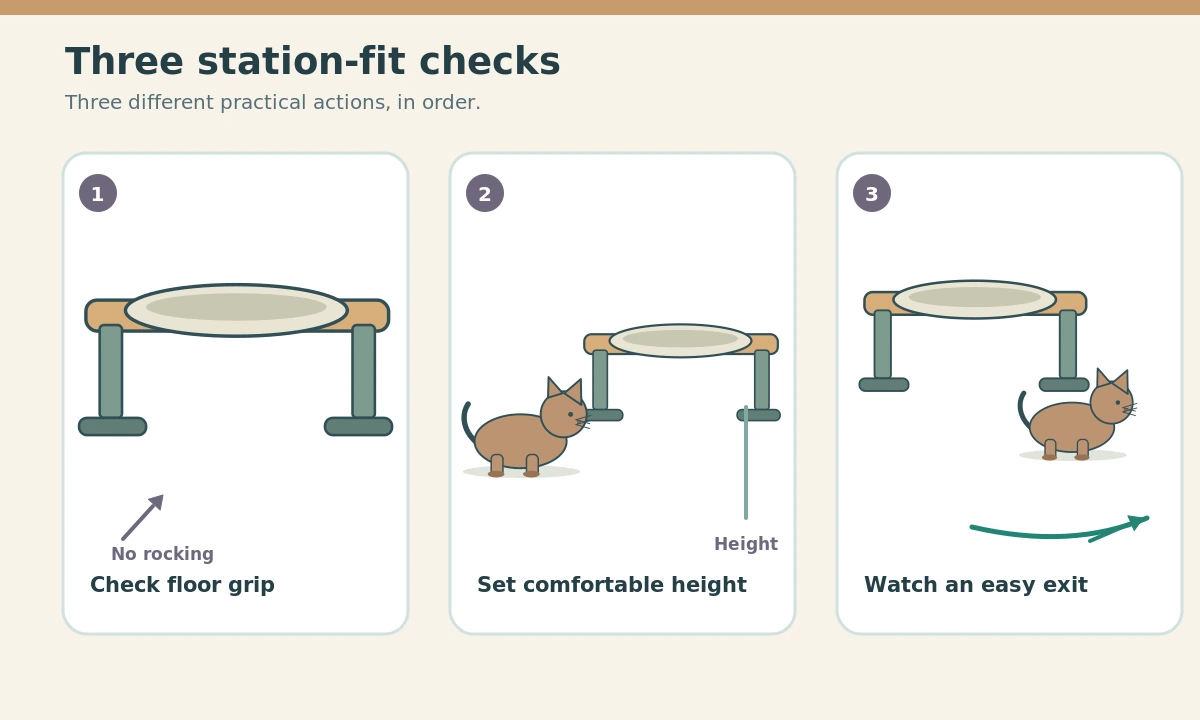
Measure from the floor to the upper food surface, not to the rim or decorative top of the stand. A cat should be able to approach without climbing, reaching over a high crossbar, or standing with paws braced on the frame. Watch a natural meal: the posture should appear unforced, with easy access from the front. Products labeled “ergonomic” may omit useful dimensions. If a stand has adjustable levels, start with the lower setting and adjust only if the cat uses it comfortably. Keep the frame away from stairs and avoid a setup that puts food near an edge.
Look closely at bowl retention
A ceramic or metal insert can rattle, rotate, or lift when a cat pushes food to one side. Inspect how the bowl sits in the ring or tray. A supporting lip should be broad enough to hold the insert without trapping food residue, and removable bowls should lift out without sharp catches. Test the empty station with gentle pressure from different directions. A matching bowl set is not proof every replacement size will fit; check opening and underside dimensions. Keep any rubber retaining gasket accessible for washing and inspect it for splitting or food buildup.
Test the feet on your real flooring
A tall narrow frame can rock on uneven tile or slide on wood. Wide contact feet, rubber pads, and a low center of gravity matter more than attractive metal tubing. Push gently at the height where a cat would touch the food. If the whole station shifts, reposition it or choose a more stable design. Do not improvise with loose bricks or unstable boxes. A heavy ceramic bowl in a light high frame can still create a top-heavy unit. On washable flooring, look for a base that allows you to clean underneath without taking apart the entire stand.

Avoid crowding a cat with a two-bowl rack
Food and water bowls displayed side by side may be convenient for owners, but cats may prefer separate water stations or quiet food locations. A double holder also creates a shared resource that can be hard to use when a housemate guards the area. Offer a separate food station for each cat when competition occurs. Keep enough room around the stand to approach and retreat without another pet blocking the route. A single removable bowl may be more practical than a decorative joined pair in a narrow kitchen. Watch actual use over several meals before deciding the layout.
Do not confuse elevation with a medical treatment
A raised station is a piece of furniture, not a treatment for nausea, swallowing problems, arthritis, or dental pain. An older cat that struggles to lower its head may need an individualized feeding plan, which can include veterinary assessment and changes to room access. Avoid dramatic elevations unless a veterinarian has advised a specific setup for that animal. If a cat regurgitates, eats less, vocalizes while feeding, or seems painful, seek professional guidance instead of changing bowl height repeatedly. Focus first on comfort, reliable intake, hygiene, and choice rather than unverified digestion claims.
Build cleaning into the daily routine
Lift the food bowl out after a meal and clean it with warm soapy water, rinse, and dry it as FDA advises. Wipe the ring that supports the bowl as well as the legs and foot pads. Sticky food can hide where the lip meets the frame. If the manufacturer labels only the insert dishwasher-safe, hand-clean the rack. Check metal welds for rust and unfinished wood for swelling after spills. If the unit has decorative trim, determine whether that trim creates cracks you cannot reach. The easiest station to clean is often the simplest one.
Make the switch gradually and observe
Set the new station close to the familiar feeding location, keeping the old bowl available initially. Offer a small normal meal, then step back and observe whether the cat approaches easily. If there is hesitation, lower the food surface, change the location, or return to the familiar dish. Do not place the cat physically on the station or hold its head near food. Keep a brief record of stability, intake, and any spills for several days. If the station works well, maintain the arrangement consistently. Your cat’s comfort and safe access are better evidence than promotional photographs.
How We Research
HubPet reviewed FDA and CDC hygiene guidance alongside relevant veterinary sources about feeding comfort and enrichment. We compare observable features—dish width, stability, food access, finish, and cleaning—rather than claiming laboratory product tests. Examples in the drawings are original explanatory illustrations, not tested products or medical outcome claims. Read our editorial approach, confirm manufacturer instructions, and adapt the setup to the individual pet.
Sources
FDA — Proper Storage of Pet Food and Treats — https://www.fda.gov/animal-veterinary/animal-health-literacy/proper-storage-pet-food-treats (accessed October 2026).
Ohio State — Environmental Enrichment — https://indoorpet.osu.edu/node/435 (accessed October 2026).
AVMA — Safe Handling of Pet Food and Treats — https://avma.org/resources-tools/pet-owners/petcare/safe-handling-pet-food-and-pet-treats (accessed October 2026).
Safety note: This article provides general pet-care information, not veterinary diagnosis or treatment. If appetite, swallowing, behavior, or physical comfort changes suddenly, seek advice from a veterinarian. Keep small parts, damaged ceramics, and cleaning products away from pets.
There is no single recommended height for every cat. Begin low, measure the actual food surface, and watch whether your cat eats and leaves comfortably.
Do not assume elevation treats digestive or joint problems. Some individual cats may prefer a modest change; seek veterinary advice for pain or feeding difficulty.
Yes, particularly if it has a narrow base or loose inserts. Test its stability on your floor and check how securely each bowl sits.
You can offer both, but provide other fresh water locations when needed and watch your cat’s preferences and access.
Remove the inserts, wash and dry the food dishes after use, and wipe any grooves, pads, and supports according to the manufacturer’s instructions.