
Dog ID tags are simple, inexpensive tools, but their usefulness depends on information that a stranger can read immediately. An outdated phone number or a worn engraving may fail a lost dog and the person trying to reunite it with its family. The American Veterinary Medical Association explains that a microchip does not replace a collar with current identification tags, because a finder can often call directly when a tag is readable. Oregon veterinary guidance likewise recommends updating tags when you move. This guide covers which details deserve limited engraving space, how to judge different tag styles, how to attach them without using the tag ring as a leash point, and how to maintain an effective backup identification plan.
Put the most useful contact method first
Use a phone number where someone can realistically reach you, including area code, and verify every digit before placing an order. A second contact may help if you are unavailable, but only if that person has agreed to help. Add the dog’s name if you wish, while giving priority to practical identification information. Local license or rabies tag rules can require separate tags; check your jurisdiction instead of assuming decorative engraving satisfies every requirement. Consider how the information looks to a finder standing outdoors with a dog on a leash. A clear phone number on one side usually serves that situation better than five tiny lines of text.
Decide how much personal information to show
Some owners engrave a street address, while others choose a phone number and town or neighborhood for privacy. There is no single layout for every household. Think about who would see the tag in public and what details are useful to reunite the animal quickly. Before traveling, check that your contact number works in your destination. Consider a temporary travel tag when appropriate. Do not include sensitive account or microchip registry login details. A registered microchip supplies a separate recovery path if the collar comes off, provided the registry contact information remains current.
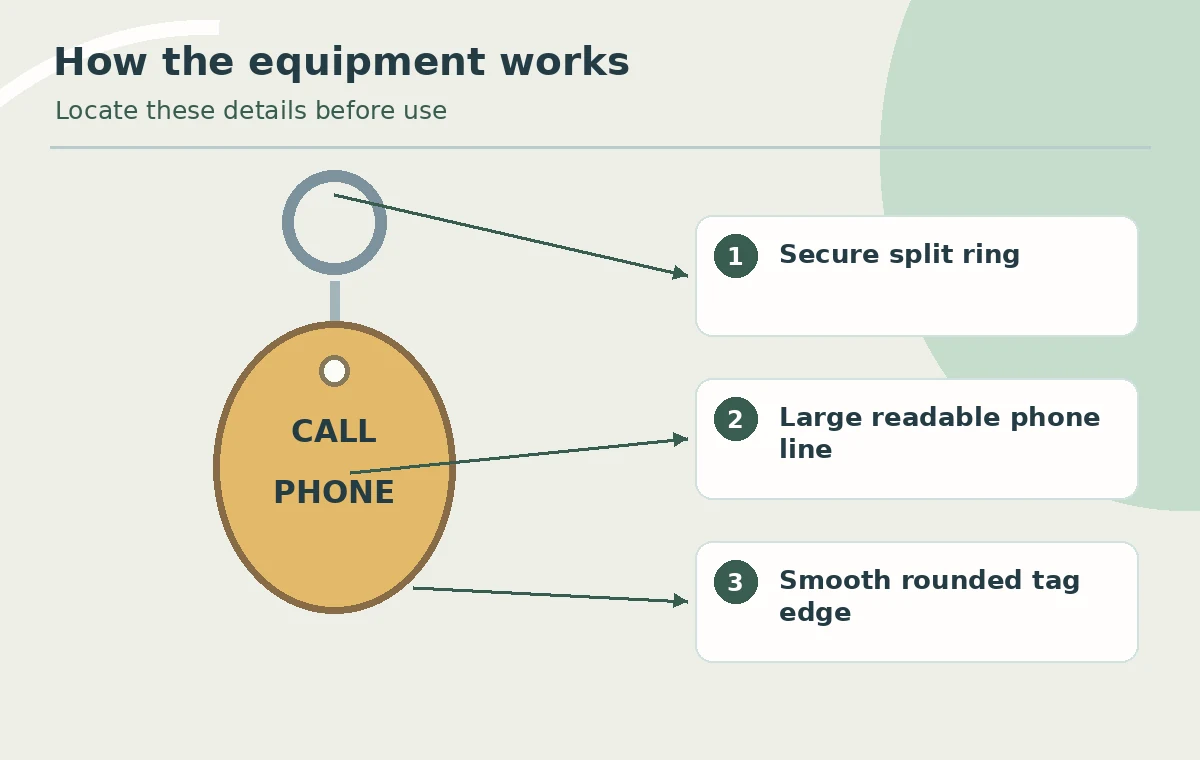
Choose a readable engraving format
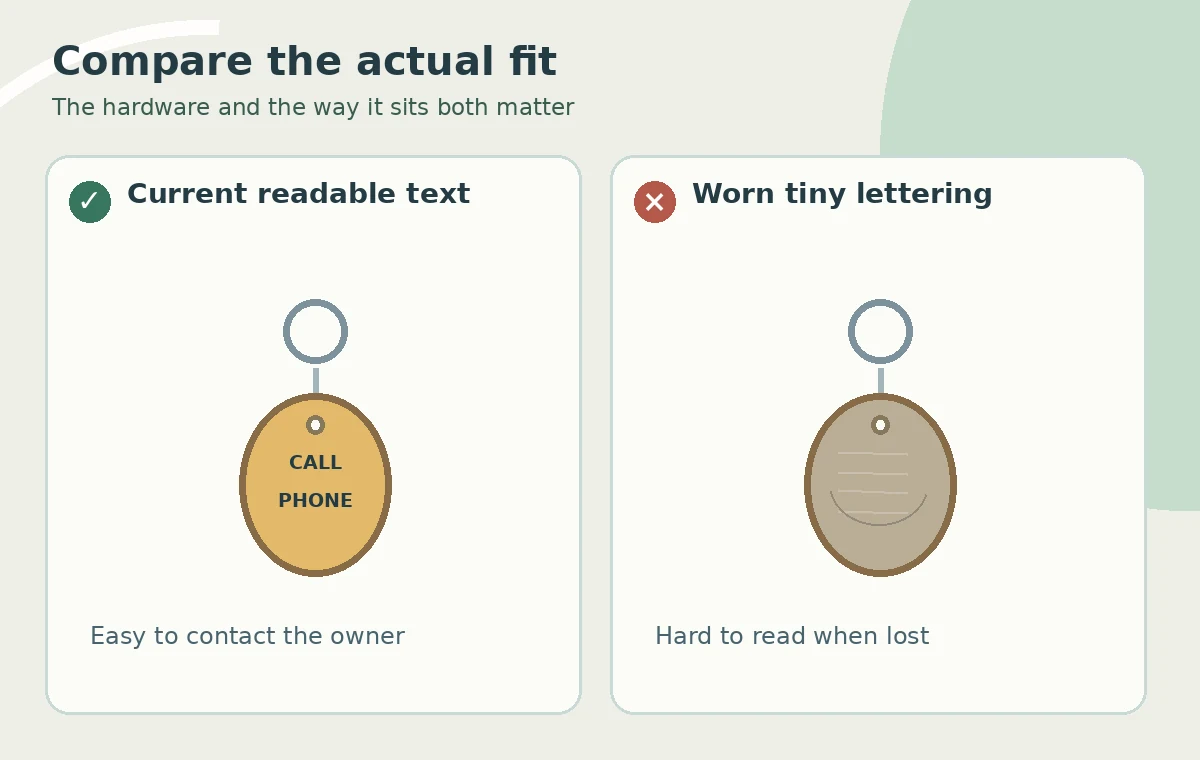
Hold a sample tag at arm’s length and ask whether the main number can be read without rotating it under a lamp. Deep engraving or durable printing may outlast very shallow marks on soft metal, but quality varies by product. Large, high-contrast characters are usually more valuable than squeezing extra words into the same space. Avoid crowded scripts and decorative symbols that resemble digits. Remember that a moving dog makes text harder to inspect; the person finding the animal should not need a magnifier. Check both sides under ordinary indoor and outdoor light before accepting the tag.
Compare hanging and slide-on styles
A hanging tag can transfer between collars easily, but may jingle and contact other hardware. A slide-on or riveted plate can sit flatter. Check that it fits the strap width, has no sharp edges, and allows collar adjustment. Some dogs are noise-sensitive, so the quieter format may be more comfortable. Inspect the plate backing and any rivets where they touch the dog’s neck. A tag should not turn a smooth collar into an abrasive surface. Follow the specific collar manufacturer’s limits, since bulky hardware around a buckle or martingale control loop can interfere with normal operation.
Use an attachment made for ID, not restraint
For a dangling tag, close the supplied split ring fully and inspect for a visible gap, sharp point, or metal distortion. The tag should hang from the designated collar tag loop without blocking the leash D-ring or buckle. Oregon veterinary guidance favors strong O-ring attachment for tags; inspect whatever attachment you use after rough play. Never clip the leash onto a small tag split ring. Those small parts hold identification, not a dog’s pulling force. For collars without a safe ID attachment point, choose a compatible plate or ask the maker. Never improvise with thin wire.
Keep a current microchip registration as backup
A dog may lose even a well-fitted collar during an escape. Owners also remove collars for bathing, and straps may suffer damage. A microchip provides a different means of identification when a shelter or veterinary clinic scans it, but the owner must keep its number linked to an active registry record. Check the registry contact details and ask your veterinarian to scan the chip during routine visits. Microchips are not GPS trackers, and the engraved number on an ordinary ID tag is not a live location feed. Having both visible contact information and updated microchip registration improves the available recovery routes without promising that a lost pet will always be found.
Check readability with your weekly gear inspection
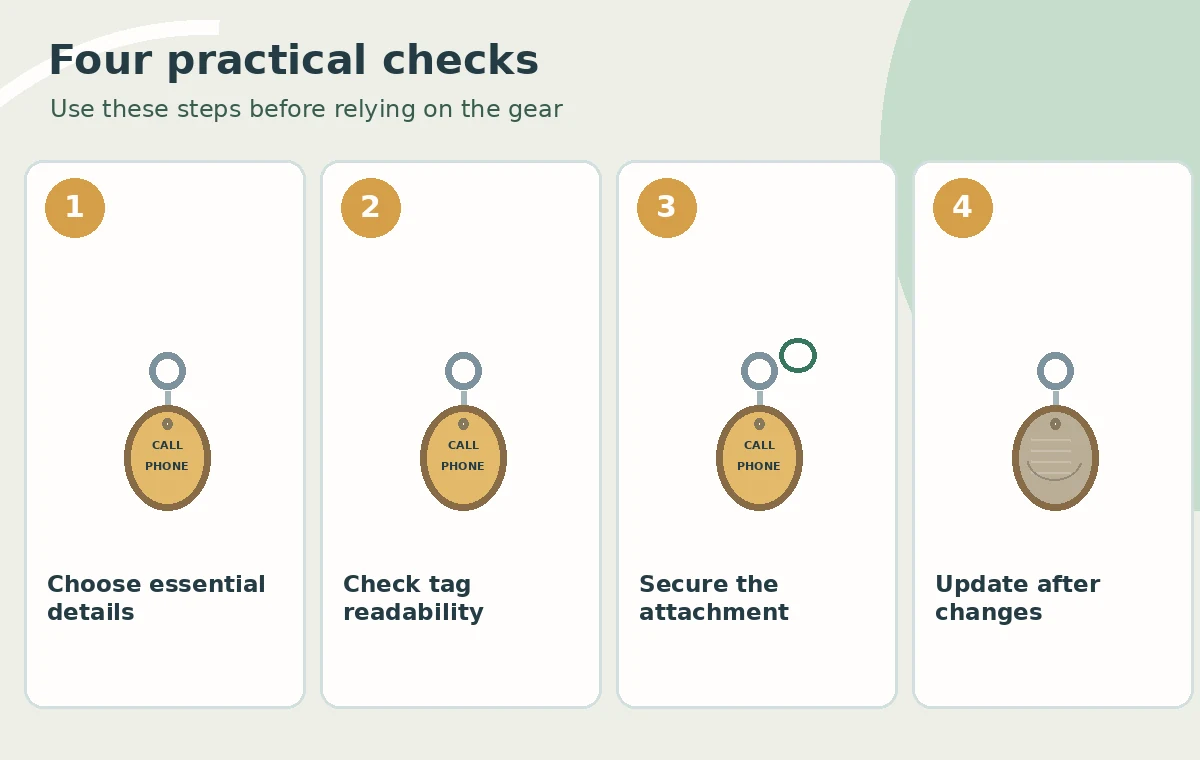
Inspect the tag and its attachment when washing or fitting the collar. Look for scratched text, a widening split ring, bending, sharp edges, and rivets that work loose. Gently rotate the hanging tag to confirm it cannot slip free through an open ring. Replace unreadable engraving even if the metal itself looks intact. Review the printed number every time a phone or address changes. Keep a photo of your dog’s current tag and a separate note of microchip registration details. This makes updates easier while keeping private recovery information out of casual public view.
Make a travel and emergency ID plan
Before a trip, check the number printed on the everyday tag and confirm the phone will be reachable where you are traveling. Bring a temporary address or secondary contact tag when staying away from home for longer periods. Ensure any required local license and vaccination tags are present. Take current photographs of the dog that show markings, body shape, and collar, while keeping recovery records in a place you can access without the pet. An ID tag cannot replace a secure leash, supervised walks, or safe fencing. It adds a visible layer to a broader prevention and recovery plan.
How We Research
Our editorial review uses first-party animal welfare and veterinary guidance to check equipment fit, movement, attachment, and handling risks. We evaluated product construction and observable use criteria, not untested brand rankings or invented laboratory results. Illustrations explain principles; they do not represent product certifications or veterinary examination. Sources reviewed October 27, 2026. Learn more at About HubPet.
Sources
American Veterinary Medical Association — Microchipping FAQs. Read source. Accessed October 27, 2026.
Oregon Veterinary Medical Association — Pets Need ID. Read source. Accessed October 27, 2026.
VCA Animal Hospitals — Collar and Harness Options for Dogs. Read source. Accessed October 27, 2026.
Edmonton Humane Society — Selecting Walking Gear. Read source. Accessed October 27, 2026.
Safety note: This guide provides general equipment information, not a diagnosis or an individualized behavior or medical plan. Stop using gear if your dog shows pain, coughing, breathing difficulty, or persistent distress. Contact a veterinarian for health concerns and consult a qualified reward-based trainer for difficult walking behavior. See our veterinary disclaimer.
Start with a current phone number and enough identifying context to help a finder contact you, while considering your privacy and local tag requirements.
Yes. A readable tag allows immediate contact, while a registered microchip provides a backup if the collar or tag is lost.
Neither is universally better. Compare noise, readability, fit, sharp edges, and whether the style interferes with the collar hardware.
No. ID attachment rings are not restraint hardware; always attach the leash to the intended load-bearing ring on the collar or harness.
Replace it whenever contact details change, lettering becomes difficult to read, or the tag or attachment shows damage.