
A hard cheese-based chew is not automatically safe: inspect tooth risk, fragments, behavior and safer options. For individualized nutrition restrictions or health concerns, follow your veterinarian’s guidance and see the veterinary information disclaimer.
Understand what this chew actually is
Yak-style dog chews are typically hard, dense, cheese-based bars sold as long-lasting edible chewing items. Their firmness is the key selling point and the chief reason to assess them cautiously. A food label does not tell you whether a particular dog’s teeth can tolerate the mechanical force of gnawing. The formula and density can differ between products. Treat the chew as an optional item, not a dental treatment or a necessary daily supplement. Some dogs are better served by softer food rewards and supervised non-food enrichment.
Put tooth safety before chew duration
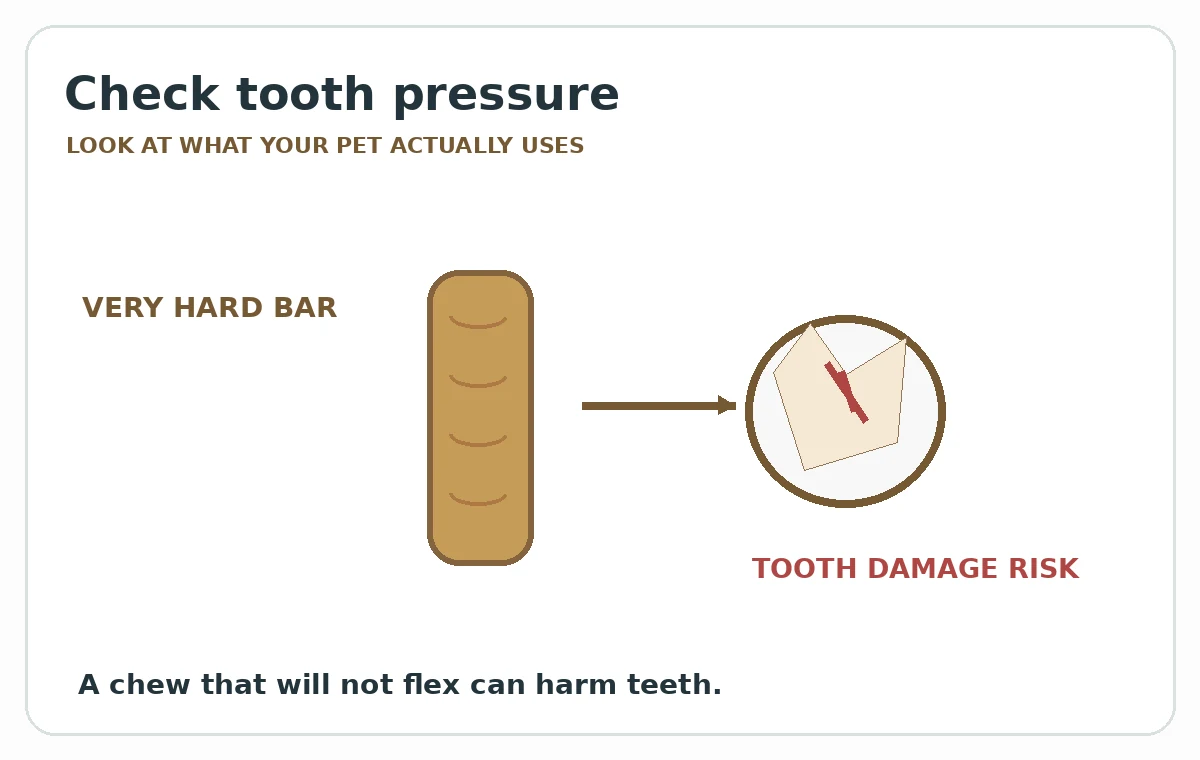
Veterinary dental guidance warns that objects which do not bend or give can fracture teeth. A compressed cheese bar can be remarkably hard, even when the package describes it as natural. Use the familiar thumbnail-indentation check as a conservative screening tool: if a chew is too hard to mark, choose something gentler. This is not a guarantee that a softer item cannot injure a dog. Animals with previous dental work, visible damage or painful chewing need individualized veterinary guidance before using any hard chew.
Judge size by the dog’s swallowing behavior
A chew must be large enough that the dog cannot swallow it whole, yet a large piece alone does not solve the problem. Watch whether the dog tries to bite off and gulp chunks instead of gnawing gradually. Size labels based on weight may not capture a dog’s mouth shape or eagerness to gulp. A leftover nub can become a choking or obstruction hazard; remove it before it is small enough to swallow. Never reach aggressively into the mouth of a guarding dog to retrieve a fragment.
Check for sharp chips and changing edges
Some hard chews develop splinters, pointed edges or fractured corners as the dog works. Pause play and inspect the surface on a regular schedule. If the material begins to crack into chunks, discard it. A broken section might cut the mouth or be swallowed before you can react. Avoid leaving a chew in a crate or overnight when no one can observe it. A dog that suddenly drops the chew or favors one side of the mouth may need a dental assessment.
Consider digestion and ingredient restrictions
Cheese-based chews are edible, but that does not mean every dog tolerates the recipe. Read the full ingredient list, feeding directions and calorie information. Dairy-related intolerance, veterinary diets or other ingredient restrictions may make the product unsuitable. Begin with a very limited supervised exposure if your veterinarian approves the category. Do not substitute a hard chew for a balanced meal. Notice stool changes or vomiting after introduction and stop until the cause is clarified with your veterinary team.
Do not treat a long chewing session as automatically helpful
A dog may chew a hard object for a long time because little material comes off, not because the activity is harmless. Prolonged forceful biting increases contact with the teeth. Set reasonable, supervised sessions and offer the dog opportunities to rest. Do not insist that the dog continue if it walks away. A different form of enrichment, such as sniffing or short reward-based training, can provide an enjoyable outlet with less dental load. Rotate activities rather than relying on one hard item every day.
Compare practical alternatives honestly
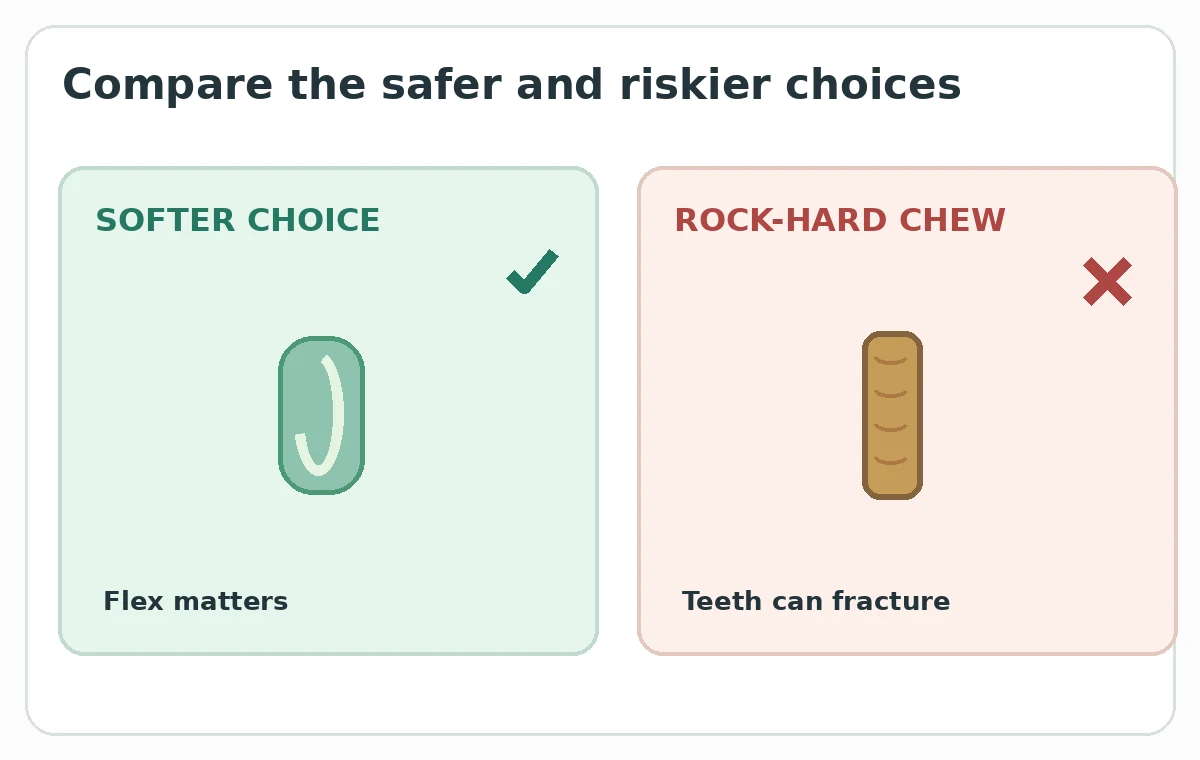
A flexible, correctly sized chew product may offer a more forgiving surface, but its pieces and ingredients still need attention. Soft treats in a training game offer brief rewards without prolonged grinding. Food puzzles give dogs a way to investigate food with its nose and paws, provided the dog does not chew apart the puzzle. Choose based on actual behavior, dental status and supervision rather than claims about how many hours the chew lasts. No edible item is completely risk-free.
Review misleading dental and natural claims
Words such as Himalayan, traditional, organic or long-lasting do not establish a veterinary dental benefit. If a package claims oral-health effects, distinguish marketing language from evidence for that specific product. A chew is not a replacement for professional dental evaluation and toothbrushing where advised. Avoid comparing brands solely by visible hardness; a lower price or higher protein percentage cannot predict fracture risk. Ask your veterinarian for suitable options if chewing is an important part of the dog’s routine.
Create a supervision and discard routine
Offer a chew in a calm spot with one dog at a time, especially when food guarding is possible. Stay close enough to observe changes in chewing style and collect fragments without confrontation. Check the remaining size after each brief period and store leftovers according to the label in a secure container. Discard damaged, contaminated or swallowable remnants instead of saving them for another day. Do not microwave or reprocess a tiny leftover chunk unless a veterinarian and manufacturer explicitly support a safe approach; the fragment can remain hazardous.

Know the warning signs that end the experiment
Stop at once if the dog coughs, gags, paws at the mouth, yelps when chewing, bleeds or cannot swallow normally. Choking, breathing difficulty and suspected obstruction need urgent veterinary attention. A cracked tooth may not cause dramatic symptoms, so any sudden reluctance to chew or one-sided chewing deserves examination. Do not attempt to examine a painful mouth by force. The sensible choice is not the hardest chew a dog can endure, but an activity that remains safe and comfortable for that individual.
How We Research
We evaluated yak chews for dogs through veterinary nutrition, public-health, and manufacturer-agnostic safety guidance listed below. The review compares observable labels, practical handling, predictable risks and real household use rather than claiming personal laboratory tests or endorsements. We did not diagnose individual animals, certify retail products, or assign untested performance scores. Product instructions and your veterinary team’s dietary advice take priority. Read our editorial approach. Sources reviewed October 28, 2026.
Sources
VCA Animal Hospitals, Toy or Toxin: How to Identify Safe Products for Pets. Read original guidance. Accessed October 28, 2026.
VCA Animal Hospitals, Fractured Teeth in Dogs. Read original guidance. Accessed October 28, 2026.
VCA Animal Hospitals, Dog Treats. Read original guidance. Accessed October 28, 2026.
FDA, Proper Storage of Pet Food & Treats. Read original guidance. Accessed October 28, 2026.
Safety note: Treats and food puzzles are optional enrichment, not substitutes for complete nutrition or veterinary care. Stop use if choking, oral injury, distress or suspected toxicity appears; seek urgent veterinary assistance for emergencies.
Do not assume so. Hard chews may fracture teeth, and chewing does not replace appropriate veterinary dental care.
If you cannot indent the item with a thumbnail or it feels rock-hard, avoid it and ask about more forgiving options.
No. Chews can break into choking-sized pieces and may produce sharp fragments, so direct supervision matters.
Remove and discard it before the dog can gulp it. Do not rely on heating or reshaping to make a tiny remnant safe.
Stop offering hard objects and schedule a veterinary dental evaluation for possible pain or a damaged tooth.