
A matching harness and leash set makes shopping convenient, but it packages two separate safety decisions. The chest harness must fit the dog, while the leash must fit your grip and the place you walk. Matching colors do not establish that a clip is compatible with a ring or that the strap width is suitable. This guide shows how to assess each component independently and when buying parts separately makes more sense. Think of a set as a coordinated starting point rather than a guarantee that every piece works for your dog. See our veterinary disclaimer for pet-health questions.
First confirm the harness geometry
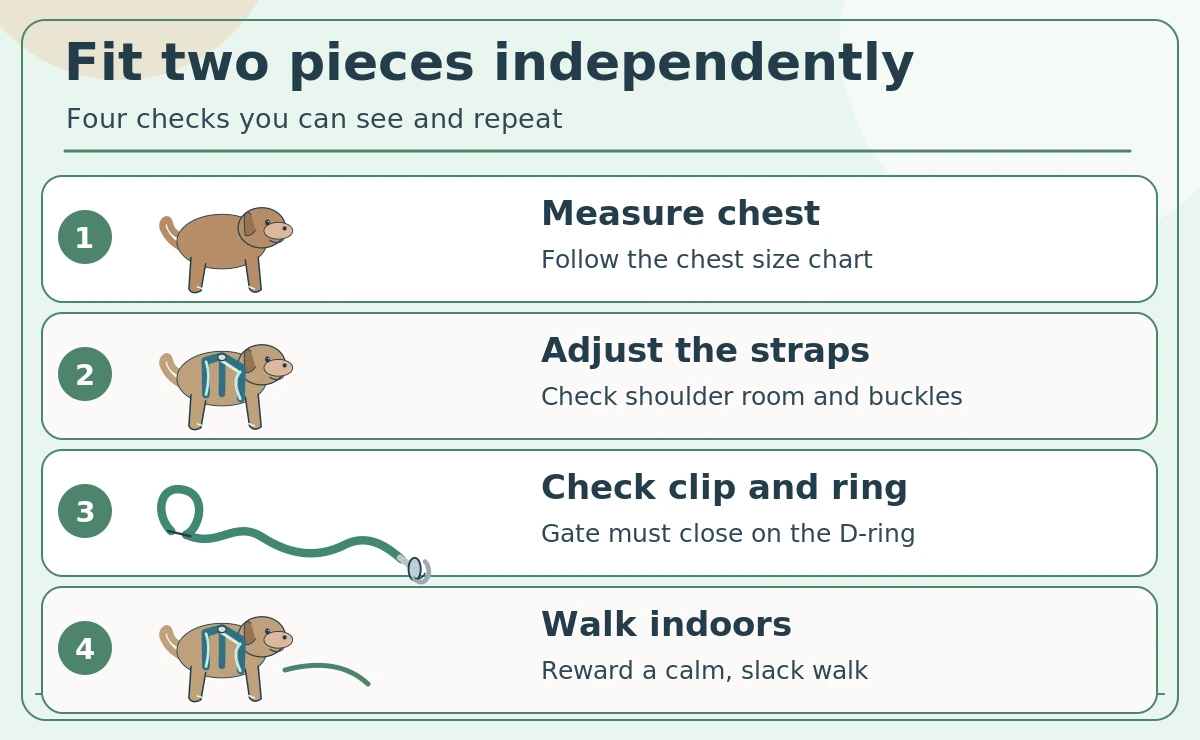
Lay the harness flat and identify the neck opening, chest panel, girth strap, and walking ring. Some designs have a Y-shape across the chest that leaves more shoulder room than a horizontal band. The correct shape depends on the individual dog and actual movement. Measure the chest where the maker directs, then select the right size before considering the matching leash. If the brand offers only one strap adjustment on a hard-to-fit dog, a separate harness with better adjustment may be the safer purchase.
Use an independent leash checklist
Measure the leash length from handle to snap and try the handle with the same gloves you wear outside. Inspect the webbing and seams. A leash supplied with a tiny puppy harness may have a very light clip; a strong larger dog needs an appropriately designed connection. Do not assume that every set scales all hardware proportionally. Choose a manageable length for your routes. A fixed four- to six-foot leash is a common everyday option, while retractable lines bring extra control and entanglement risks.

Check ring and clip compatibility
Hook the leash snap to the harness D-ring while the dog is indoors. The gate must close completely and the clip must pivot freely. A bulky carabiner may collide with a small ring or press against the dog’s back. A small snap can be too narrow to capture a thick ring without binding. Never attach the leash to a label loop, handle, decorative tab, or lighting module. Gently rotate the connection and inspect it from more than one angle. If the set’s snap does not seat reliably, do not use it on a walk.
Inspect the adjusters and buckle points
Straps should lie flat and stay in place after gentle movement. Slide the adjusters as directed, then tug each strap lightly to see whether it creeps. Buckles should fully click without trapping hair, and their curved surfaces should not rub the armpit. Look for stitching that anchors each ring and buckle to load-bearing fabric. A beautiful print does not compensate for weak stitches. Check that the dog can sit, turn, and walk normally. Fit needs reassessment after coat changes, growth, or weight changes.
Do the back-out check without pulling
On a calm, safely enclosed surface, look at the harness from the side and rear. The girth should be secure enough that the dog cannot easily step backward through it. Do not yank the leash to simulate an escape. Instead, watch how the straps shift when the dog naturally turns or steps backward. If the harness slides toward the front legs or over the shoulders, try another adjustment or shape. An escape-prone dog may need an appropriately fitted multi-strap design and professional handling advice.
Compare identical colors with independent fit
Imagine two purchase options. One set matches perfectly but has an oversized harness and a clip that jams on the ring. The other uses a correctly sized harness and an unrelated but sturdy leash that closes properly. The mixed option is safer. This comparison sounds obvious until a sale encourages you to settle for an almost-right size. Choose function first. A harness and leash do not need the same maker, pattern, or material, provided the intended attachment works and each component meets your dog’s handling needs.

Keep an ID collar in the plan
Many harnesses do not provide a secure, comfortable place for identification. A properly fitted ID collar can carry a tag, while the harness serves as the walking restraint. Do not stack thick buckles where they press into the dog’s neck or shoulders. Check that the collar and harness do not pull on each other when the dog lowers its head. An ID collar is not a substitute for a secure walking connection. Ask your veterinarian about specific neck or respiratory concerns before choosing the right combination.
Introduce a new set one part at a time
Show the harness in a quiet room and reward the dog for calmly investigating it. Practice the head opening or step-in motion without fastening everything at once. Separately let the dog notice the leash clip and hear its sound. Once the harness is comfortable, connect the leash and take a few slow steps indoors. Reward a relaxed posture and give frequent breaks. If the dog freezes, shakes, or tries to escape the gear, back up to easier steps. A coordinated set should not create a rushed introduction.
Check how the set behaves on real turns
During a short supervised walk, watch the leash ring when the dog turns toward you. It should not twist the harness across the shoulders or drag the chest panel sideways. Notice whether the handler ends up gripping thin webbing rather than the handle to manage traffic. A matching set often looks neat in a product photo but behaves differently with a moving dog. Make adjustments while stopped, away from a road. If the harness repeatedly rotates or the leash tangles around legs, rethink the combination.
Cleaning and repair are separate tasks
The leash and harness may have different washing instructions even when sold together. Remove detachable electronic or decorative parts before cleaning as directed. Check hardware for grit, dry buckles fully, and look for fraying near stitched loops. Do not use a weak clip because the rest of the set still appears new. You can replace one worn component without discarding the other, as long as the replacement meets the same safety checks. Avoid tying broken straps or mending a load-bearing seam with household thread.
Who benefits most from a coordinated set
A matching set can be convenient for a dog with predictable dimensions when both parts pass separate fit and handling tests. It may be useful as a simple starter kit, but puppies can outgrow the harness before the leash wears out. Dogs with unusual chest proportions, sensitive skin, mobility issues, or strong pulling may do better with individually selected components. Keep the receipt until you have done an indoor fit check. The right outcome is comfortable, controlled movement, not matching hardware in every photograph.
How We Research
We checked veterinary and animal-welfare guidance on fit, equipment pressure, and reward-based handling. We separated the features a buyer can inspect from guarantees that a product cannot make. The illustrations explain common construction and use; they are not product certification or individual fitting advice. Every dog has different proportions, movement, and handling needs. Our priority is a comfortable, secure connection and a practical stop rule when gear causes distress. See our editorial approach for more about HubPet.
Sources
Dogs Trust, Teach Your Dog to Wear a Harness — https://www.dogstrust.org.uk/dog-advice/training/outdoors/harness-training (accessed October 2026).
VCA Animal Hospitals, Collar and Harness Options for Dogs — https://vcahospitals.com/know-your-pet/collar-and-harness-options-for-dogs (accessed October 2026).
RSPCA Knowledgebase, Equipment for Walking a Dog or Puppy — https://kb.rspca.org.au/categories/companion-animals/dogs/training/what-equipment-should-i-use-when-teaching-my-dog-or-puppy-to-walk-on-a-leash (accessed October 2026).
San Francisco SPCA, Collars and Leashes — https://www.sfspca.org/resource/collars-and-leashes/ (accessed October 2026).
Safety note: Do not use walking equipment to jerk, punish, or restrain a distressed dog. Seek veterinary advice for pain, coughing on leash, abnormal gait, or exercise intolerance. Check the manufacturer’s exact fitting and care directions before use.
Yes, provided the leash snap closes securely on the designated walking ring and both products suit your dog. Brand matching is not required.
Do not use the oversized harness. Replace or exchange it, even if that means losing the matching appearance.
Not unless the manufacturer explicitly designates that part as a leash attachment. Use the intended D-ring or walking point.
No. Fit and equipment can help with comfort and control, but loose-leash walking requires humane training and practice.
Inspect it before walks and after hard pulls, wet outings, or washing. Recheck harness size as your dog’s body changes.