
A tiny harness can still sit badly. Learn to assess the chest straps, shoulder motion, buckles, and escape risk on a real small dog. We focus on fit and practical handling rather than untested brand rankings. The diagrams illustrate general principles; use the actual manufacturer instructions for your specific equipment.
Start with a standing chest measurement
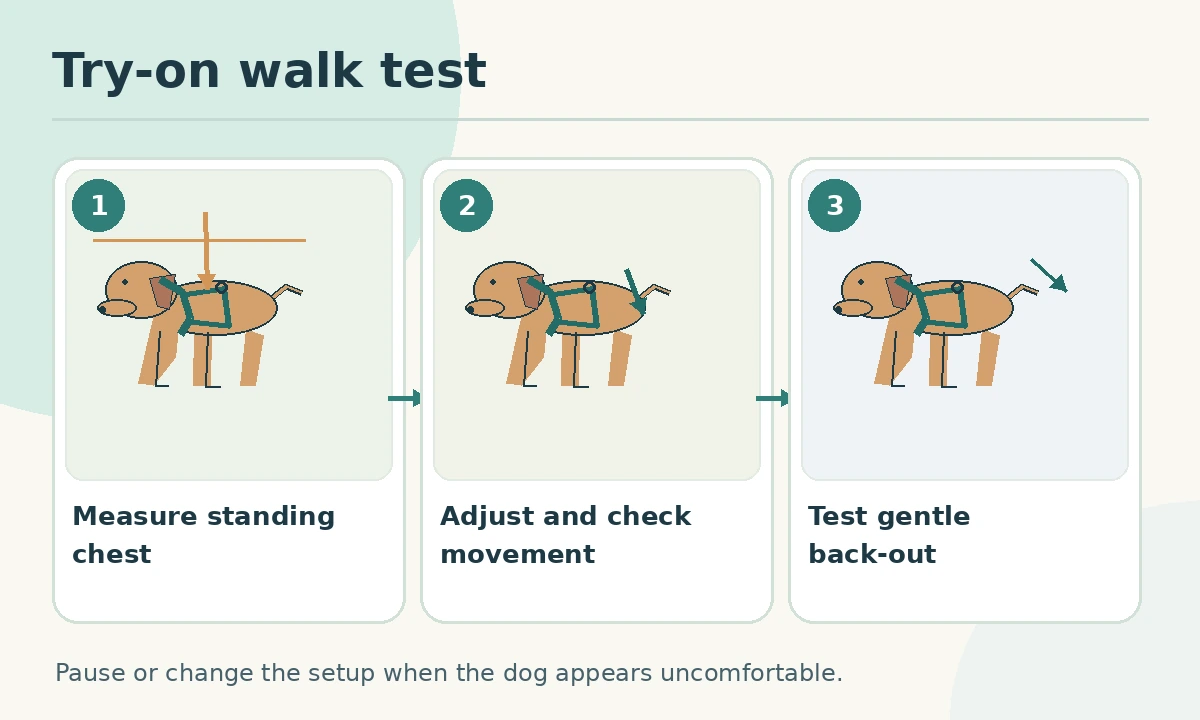
“Small” is a marketing label, not an anatomical measurement. Wrap a soft tape around the widest part of the rib cage while your dog stands naturally. Take the measurement just behind the front legs, without compressing the fur or skin. Check the maker’s diagram because some harnesses require a separate neck-base measurement. If your dog falls between sizes, compare the usable adjustment range instead of automatically sizing down. Thick coats can change after grooming, and growing puppies need repeat checks. The useful question is whether this specific harness can sit correctly on this specific body, not what weight range appears on the package.

Protect the throat and allow the shoulder to swing
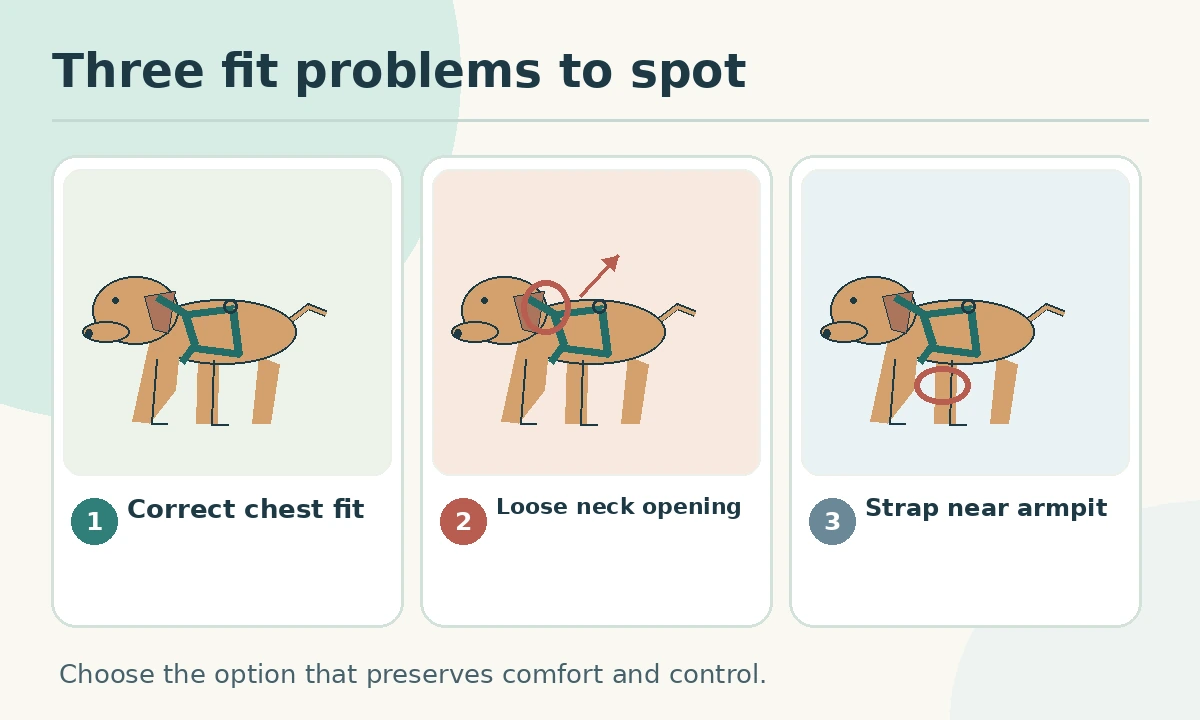
Look at the front of the harness from the dog’s eye level. A well-placed chest piece sits over the breastbone rather than cutting into the soft throat. Watch your dog take several unhurried steps toward you and past you. The shoulder blade and upper front leg should not fight a stiff or low cross-strap. A padded vest may look comfortable when standing yet bunch at the armpit once the dog moves. Choose shape over bulk: tiny dogs do not automatically need a huge padded panel, but they do need a stable load path and no hard edge at the joint.
Understand the difference between security and tightness
Tightening every strap is not a substitute for suitable geometry. A dog may back out if the neck opening is too wide or the chest ring shifts toward the head. A harness that is painfully tight, however, can chafe, limit breathing, and make future fitting harder. Adjust the sections in the order the manufacturer recommends, then check that the chest band does not slide forward into the elbows. Run a gentle hand beneath each strap rather than relying on an exact finger rule for every tiny dog. Aim for firm contact without pinching and test with normal movement.
Choose proportionate clips and attachment points
A large snap hook can hang heavily against the back of a toy dog. Compare not only webbing width but the weight and placement of rings, buckles, sliders, and the leash clip. The lead should attach where the maker designed it, with no makeshift loop through fabric or decorative trim. Check whether the buckle can close fully without catching fur and whether the slider creeps during a short indoor walk. Some dogs do better with a neck buckle that avoids pulling equipment over the head. The correct hardware is secure, smooth, accessible to the handler, and not physically burdensome for the dog.
Run a quiet indoor escape check
Before going outside, put the harness on during a calm moment and reward your dog for standing, moving, and returning to you. Clip on a lightweight leash. From a safe floor-level position, apply only gentle backward-direction tension to see whether the neck opening shifts toward the head. Stop before anything pinches or startles your dog. Do not stage an aggressive “escape challenge,” jerk the leash, or haul a dog by the harness. If it seems possible for the dog to slip backward out of the front, readjust or choose another design; a second collar connector is not a substitute for a secure primary fit.
Compare step-in, overhead, and adjustable Y designs
A step-in harness may suit a dog who dislikes anything going over the head, provided the front feet are easy to position without twisting the shoulders. Overhead designs can be fast for confident dogs but are not appropriate when you must force a nervous dog through a small opening. A Y-shaped front often makes shoulder clearance easier to inspect, yet not every “Y” product is cut alike. Consider access for arthritic joints, how far the buckles travel toward thin skin, and whether the dog can back out. Buy for the actual walking movement and daily handling, not the product silhouette alone.
Introduce the harness without restraint battles
Place the harness on the floor and allow voluntary sniffing. Pair brief contact with a treat or praise your dog enjoys. Then hold the neck opening near the face, reward an approach, and work up to a second or two of wear. Keep practice sessions short enough that the dog remains willing. If the dog freezes, backs away, licks lips repeatedly, or fights the buckles, make the next step easier rather than forcing compliance. Handling cooperation matters as much as fit: a theoretically excellent harness that cannot be put on gently is not the best option for this dog.
Inspect the skin and readjust over time
After the first short walk, remove the harness and inspect the armpits, chest, belly, and around each buckle. Check for flattened fur, obvious rubbing, warmth, red lines, or discomfort when touching the area. Recheck after haircuts, seasonal coat changes, weight changes, or puppy growth. Wash textile parts as the maker directs and dry them thoroughly before fitting again. Retire fraying webbing, a cracked buckle, corroded hardware, or a slipping adjuster. A harness is a wearable safety item, so inspection has more value than assuming that an expensive brand cannot fail.
A practical purchase decision for small dogs
Bring chest measurements and a short checklist: unobstructed breathing, a stable chest band, free shoulders, low-weight hardware, easy buckling, and no backward escape route during gentle assessment. Prefer sellers who provide actual dimensions and returns, since “teacup,” “small,” and “extra small” lack universal meaning. Start with a short, low-distraction walk and reward the behavior you want. If your dog coughs on walks, struggles to breathe, moves differently in equipment, or has persistent sore spots, ask a veterinarian for individualized advice rather than adjusting indefinitely at home.
How We Research
We compare the physical design of walking equipment with veterinary safety guidance and established humane handling advice. Our framework weighs secure fit, realistic movement, hardware condition, a handler’s control, and the dog’s comfort before convenience or advertising claims. We have not independently crash-tested, strength-tested, or field-tested a specific commercial model. Illustration labels are teaching examples, not manufacturer specifications, guarantees, or certifications. For our editorial approach see About HubPet.
Sources
American Kennel Club, The Importance of a Well-Fitting Dog Harness: Read source. Accessed October 27, 2026.
American Kennel Club, How to Find the Right Dog Harness for Your Dog: Read source. Accessed October 27, 2026.
VCA Animal Hospitals, Collar and Harness Options for Dogs: Read source. Accessed October 27, 2026.
Safety note: Stop using equipment that slips, squeezes the neck, restricts movement, or causes visible discomfort. For coughing, breathing changes, injury, or persistent skin irritation, contact your veterinarian; this general buying guide does not replace individual professional advice. See our veterinary disclaimer.
No. Brand labels are not interchangeable. Use the actual chest and neck measurements for that product, then check movement and escape security after fitting.
No harness strap should press across the windpipe during an ordinary walk. Look for a front opening that rests on the chest instead of riding into the neck.
With the dog calm and stationary, gently assess whether the front opening could slide forward over the shoulders during backward movement. Do not pull hard.
Remove walking gear when it is not needed, especially when the dog is alone, crated, or playing where straps can snag.
Readjust or choose another cut. Recurring redness, lost hair, or reluctance to move means the current fit is not suitable; seek veterinary advice if the skin is sore.