
Back claws can be easy to overlook when a cat sits with its front feet in view. The hind claws are shaped and used differently, and many cats dislike having their back legs lifted. A rear-paw check should be a brief observation, not a wrestling match. This guide explains what to look for, when a tiny tip trim may help, and how to support the paw without twisting a joint. If a nail curls toward the pad, breaks, or seems painful, book veterinary care instead of trying to fix it by force. See our veterinary disclaimer for pet health questions.
Start with a relaxed rear-paw observation
Watch your cat walk across a familiar floor and settle on a comfortable blanket. Look for a claw that catches fabric, a bent tip near a toe pad, or repeated licking of one paw. Not every sharp nail needs cutting. A healthy cat may keep rear claws in good condition through movement and scratching. Compare left and right paws without pulling on the leg. If the cat limps, guards a paw, or suddenly refuses normal activity, stop home grooming and ask a veterinarian to examine the foot.
How back claws differ from front claws
Rear claws often appear shorter or less hooked than front claws because they help with traction and climbing. Unlike front paws, hind paws usually have four visible weight-bearing claws and no typical front dewclaw. The exact wear pattern varies with age, activity, and mobility. Claw sheaths shed normally, but a tip that curves inward or presses into skin is not ordinary wear. Never assume a back nail is harmless just because it rarely scratches furniture. Look carefully at the toes themselves.

Choose a position that keeps the leg natural
A cat lying on its side or sitting beside you may allow a quick look at one back toe. Keep the foot close to the position the cat selected. Support the lower leg lightly if needed, without pulling the paw backward. Place yourself where light falls on the nail rather than bending the toe into an awkward angle. Many cats do better with an open escape path. If the cat pulls away or tenses its body, release the paw and return to ordinary handling later.
Find the clear tip and protect the quick
On a pale claw, the pink quick is living tissue inside the nail; cutting into it hurts and may bleed. Only consider a small sharp outer tip when you can identify safe separation. Back claws may be short already, leaving little to remove. On dark claws or thickened tips, do not guess where the quick ends. Ask a veterinarian or experienced groomer for a demonstration. Avoid clipping a claw that touches the pad or looks split, swollen, or infected. That needs professional assessment.
Place the clipper where you can see both blades
Use a small, sharp pet nail clipper that fits the claw. Hold the tool so the cutting edges stay clear of the toe and fur. A large clipper can block your view of a slender hind claw. Before any cut, check the position twice and let the cat move if it wants to. Do not hold the paw still with force just to complete the task. If you cannot see the safe tip clearly, an incomplete trim is much better than an injury.
A gentle one-claw practice sequence
Begin on a day when you do not need to finish a trim. Touch the leg, then offer a small familiar reward. On another short session, briefly touch a toe and release it. Let the cat investigate the closed clipper at a comfortable distance. If those steps remain easy, reveal one claw by gently pressing the toe pad and then release it. Only when the cat is calm and the tip is clear should you remove a tiny amount. End immediately after success.
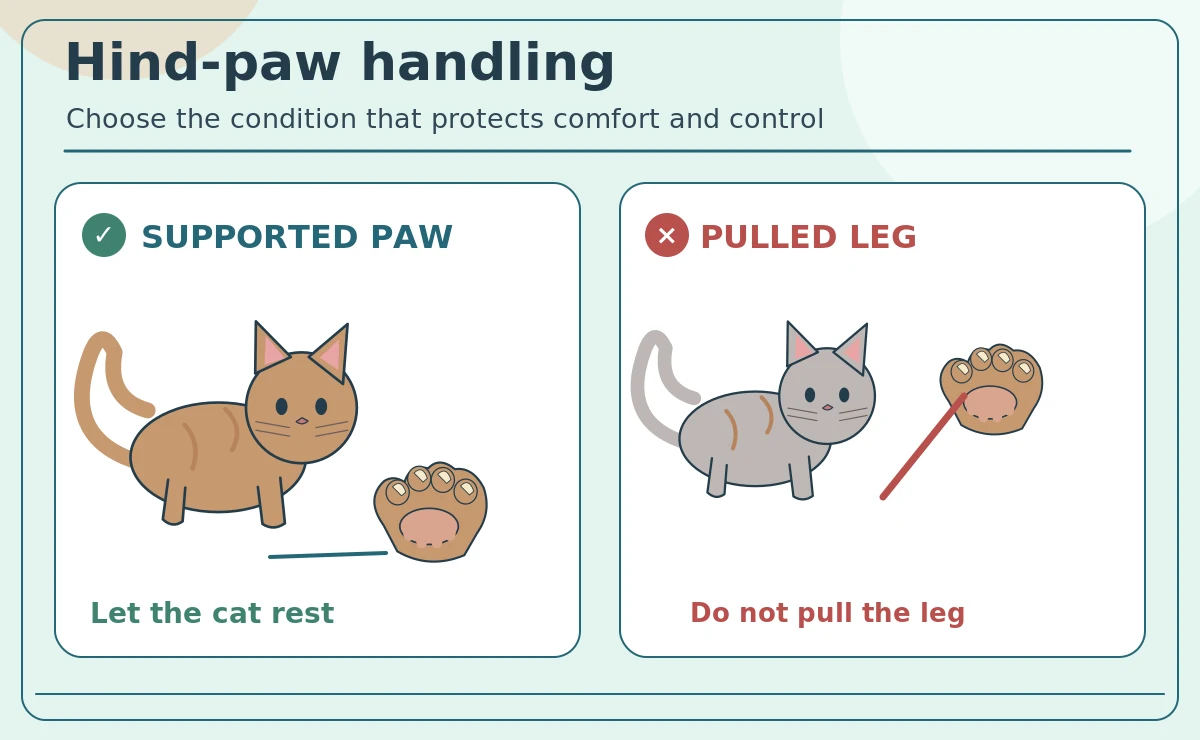
Compare calm access with forced handling
A cooperative rear-paw position allows the cat to rest its body on a stable surface. The handler supports the paw close to the body and releases it between attempts. A risky position involves dangling a hind leg, lifting the cat by the paw, or pinning the cat to finish multiple claws. Those approaches can cause fear, injury, and worse cooperation next time. If a helper participates, ask them to offer calm rewards rather than hold the cat rigidly. Your cat must have a way to pause.
What to do if the cat keeps withdrawing
Persistent pulling away is information, not disobedience. End the nail session and return to gentle paw-touch practice over several days. Try a different quiet surface, a familiar resting spot, or a time when the cat voluntarily approaches. Do not chase the cat around the house with clippers. If the nails are long enough to snag repeatedly and you cannot handle them safely, arrange a professional trim. A veterinarian can also check whether discomfort makes hind-leg handling hard.
Inspect the whole hind foot while you are there
During a brief paw check, glance at the spaces between toes and the pad surface. Look for redness, discharge, a cracked claw, or a foreign object, but do not probe a sore area. Hair and skin should look similar on both back feet. A change in stance or reluctance to jump may be an important clue even when the nail appears normal. Photograph a concerning change for your veterinarian if your cat tolerates it. Do not treat a paw wound with household cleaners.

Keep an easy, individual maintenance rhythm
Some active cats rarely need rear-claw clipping; others need help because claws grow longer than they wear. Use what you see and what your veterinarian recommends rather than a rigid calendar. Check all paws during regular grooming and provide stable scratching surfaces. If only one nail is sharp, there is no need to trim all eight hind claws in one sitting. A conservative approach protects both the toe and your cat’s trust. Track snags or changes rather than chasing a perfect length.
When to call a veterinary professional
Contact your veterinarian if a claw curves into the pad, a nail is torn near the base, bleeding persists, or your cat shows pain or limping. Thick, distorted, or rapidly changing nails also merit an examination. A cat that suddenly refuses hind-paw touch may have a joint or foot problem. For routine trims, ask your clinic to demonstrate safe toe support and the correct cut position on your individual cat. This article supports observation and gentle handling; it cannot replace an in-person assessment.
How We Research
We reviewed independent veterinary guidance and animal-welfare resources on trim cat back claws. We separated ordinary preventive care from painful or abnormal nail conditions and checked that each illustration shows a conservative action rather than a precise cut line. The diagrams are conceptual and cannot identify the quick in a real pet. We favor gradual, voluntary handling and referral when the toe, claw, or behavior is abnormal. Learn more about our editorial approach.
Sources
VCA Animal Hospitals — How to Trim a Cat’s Nails — https://vcahospitals.com/know-your-pet/how-to-trim-a-cats-nails (accessed October 2026).
ASPCA — Cat Grooming Tips — https://www.aspca.org/pet-care/cat-care/cat-grooming-tips (accessed October 2026).
HumanePro — How to Clip Your Cat’s Claws Safely (September 2026) — https://humanepro.org/magazine/articles/fact-sheet-how-clip-your-cats-claws-safely (accessed October 2026).
Cats Protection — How to Trim Cat Claws — https://www.cats.org.uk/help-and-advice/caring-for-your-cat/how-to-trim-cat-claws (accessed October 2026).
Safety note: Stop handling if your pet becomes distressed. A claw embedded in skin, significant bleeding, severe pain, or a newly abnormal paw warrants veterinary assessment; an illustration cannot diagnose a problem.
No. Check each claw separately and only consider a tiny tip trim when needed and clearly safe. Many cats maintain their hind claws without frequent cutting.
Hind paws can be sensitive, and the position may feel awkward. Stop, allow an exit, and consider a veterinary check if the reaction is new or painful.
Avoid stretching or twisting the hind limb. Let the cat rest comfortably and support a paw only within its natural, relaxed range.
Do not guess the location of the quick. Remove nothing if a safe tip cannot be identified and ask a professional for help.
Inspect for an unusually hooked or damaged tip. Ask a veterinarian about an embedded, split, painful, or bleeding claw rather than pulling it free.