
A running harness should hold a secure leash connection while letting a dog move naturally at a faster pace. It cannot make a dog ready for distance running or correct an uncomfortable gait. Consider your dog’s age, health, conditioning, and the weather before you shop. Then evaluate chest clearance, girth security, and how the leash approaches the attachment ring. This guide focuses on ordinary recreational jogging beside a person, not specialized canicross pulling equipment. If your dog is still growing or has an illness, consult your veterinarian before sustained running. See our veterinary disclaimer for pet-health questions.
Separate jogging from pulling sports
A recreational jogging harness is intended to support a dog traveling beside its handler on a reasonably slack leash. A dedicated pulling-sport harness is shaped for different lines of force and may not fit the same way during relaxed walking. Do not buy an X-back pulling harness solely because it looks athletic. Decide whether your activity is easy shared jogging, trail hiking, or an organized pulling sport. The intended use changes where the chest and shoulder straps should sit and where the leash attaches. Check manufacturer instructions for the exact activity.
Watch the shoulder blade move
The front legs need room to reach forward and back without a strap pressing tightly across the shoulder joint. Look at the dog’s stride before putting on the harness, then compare it while walking indoors. The motion should look equally free, with no sudden shortening of a step. A Y-shaped chest layout may allow more shoulder clearance than some straight horizontal bands, but fit still depends on placement. Ask for a second person to observe your dog from the side. If the gait changes, stop and adjust or replace the harness.
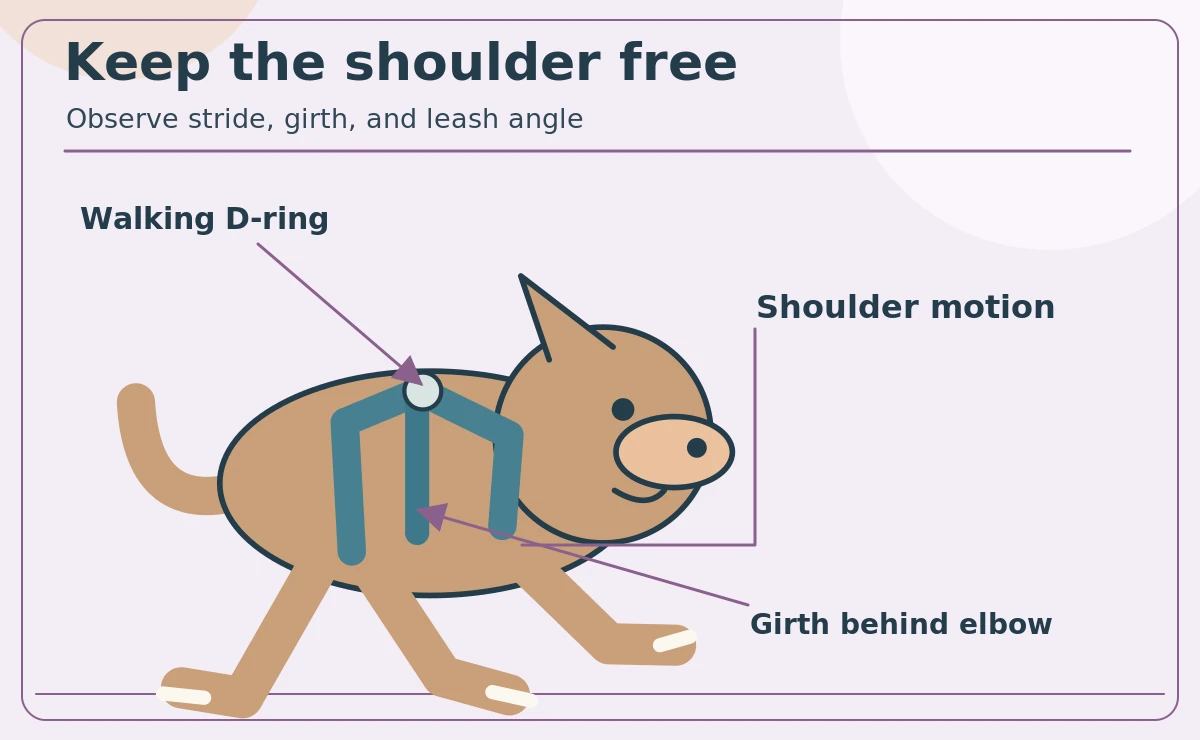
Place the girth behind the elbows
A girth strap that sits directly against the armpit can rub with each stride. Too far back, it may shift the harness across the torso or compress sensitive areas. Follow the maker’s measurements and check the strap during a comfortable walk. Slide fingers underneath without forcing them and watch for friction as your dog turns. The harness should stay aligned with the spine when the leash moves. Recheck after running gear becomes wet, after a grooming change, or when body condition shifts. Never rely on a one-size-fits-all adjustment.
Inspect the leash ring and line angle
A rear attachment is common for relaxed jogging, but its position matters. The clip should have space to swivel and should not repeatedly strike the spine or swing under a leg. Look at the leash when you and the dog move side by side. If it pulls sideways across the shoulders, adjust your handling distance and reassess the harness. Do not attach the leash to a fabric carry handle unless the product specifically permits it. Keep the line away from feet and wheels. A secure connection matters more than an extra sporty-looking loop.
Prepare the dog before adding speed
A healthy adult dog that is comfortable walking on leash still needs time to learn a shared jogging pace. Consult your veterinarian first if your dog is a puppy, senior, short-nosed, recovering from injury, or has any exercise limitation. Start with normal walks and insert very short easy jog segments only when appropriate. Reward staying near your side and teach a cue for slowing down. Increase duration gradually, not according to a rigid one-week plan. Stop if the dog falls behind, refuses to continue, or appears unusually tired.
Use visible signals of comfort
Notice whether your dog holds a normal posture and moves with an even stride. Heavy or unusual panting, lagging, stumbling, excessive drooling, or seeking shade are signs to stop and assess. Heat and humidity can make running dangerous even when the human feels comfortable. Offer water and breaks, choose cooler conditions, and shorten the route when needed. The harness should not be used to pull a tired dog forward. If symptoms suggest heat illness, stop exercise and seek urgent veterinary guidance. Never push through distress to finish a mileage goal.

Compare safe alignment with a shoulder-blocking strap
In the better arrangement, the chest panel sits between the front legs and the side straps clear the moving shoulder joint. The leash clips to the manufacturer’s designated walking ring. In a poor arrangement, a tight horizontal band crosses the forward shoulder and the leash drags the harness sideways. The second look may be easy to miss when the dog is standing still. Use a few slow steps and a turn to reveal rubbing and rotation. Reject an athletic-looking product that restricts ordinary movement.
Choose leash handling for your route
For recreational running, a manageable fixed-length leash can provide a predictable connection. Hands-free waist belts need careful fit and a safe release method; they are not suitable for every handler or dog. Keep enough room to avoid a taut line but not so much that the dog crosses in front of your legs. Avoid retractable cords near traffic and shared paths. Practice gentle pace changes in a quiet area before using a crowded trail. Running beside a dog should never involve sudden leash jerks to force position.
Test the harness on different surfaces
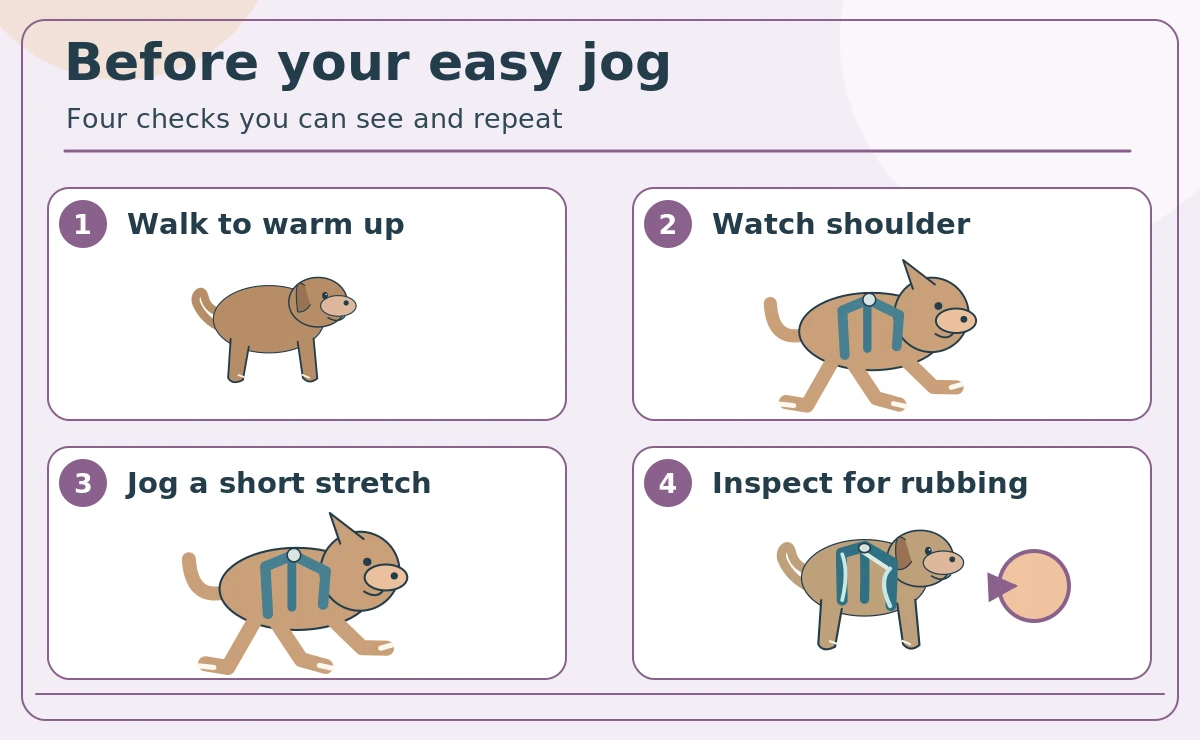
Start with a short easy walk on a level, low-traffic path. Watch the harness on turns, stops, and changes from pavement to grass. A slipping chest panel may become more obvious on an incline. The outer material should not hold grit against the dog’s underarms. Do not attempt a long run as your first equipment test. After the session, remove the harness and look for redness or flattened patches that suggest rubbing. Allow the dog rest and evaluate whether it still approaches the gear willingly.
When weather or terrain changes the plan
Hot pavement can injure paws, and uneven ground creates stumble risks even with good gear. Avoid running near traffic without safe separation. Do not assume reflective strips guarantee visibility at dawn or dusk. Carry water and check pavement conditions. In winter, salt and ice can irritate paws or reduce footing, so a short walk may be the better activity. If your dog hesitates to cross a surface or keeps stopping, respect that response. A secure harness provides connection, not permission to ignore terrain.
A quick pre-run and post-run audit
Before leaving, confirm secure buckles, a balanced girth, a free shoulder swing, a closed leash snap, and an ordinary relaxed walk. Check the dog’s willingness and the outside temperature. After returning, inspect the armpits and chest for rubbing, rinse grime according to label directions, and air-dry the harness. Examine stitching and hardware after any sudden pull. Make a note of changes in gait or reluctance to run. If any concern persists, stop jogging and seek advice from your veterinarian or a qualified professional.
How We Research
We checked veterinary and animal-welfare guidance on fit, equipment pressure, and reward-based handling. We separated the features a buyer can inspect from guarantees that a product cannot make. The illustrations explain common construction and use; they are not product certification or individual fitting advice. Every dog has different proportions, movement, and handling needs. Our priority is a comfortable, secure connection and a practical stop rule when gear causes distress. See our editorial approach for more about HubPet.
Sources
American Kennel Club, How to Train Your Dog to Run With You — https://www.akc.org/expert-advice/training/train-dog-to-run-with-you/ (accessed October 2026).
American Kennel Club, Tips for Starting a Jogging Program with Your Dog — https://www.akc.org/expert-advice/lifestyle/jogging-program-with-your-dog/ (accessed October 2026).
VCA Animal Hospitals, Collar and Harness Options for Dogs — https://vcahospitals.com/know-your-pet/collar-and-harness-options-for-dogs (accessed October 2026).
Dogs Trust, Teach Your Dog to Wear a Harness — https://www.dogstrust.org.uk/dog-advice/training/outdoors/harness-training (accessed October 2026).
Tufts Cummings School of Veterinary Medicine, Dog Collars and Harnesses — https://vet.tufts.edu/news-events/news/dog-collars-and-harnesses (accessed October 2026).
Safety note: Do not use walking equipment to jerk, punish, or restrain a distressed dog. Seek veterinary advice for pain, coughing on leash, abnormal gait, or exercise intolerance. Check the manufacturer’s exact fitting and care directions before use.
A harness does not make sustained running appropriate for a growing puppy. Ask your veterinarian when the individual dog can begin structured jogging.
Not necessarily. Sport-specific harnesses are shaped for different forces. Choose gear for your actual activity and follow the maker’s instructions.
It should avoid restricting the shoulder or rubbing the armpit, while the girth stays secure. Assess movement, not just standing fit.
No. Harnesses do not prevent heat stress. Adjust exercise for conditions and stop if the dog shows concerning signs.
Pause the outing and inspect strap adjustment and leash angle. If rotation continues, use a different fit or harness design.