
A cat litter box splash guard is a removable panel or higher wall section intended to keep litter or urine inside the tray. It can help in a household where the cat digs enthusiastically or sometimes points toward the edge. But a guard that wobbles, curls inward, or turns an easy opening into a high step can make the box less usable. The safe purchase starts with the cat’s preferred tray, not the accessory. This guide covers where to measure, which edges matter, and when a different pan is the simpler answer. For sudden changes in elimination, consult your veterinarian; our veterinary disclaimer explains the limits of general pet-care advice.
Match the panel to the existing rim
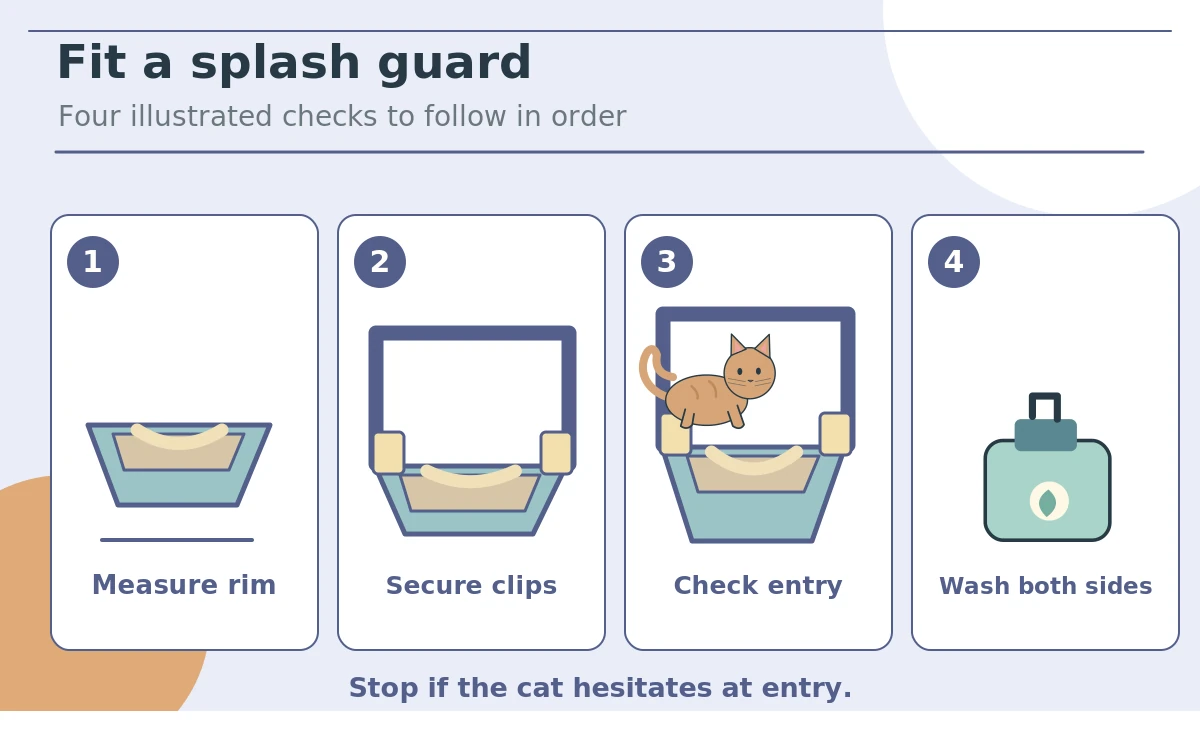
First identify the tray’s lip: is it thin and flat, wide and rounded, or molded into an unusual curve? A clip-on guard may fit one edge profile and slip off another. Measure the rim width and the full straight section available for attachment. Look for a continuous connection rather than a few clips that leave large gaps. The attachment must hold during ordinary scooping without exposing sharp corners. If the product only fits by bending the pan or forcing clips, reject it.
Keep a true front doorway
The front opening must remain clear and low enough for the cat that uses the tray. A tall guard across every side can turn an accessible box into an obstacle course, particularly for kittens and older or less mobile cats. View the installation at cat height and check that there is a broad approach with no flap pressing against the body. Do not use a step stool or unstable ramp simply to make a poorly designed guard work. Choose the cat’s easy entry over maximum containment.

Measure height without covering the view
A higher panel may reduce some outward spray, but cats also need enough room to stand naturally and see their surroundings. Keep the top open and avoid panels that curve deeply inward over the digging area. Measure clearance with your cat standing in the familiar tray, not just the height of a product photo. A narrow wraparound shield might protect the wall while leaving too little room for turning. If the guard blocks the cat’s ordinary posture, choose a larger box or a different layout.
Inspect joints where urine and litter collect
Overlapping panel seams can trap damp litter, producing odor despite daily scooping. Look for smooth surfaces that can be separated and washed without tools. A permanent adhesive strip is hard to inspect and may loosen under moisture. If a flexible guard lifts at the corners, waste may leak into the gap between the guard and tray. Protecting the floor requires both a secure joint and practical hygiene. Do not cover an existing crack with a guard; replace the cracked tray.
Compare a fixed tall-wall tray with an add-on guard
A molded tall-wall box has fewer joints and often washes more easily. A removable panel can preserve an existing comfortable tray, and its height may be adjustable. On the other hand, clips can create gaps, pinch points, or rough edges. Neither option is necessarily right for every cat. If a cat is missing the box because it is too small, adding panels will not help. Compare floor space, entrance comfort, and the cleaning process before deciding which construction makes sense.

Use the guard to address a specific problem
Try to identify whether the mess is kicked-out litter, high-angle urine, or waste deposited outside because the cat cannot fit. Scatter near the entrance may respond to a well-placed washable catch mat. Spray against a rear wall may respond to a higher continuous back with a low front. Waste just outside the box, especially with signs of discomfort, requires a different response and veterinary assessment. A splash guard is not a medical treatment or a way to conceal elimination changes.
Avoid loose tape, magnets, and improvised edges
Household tape can peel, collect debris, or leave sticky areas a curious cat may contact. Loose magnets, clips, and small broken plastic pieces can become hazards. Do not mount a rigid sheet with exposed screws on the inside of a litter pan. Choose a purpose-built, securely attached product with smooth washable edges, or a suitably shaped one-piece tray. If the cat noses or bites at the attachment, stop using the unstable accessory and reassess the setup.
Install without changing everything else
Empty and wash the tray before adding a panel, and dry the rim thoroughly. Attach the guard according to the manufacturer’s instructions, then gently check it for wobble. Restore the cat’s usual litter type and depth, and leave the box in the same calm location. Observe the cat from a distance without hovering over it. If the cat hesitates or cannot enter comfortably, remove the new guard and return to the familiar arrangement. A useful addition should not require pressure or forced training.
Clean both sides on a schedule
At each scooping, examine the lower seam for accumulated grains and moisture. On full-clean days, remove any detachable panel, wash both surfaces with mild unscented soap, rinse, and dry before reassembly. Do not spray strong deodorizer onto a box just to mask odor in inaccessible joins. Check that clips have not cracked and the panel is still stable after repeated washing. If it becomes brittle or warped, replace it rather than continuing to use a sharp or unstable edge.
Judge success by the cat as well as the floor
A dry floor is helpful, but the guard has failed if the cat now strains to enter, perches on the rim, or avoids the tray. Keep an accessible alternative available when testing the change. If your cat’s urine volume, posture, frequency, or location suddenly changes, consult your veterinarian promptly. Never treat repeated accidents as disobedience. The desired result is a comfortable toilet area with manageable cleaning, not an enclosure that traps every grain at any cost.
How We Research
We reviewed guidance from veterinary and established cat-welfare organizations about litter box size, hygiene, placement, and changes in toileting behavior. We distinguished general cat preferences from product-specific claims and from the needs of an individual cat. Measurements and diagrams are practical aids, not guarantees that a cat will accept a tray. We prioritize access, choice, and prompt veterinary evaluation for new elimination problems. Read more about our editorial approach.
Sources
VCA Animal Hospitals, Housetraining for Kittens and Cats — https://vcahospitals.com/know-your-pet/litter-box-training (accessed October 2026).
Ohio State University Indoor Pet Initiative, Litter Boxes — https://indoorpet.osu.edu/cats/basic-indoor-cat-needs/litter-boxes (accessed October 2026).
ASPCA, Litter Box Problems — https://www.aspca.org/pet-care/cat-care/common-cat-behavior-issues/litter-box-problems (accessed October 2026).
VCA Animal Hospitals, Cat Behavior Problems: House Soiling — https://vcahospitals.com/know-your-pet/cat-behavior-problems-house-soiling (accessed October 2026).
Cats Protection, How to Choose the Best Cat Litter for Your Cat — https://www.cats.org.uk/cats-blog/how-to-choose-the-best-cat-litter-for-your-cat (accessed October 2026).
Health and safety note: Straining to urinate, repeated attempts with little or no urine, blood, obvious pain, or sudden elimination changes need prompt veterinary assessment. Inability to pass urine is an emergency. Never punish a cat for avoiding a litter box.
No. Rim shapes and attachment systems vary. Use a product designed to fit without bending the tray or leaving sharp gaps.
Not necessarily. A continuous tall back can help some situations, but persistent new changes require veterinary assessment.
No. Preserve a broad easy entry, especially for kittens, senior cats, and cats with mobility challenges.
Not always. Removable panels allow separate washing, but the joints can collect litter and moisture.
Remove the guard and offer the familiar tray. Recheck entry height, usable area, and any possible medical cause.