
A corner cat litter box looks efficient because its pointed back fits two adjoining walls. The shape can be misleading: outside width does not equal usable floor space inside a tapered tray. Your cat still needs room to turn, dig, and step away from waste. This guide explains a simple interior measurement, where to put the entrance, and why a rectangular tray in a slightly different spot may be better. Saving household space is worthwhile only when the cat keeps a comfortable toilet area. For sudden changes in elimination, consult your veterinarian; our veterinary disclaimer explains the limits of general pet-care advice.
Sketch the actual floor shape
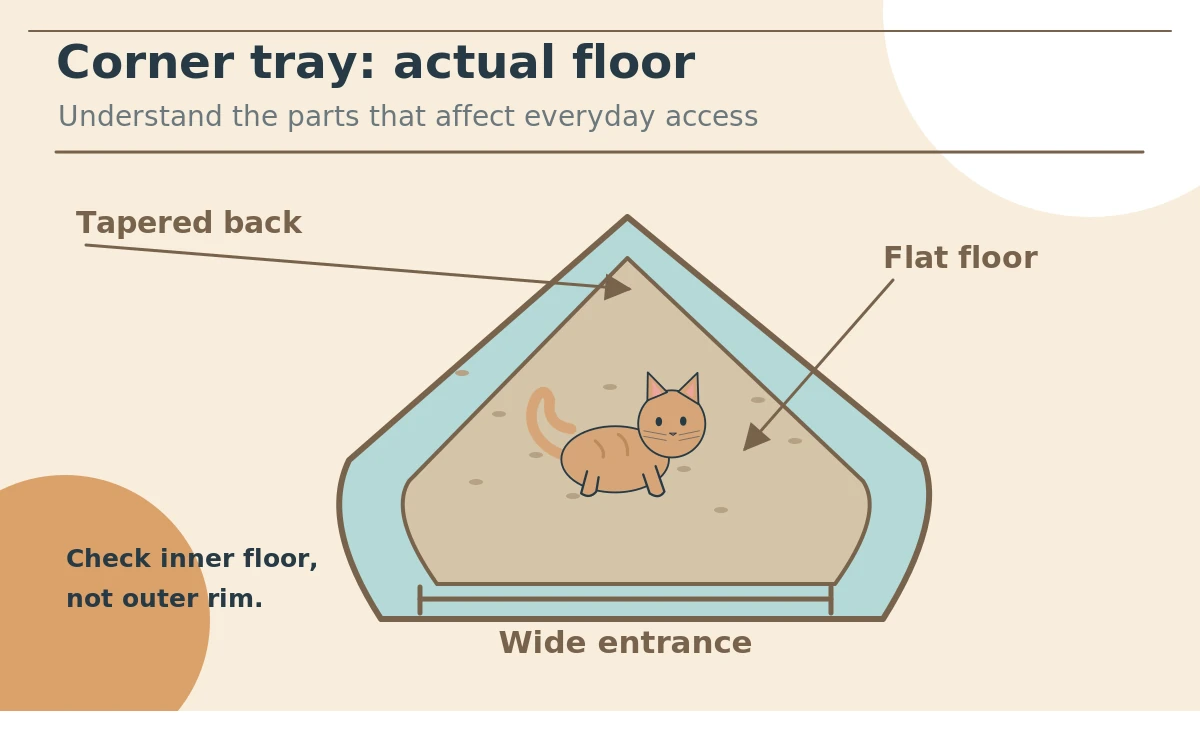
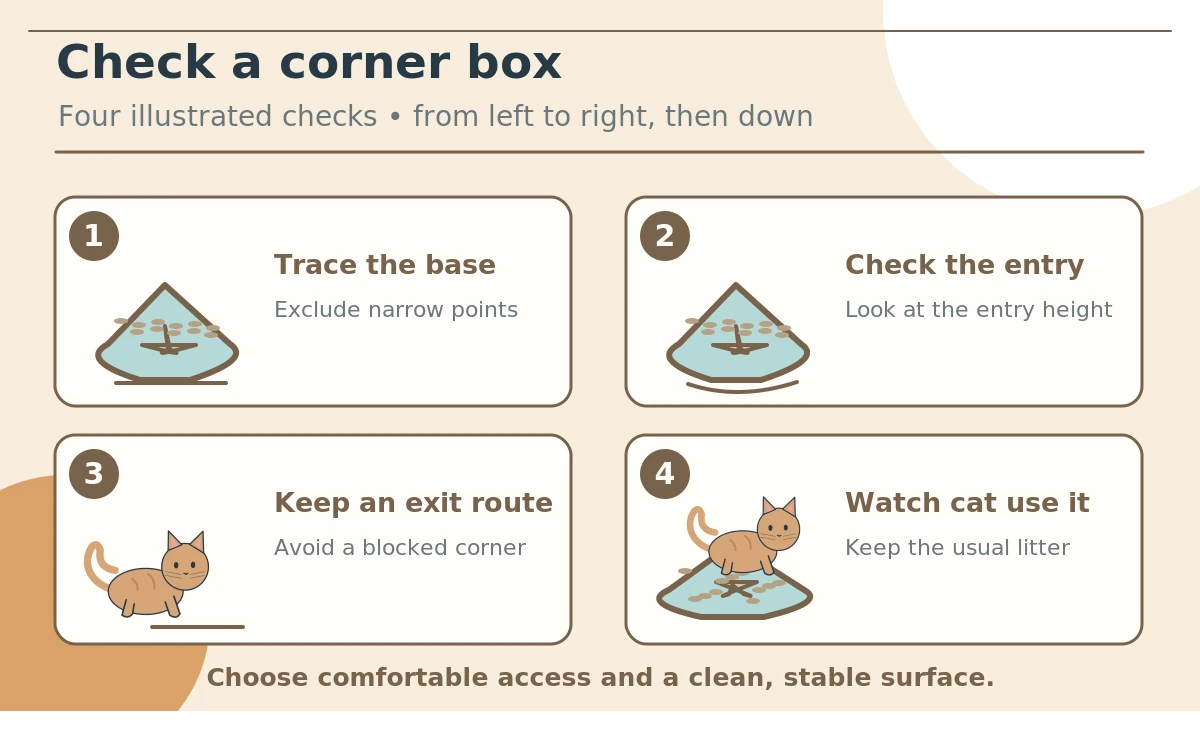
Start by tracing or measuring the flat bottom, not the widest top rim. A triangular or wedge-shaped base narrows toward the rear point. The cat may be unable to stand or turn in that tip even though it counts toward the advertised dimensions. Use a piece of paper to outline the interior length and width where the paws will be. Compare that space with your cat’s body length and turning movement. The useful area is the broad region, not an imaginary rectangle spanning the outer corners.
Check the open side from the cat’s viewpoint
Most corner trays place the entrance along the broad curved front. This can offer a good approach if the entrance stays fully open. However, a clip-on lid, tall front rim, or nearby cabinet door may narrow the practical route. A cat should not need to twist sideways through an opening to use the tray. Watch how your cat walks into a familiar box and mimic that clear route. If the corner model is awkward for a hesitant or less mobile cat, use a lower and roomier design.
Do not equate a corner location with privacy
A quiet wall may offer a sheltered backdrop, but pushing a tray tightly into a tiny corner can leave the cat facing an approaching person or pet with no alternative route. Consider visibility from the entrance and the direction of the nearest doorway. Keep a clear path beside the tray and avoid wedging it between a cabinet and a machine that cycles loudly. The cat should be able to walk away without passing directly through a busy bottleneck. Privacy is about predictable safety, not confinement.
Calculate room after adding the litter
Litter and sloped sides change how much flat floor is available. When the fill line is near a narrowing edge, a cat can step onto an unstable mound rather than a roomy base. Fill according to the cat’s preference and product directions, then inspect the usable surface again. A box that appears adequate empty may feel small once the rim and litter create higher borders. Do not compensate for a cramped pan by putting in barely any litter; digging opportunity remains important for comfort.
Compare a wedge tray with a standard rectangle
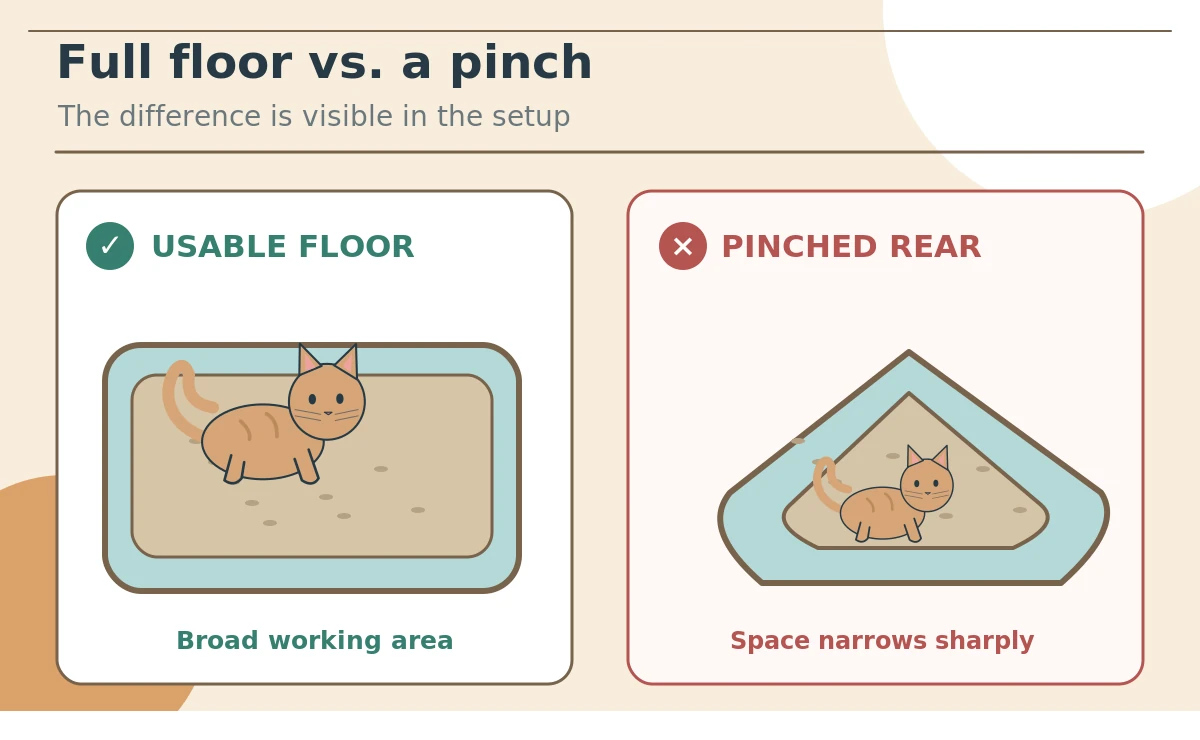
A well-sized rectangular tray offers consistent width along most of its length. A small wedge tray often offers extra width at the front but much less at the back. For a tiny cat, a large wedge may work; for a long adult cat, the rectangle may provide a clearer path to turn. Lay paper outlines of both options on the floor and imagine the cat standing, turning, then stepping past a used area. Choose by usable shape and behavior rather than the claimed number of inches saved.
Mind the wall and baseboard clearance
A corner box needs enough space for your hand and scoop to reach the back point without knocking the tray sideways. A baseboard heater, vent, pipe, or electrical cord should not sit inside the area used for a litter station. Leave clearance for removal and cleaning. If the tray must be lifted vertically out of an enclosed cabinet, you may find routine scooping awkward and postpone it. Convenience matters because frequent cleaning makes the tray more acceptable to the cat.
Plan for kicks and high rear walls
Some corner models use a tall rear wall to control scattered litter. Look for a smoothly joined wall with no sharp fasteners and a low-enough front step. The high back must not crowd the cat’s back or force its tail against a lid. If your cat urinates toward the wall, a continuous splash-resistant back may help. But if the pan is too narrow to turn comfortably, increasing rear height does not solve that underlying problem. Check both splash management and access together.
Set the box where the cat already feels safe
Choose a stable floor away from sudden appliance noise and constant foot traffic. Do not move the only working tray to a remote corner without a transition. Put the trial corner pan near the existing litter station or in another familiar, accessible location. Use the same unscented litter and maintain normal scooping. If your cat ignores the wedge tray, it may be signaling insufficient room, a high entry, or a location concern. Observe rather than forcing the cat to try it.
Account for multi-cat traffic
A geometric corner often has only one realistic approach from a room. In homes with several cats, that can turn into an ambush point even when each individual pan is large enough. Separate litter stations across different accessible areas, with at least one more box than the number of cats as a common starting recommendation. Do not line every compact tray along one wall and assume they count as independent options. Watch for staring, guarding, or one cat waiting until another leaves.
Know when to reject the space-saving idea
If the cat repeatedly puts front paws outside, balances on the edge, backs away from the point, or soils beside the tray, reconsider the geometry. Sudden changes in elimination warrant veterinary guidance regardless of box shape. A small corner tray is not an appropriate substitute for a sufficiently spacious box just because it looks neat. You can often make better use of the room by shifting a standard open tray a few inches and keeping the path unobstructed.
How We Research
We reviewed guidance from veterinary and established cat-welfare organizations about litter box size, hygiene, placement, and changes in toileting behavior. We distinguished general cat preferences from product-specific claims and from the needs of an individual cat. Measurements and diagrams are practical aids, not guarantees that a cat will accept a tray. We prioritize access, choice, and prompt veterinary evaluation for new elimination problems. Read more about our editorial approach.
Sources
VCA Animal Hospitals, Housetraining for Kittens and Cats — https://vcahospitals.com/know-your-pet/litter-box-training (accessed October 2026).
Ohio State University Indoor Pet Initiative, Litter Boxes — https://indoorpet.osu.edu/cats/basic-indoor-cat-needs/litter-boxes (accessed October 2026).
ASPCA, Litter Box Problems — https://www.aspca.org/pet-care/cat-care/common-cat-behavior-issues/litter-box-problems (accessed October 2026).
Cats Protection, Preparing Your Home for a Cat — https://www.cats.org.uk/help-and-advice/getting-a-cat/preparing-for-a-cat (accessed October 2026).
VCA Animal Hospitals, Cat Behavior Problems: House Soiling Synopsis — https://vcahospitals.com/know-your-pet/cat-behavior-problems-house-soiling—synopsis (accessed October 2026).
Health and safety note: Straining to urinate, repeated attempts with little or no urine, blood, obvious pain, or sudden elimination changes need prompt veterinary assessment. Inability to pass urine is an emergency. Never punish a cat for avoiding a litter box.
Usually not at the same outside dimensions; the tapered rear reduces usable floor space. Compare flat interior measurements.
Only if the actual interior has generous turning and digging space. Many compact wedge styles are too restrictive for larger cats.
Only when the door cannot block access or startle the cat. An always-open, predictable route is essential.
No. They may contain some scatter but do not replace suitable litter, adequate room, and a comfortable entry.
Keep the familiar option and evaluate interior size, opening height, and location. A vet should assess sudden toileting changes.